You can usually keep strength training with knee pain. In fact, building the muscles around the knee often helps. The trick is to choose movements that feel comfortable, start small, and build up slowly. This guide shows you which exercises to try, which to swap out, how to tell good effort from a warning sign, and when to get checked.
For most people, yes. A 2024 systematic review and meta-analysis pooled 27 studies with 1,712 people who had knee or hip osteoarthritis. Resistance training improved pain, muscle strength and physical function. That is the full set of things you want from a knee programme.
The load does not need to be heavy. A 2026 review of 20 randomised trials found that very light to moderate effort gave the biggest estimated pain reductions, while moderate effort gave the biggest gains in function. The authors rated the certainty of the evidence as low to very low, so treat this as a guide rather than a promise. It still points the same way: you do not have to grit your teeth and lift your maximum.
NHS guidance agrees that moving is the right call. Royal Wolverhampton NHS says regular movement and exercise are safe and helpful for knee pain, and that walking and squatting can strengthen the muscles around the knee when you build up gradually.
The OARSI Rehabilitation Discussion Group adds two reassuring points. A well-designed exercise programme does not worsen the outlook for osteoarthritis, and short-term pain during exercise does not mean you are damaging the joint.

Most people stop too early or push too hard because they are not sure what is normal. A traffic light system makes it easier. The version below follows guidance from St George’s NHS.
| Light | Pain during exercise | What to do |
|---|---|---|
| Green | 0 to 3 out of 10, settles within 30 to 60 minutes | Carry on as planned |
| Amber | 4 to 6 out of 10, settles within 2 to 6 hours | Adapt: fewer reps, slower pace, smaller range, or an easier version |
| Red | 7 to 10 out of 10, new severe pain, cannot put weight on the leg, big swelling, or a hot red knee | Stop and speak to a therapist. Call NHS 111 if you need more urgent advice |
NHS inform uses a slightly different scale for knee osteoarthritis exercise. It treats 0 to 3 as minimal, 4 to 5 as acceptable and 6 to 10 as too much. If pain goes above 5 out of 10, it suggests fewer repetitions, a slower pace or longer rests. It also says exercise may bump up your symptoms a little at first, but should get easier with regular practice.
The two scales are close enough to give one working rule: a little discomfort is fine, a lot is a signal to change something. Check how the knee feels the next morning too. If it is clearly worse than before you trained, make the next session easier.
Squats are not banned. The depth and the load are what matter. The South East London orthopaedic guideline for adult knee pain suggests shallower knee bends instead of deep squats or lunges, and avoiding kneeling until it is pain-free.
Here are practical swaps that keep your legs working:
If you struggle with lunges, hold on to a support and make the step short, or swap them for step-ups. If kneeling hurts, do floor work lying on your back or side instead.
This session uses movements from the NHS inform list and the South East London guideline. It needs a chair, a low step and a wall. Do it two or three times a week, with a rest day between sessions.
The OARSI recommendations say a good programme combines strengthening with aerobic, balance, flexibility and neuromuscular work, done at least twice a week. So add a walk, a bike ride or a swim on other days. The South East London guideline lists walking, cycling, swimming and cross-training as lower-impact options when high-impact activity is too much for now.
Yes, and it is a good idea on days when the knee is cranky. Presses, rows and pulldowns on a seat do not load the knee. You keep your routine, your fitness and your confidence while the knee settles.
Many people with sore knees also have a stiff or achy lower back. A few simple choices help both: use a chair or machine to support your back, keep the weights light, and avoid rounding your spine to lift things from the floor. Glute bridges, supported rows and sit-to-stands suit both problems. For more ideas, see our plans for joint friendly workouts.
Progress is the part most people get wrong. They feel good for a week and do too much. A steady approach works better.
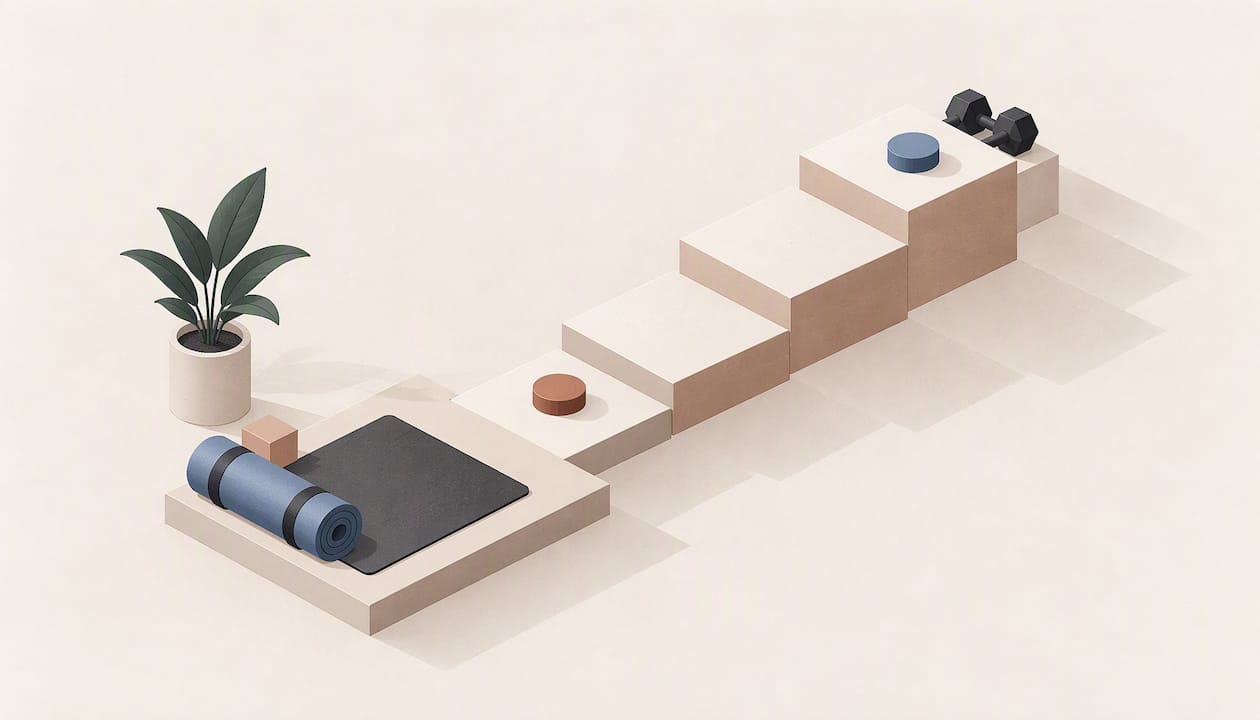
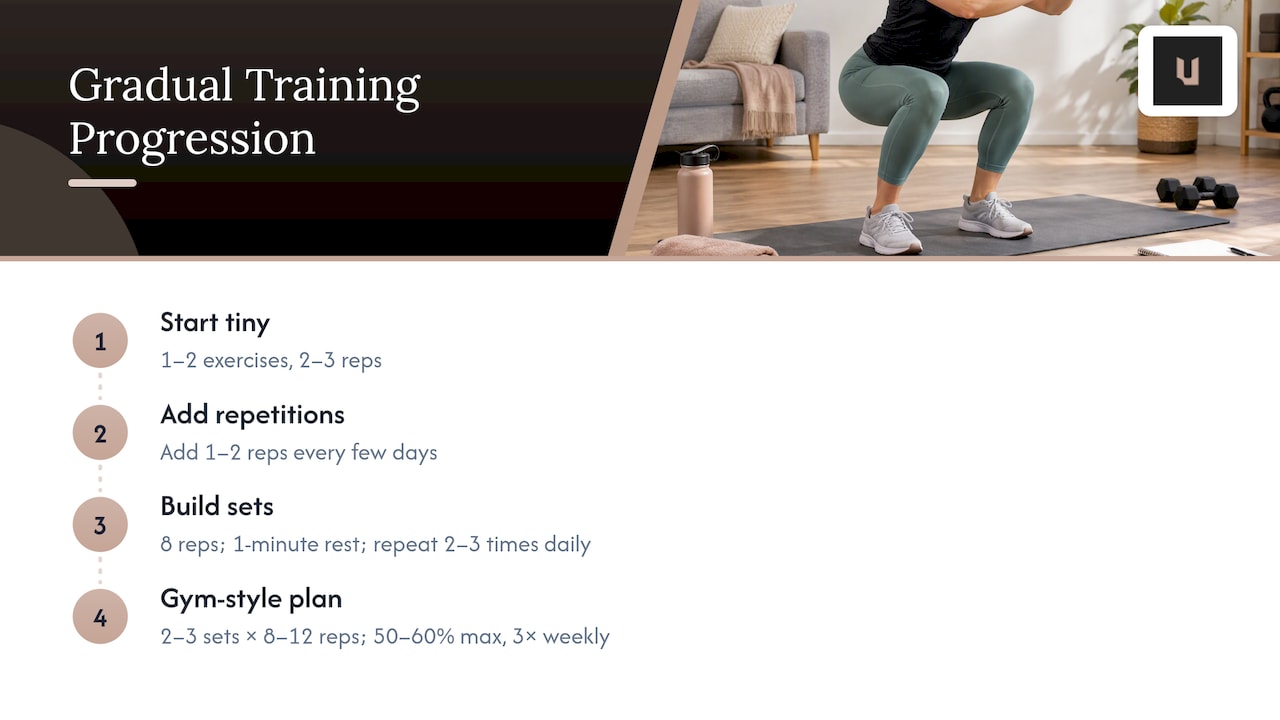
Start tiny. NHS inform suggests starting with one or two exercises and 2 to 3 repetitions. Add one or two reps every few days as you tolerate it. Once that feels easy, build into sets, for example 8 repetitions with a one-minute rest, repeated 2 to 3 times a day.
Then move to a gym style plan. A 2019 systematic review found that 11 of 12 studies improved pain or physical function. The most common programme was 30 to 60 minutes, 2 to 3 sets of 8 to 12 repetitions, starting at 50 to 60% of maximum resistance, three times a week. The same review found no single best number of reps or sets. That is why the plan should fit you rather than the other way round.
Change one thing at a time. Add a rep, a little weight, or a little depth, but not all three. Our guide to progressive overload for beginners explains why one small change beats a perfect plan.
Keep sessions short and regular. The South East London guideline advises against complete rest, and recommends modifying the movements that aggravate the knee, staying active within your comfort limits, and using short, frequent sessions rather than long, intense ones. That is useful if you are coming back after an injury.
If you want a twice-weekly structure, our articles on strength training over 50 and low impact strength training for 40+ give simple starting plans.
You do not need to stop training. You need to change what hurts. According to the South East London guideline, modify or temporarily replace:
Do not push through sharp or worsening pain. If an exercise gives you red-light pain, drop it and use an alternative. OARSI says a good programme should offer alternative exercises when a movement causes problems, so there is no shame in swapping.
We work with a lot of adults over 40 who arrive saying their knees are the reason they stopped training. Almost always, the problem was not the knees alone. They were doing a generic workout that did not fit them, or they were doing too much too soon, then stopping completely.
What works is simple. Pick a version of each movement that suits you today. Keep the effort honest but not heroic. Repeat it twice a week for months. Then nudge it up. The research above says the same: there is no single perfect number of sets or reps, so the plan has to follow how you respond.
This is why we coach in small groups. Everyone has a plan built around their body, and a coach is watching the depth, the pace and the pain levels, so you do not have to guess. Strong thighs and glutes protect your knees, and being strong makes daily life easier: stairs, the garden, playing with the grandchildren.
— Vitalij
If you would rather not work it all out alone, our small group personal training in Sheffield is built for adults over 40 who want to get stronger, leaner and fitter without feeling out of their depth. Each member follows an individual plan, so a sore knee simply means a different version of the exercise, not a day off.
Prefer a more social option? Our fitness classes are included for adult members. You can also start by reading our overview of strength training over 40 to see how a twice-weekly routine fits into a busy week.
Self-help has limits. Royal Wolverhampton NHS advises contacting your GP if the pain is getting worse or has not improved after 3 to 4 weeks of self-help. Seek medical advice straight away if you have:
If you are not sure how urgent it is, NHS 111 can help. A physiotherapist can also check your knee and give you a plan.
Yes, for most people. A 2024 review of 27 studies found resistance training improved pain, strength and function in people with knee and hip osteoarthritis. Start light and build up slowly, and check with a GP or physio if you are unsure about your diagnosis.
While your knee is sore, cut back on deep squats, deep lunges, kneeling and high-impact running or sport. Use shallower bends and lower-impact options such as walking, cycling or swimming instead. Never push through sharp or worsening pain.
Mild discomfort of up to 3 out of 10 that settles within an hour is usually fine. Pain of 4 to 6 out of 10 means make the exercise easier. Severe pain, a hot red knee, big swelling or not being able to take weight means stop and get advice.
OARSI recommends exercise at least twice a week, and many trials used three sessions a week. Begin with one or two short sessions and add more as your knee allows. Keep a rest day between harder sessions.
Walking is a good start and the NHS says it helps, but strength work builds the muscles that support the joint. Aim to do both: walk on most days and add two strength sessions a week.