Low-impact strength training builds real muscle and strength, and you don’t need heavy weights or joint-jarring moves to get there. Start with two or three sessions a week using controlled compound exercises like squats, rows and hip hinges, keep every set close to muscular fatigue, and add a little more challenge each week. The evidence behind this, and the exact workouts to use, follow below.
TL;DR:
- Low-impact strength training is effective at building muscle and strength by emphasizing slow, controlled movements close to muscular fatigue, not heavy weights.
- Research shows lighter loads below 50% of one-rep max can produce comparable hypertrophy and strength gains to heavier loads if performed with sufficient volume and near failure.
- Exercises such as machine rows, goblet squats, resistance band movements, and single-leg work are joint-friendly options suitable for both gym and home setups.
- Proper form is essential, with cues like knees tracking toes and hips driving movement, while sharp joint pain indicates the need to modify or stop the exercise.
- Many individuals, especially those with joint issues or seeking longevity, benefit from continuing low-impact training and only incorporating heavier loads gradually under professional supervision.
Low-impact strength training means building muscle and strength without jumping, jarring, or heavy joint loading. It relies on controlled movement, steady tempo and tools like resistance bands, machines, and isometric holds (where you pause and hold a position under tension) rather than explosive lifts or high-impact cardio moves like box jumps.
Here’s the part people get wrong: “low impact” does not mean “low effort.” A set of slow, controlled squats taken close to fatigue can challenge your muscles just as much as a heavier, faster set. What matters most is time under tension and how close you get to the point where your muscles genuinely struggle to complete another clean rep. That’s the real driver of growth, not how much weight sits on the bar.
Picture a resistance band row done slowly, three seconds up, three seconds down, for 15 reps until your back muscles are burning. That’s low impact. It’s also hard work. The exercises section below builds on exactly this principle.
Yes. Several controlled trials now show that lighter loads, trained properly, build muscle about as well as heavier ones. A review of the physiology behind this found that lower-load resistance training below 50% of your one-rep max can produce hypertrophy and strength gains comparable to heavier training, as long as you take your sets close to failure and do enough total volume.
A more recent trial backs this up directly. Over nine weeks, a study comparing low-load (20 to 25 reps) and high-load leg training found both groups gained roughly 7 to 8% more muscle thickness, with similar strength gains in compound lifts. The lighter loads simply required more reps per set to reach the same level of fatigue.
For older adults, tempo matters even more than load. Slow, low-intensity resistance training with sustained tension increased muscle thickness and knee strength in older participants over a ten-week programme, without needing heavy weights at all.
In practice, this translates to a simple prescription: train each muscle group multiple times per week, do a few sets per exercise, and push most sets close to muscular fatigue. Athletes with years of heavy training behind them may need more volume to keep progressing, and everyone needs proper recovery between sessions, since working close to fatigue is more taxing on your nervous system than it looks.
You don’t need a fully equipped gym to make this work. A few tools and a bit of know-how go a long way.
In the gym, these moves build strength without stressing your joints:
At home or with bands, you can build the same strength:
A basic resistance band set with several resistance levels covers most of what a beginner needs at home, and gives you room to progress as you get stronger.
To make any of these harder without adding impact, try pause reps (hold for two seconds at the toughest part of the movement), slow eccentrics (take four to five seconds lowering down), or static holds at the midpoint. All three increase time under tension, which is exactly what drives muscle growth in a low-impact programme.
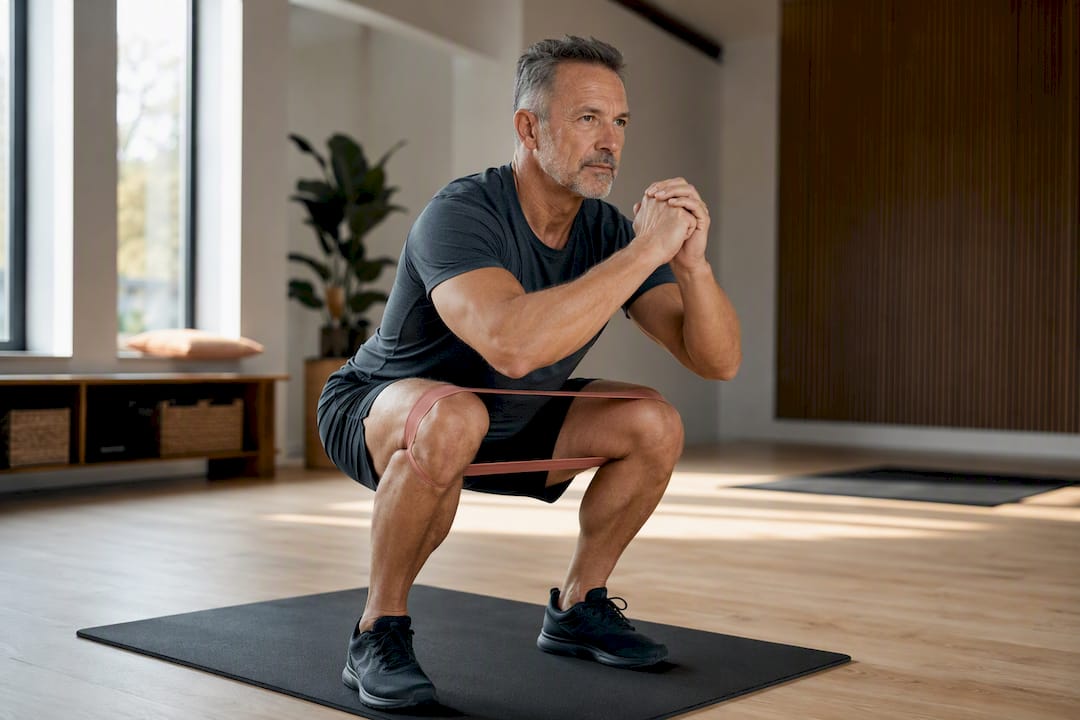
Pro Tip: If a movement feels too easy at 15 reps, don’t just add more reps forever. Switch to a stronger band, slow the tempo down, or add a two-second pause. That’s how you keep progressing once bodyweight alone stops being a challenge.
Two templates cover most people starting out.
Beginner, at home (bands and bodyweight), three sessions a week:
Gym template (machines and light free weights), three sessions a week:
Progress by adding one or two reps per set each week until you hit the top of your range, then switch to a slightly stronger band or add a small amount of weight. Slowing your tempo down is another way to make an exercise harder without changing the load at all. Our guide to strength training classes covers this kind of progression in more detail.
A few alignment cues prevent most of the joint niggles people run into.
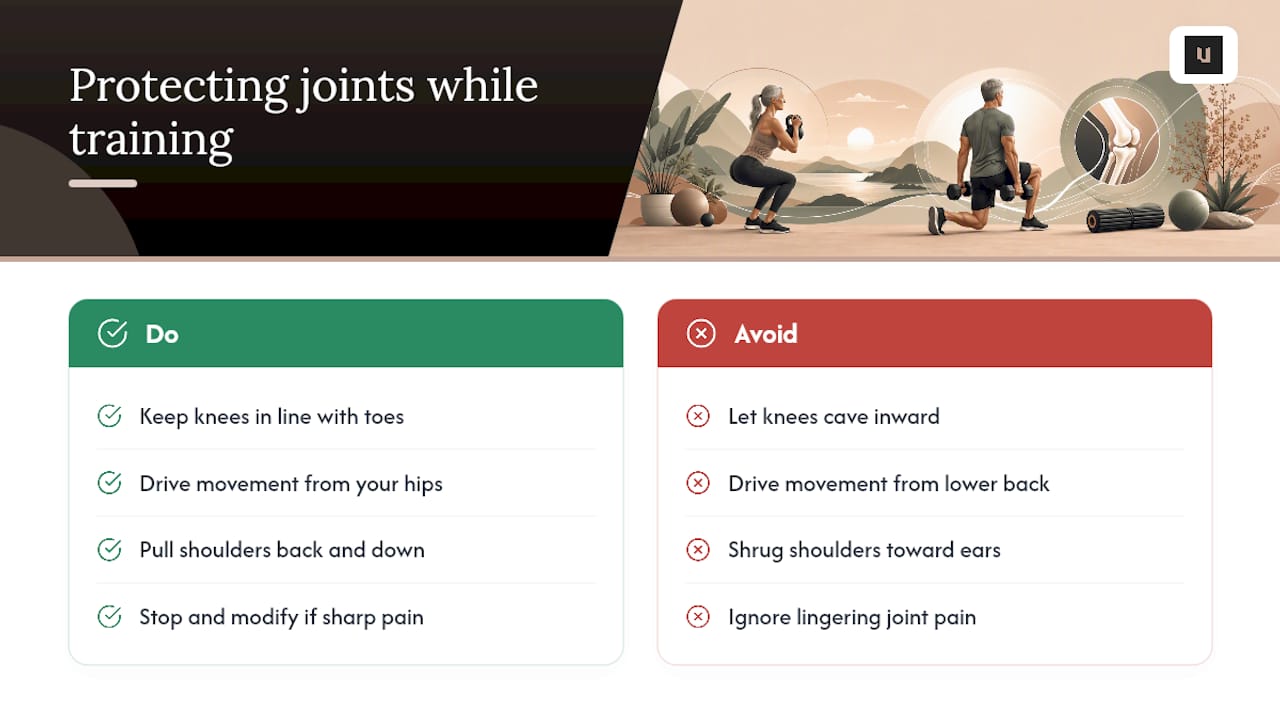
Keep your knees tracking in line with your toes during squats and step-ups, rather than caving inward. On deadlifts and hip hinges, keep a slight bend in your knees and drive movement from your hips, not your lower back. For pressing and rowing, keep your shoulders pulled gently back and down rather than shrugged towards your ears.
There’s a clear line between acceptable discomfort and a warning sign. A burning sensation in the muscle during a hard set is normal and temporary. Sharp pain in a joint, swelling, or pain that lingers well after the session ends is not. Stop the exercise, and consider modifying with a partial range of motion, an isometric hold instead of a full rep, or simply less resistance.
If joint pain persists across sessions rather than easing off, get it assessed properly rather than working around it indefinitely. Resistance training itself is well supported for joint health. Research shows it improves pain, strength and function in knee and hip osteoarthritis, and consistent strength work is linked to lower odds of frequent knee pain and structural knee osteoarthritis across multiple studies. The NHS also recommends strength and balance activity twice a week, with professional guidance where joint conditions are involved. A practical piece on preventing joint wear and tear covers related day-to-day habits worth building alongside your training.
Small-group personal training can be built around people over 40 and anyone managing joint concerns, with plans set to each member’s own starting point rather than a generic template. Coaches use tempo work, band progressions and gradually increased effort, watching form closely so overload happens safely rather than by accident. For readers who want this kind of supervised structure, our advanced strength class page shows where that progression can eventually lead.
Plenty of people should stay low-impact permanently, particularly if joint pain flares easily or longevity matters more to you than lifting bigger numbers. There’s no rule saying you must graduate to heavy barbells to keep getting stronger.
That said, when a client handles their current programme well and wants more, we phase in heavier loading gradually, always guided by how their joints respond rather than a fixed timeline. The decision belongs to the person doing the training, not a textbook. Consistency and measurable progress matter more than which category your training falls into.
— Vitalij
Reading about tempo, band progressions and fatigue markers only gets you so far. Professional training gives you what a book or article can’t: a coach watching your form in real time, adjusting your plan as you progress, in a small-group setting rather than a crowded class where nobody notices your technique slipping.
Our small-group personal training is built specifically for people over 40 and anyone training around joint concerns, with an individual plan rather than a one-size-fits-all workout. If you’d prefer a broader class schedule alongside strength work, our fitness classes offer regular coached sessions with the same safety-first approach. Parents of active teenagers can also look at our youth athlete programme for supervised speed, agility and strength development.
Your first session starts with a proper assessment of your movement and goals, followed by a plan built around what your joints can handle right now. Book your first session with a local trainer and find out what a properly coached, low-impact programme feels like.
For primary evidence behind this guide, see the low-load resistance training review, the osteoarthritis and resistance training meta-analysis, and NHS strength guidance. Explore supervised options at UNIT Health & Performance.