Small group personal training is coached, capped-number sessions that give near-personal attention within a supportive cohort, built around an individualised plan rather than a one-size workout. It suits people who want expert coaching and community at a lower cost than one-to-one sessions, including many people over 40 who want accountability without the full price tag of private coaching.
TL;DR:
- A 2026 review of 71 studies found training in groups had a small but significant functional advantage over individual approaches after outliers were removed.
- Two or three sessions a week can cover UK guidance of 150 minutes of moderate activity, or 75 vigorous minutes, plus strength training twice weekly.
- Before training begins, expect a health questionnaire and movement screen; coaches should modify exercises for limitations and refer concerns requiring clinical input.
- People returning from significant injuries or needing medical supervision should start with individual coaching or a staged rehabilitation plan before joining group sessions.
- At a trial, confirm the coach enforces a group cap, adjusts exercises individually, and offers screening plus a progression plan covering six to eight weeks.
Small group personal training (SGPT) means coach-led sessions with a deliberately capped number of participants, each following an individualised progression plan inside a shared workout. The coach designs the session around the group but adjusts loads, movements and pacing for each person, which is the core difference from a standard fitness class.
A drop-in class usually follows one fixed format for everyone in the room, with little scope for personal adjustment. One-to-one personal training gives full coach attention but costs more per session and loses the social element that keeps many people coming back.
Reputable providers typically keep ratios tight enough that a coach can see technique faults and adjust weights or ranges of motion within the session itself, rather than leaving participants to self-correct.
A session usually opens with a brief check-in or movement screen, followed by a warm-up that primes the muscles and joints you’ll use that day. The coach then runs through technique cueing before the main work begins, whether that’s a strength block or a conditioning circuit.
Across weeks, the plan builds in small increments: slightly heavier loads, a longer interval, or a more complex movement pattern, with regressions always available so nobody is forced through a rep range beyond their current capacity. A session might pair a goblet squat with a kettlebell swing for power, or rotate between rowing intervals and bodyweight circuits for conditioning.
Pro Tip: Ask your coach to show you the regression option for any lift before you need it, so you’re never guessing mid-set.

Social dynamics genuinely change how people exercise. A 2026 systematic review and meta-analysis of group-based interventions found a small but significant advantage for functional outcomes compared with individual-only training, once statistical outliers were removed.
A 2026 meta-analysis of 71 studies found group-based physical activity interventions produced a small but significant advantage for functional outcomes over individual approaches, according to the same review. That edge likely comes from the behaviour-change techniques woven into group formats:
SGPT sessions also map neatly onto national activity guidance. UK Chief Medical Officers’ guidelines recommend at least 150 minutes of moderate activity weekly, or 75 minutes vigorous, plus muscle-strengthening work for all major muscle groups at least twice a week. Two or three SGPT sessions a week comfortably covers both targets.
A properly run SGPT programme starts with an intake, not a workout. Expect a health questionnaire covering injuries, medical history and current activity levels, plus a movement screen so the coach understands your baseline before setting loads.
Inside the group, a competent coach adapts exercises individually: a different grip for a wrist issue, a shortened range for a stiff hip, a seated variation where standing isn’t appropriate. Look for coaches working to CIMSPA-aligned competence standards, which cover induction, environment adaptation and small-group assessment as part of baseline training, not an optional extra.
SGPT tends to suit busy adults who want structure without managing their own programming, people over 40 rebuilding strength and confidence, and anyone who finds solo gym sessions hard to sustain. The coaching plus peer presence solves the two biggest dropout causes: not knowing what to do, and not wanting to do it alone.
If you’re returning from a significant injury or need close medical supervision, one-to-one PT or a staged clinical approach, such as the Rest, Rebuild, Reintroduce, Return model used in NHS rehabilitation settings, is the safer starting point before joining a group.
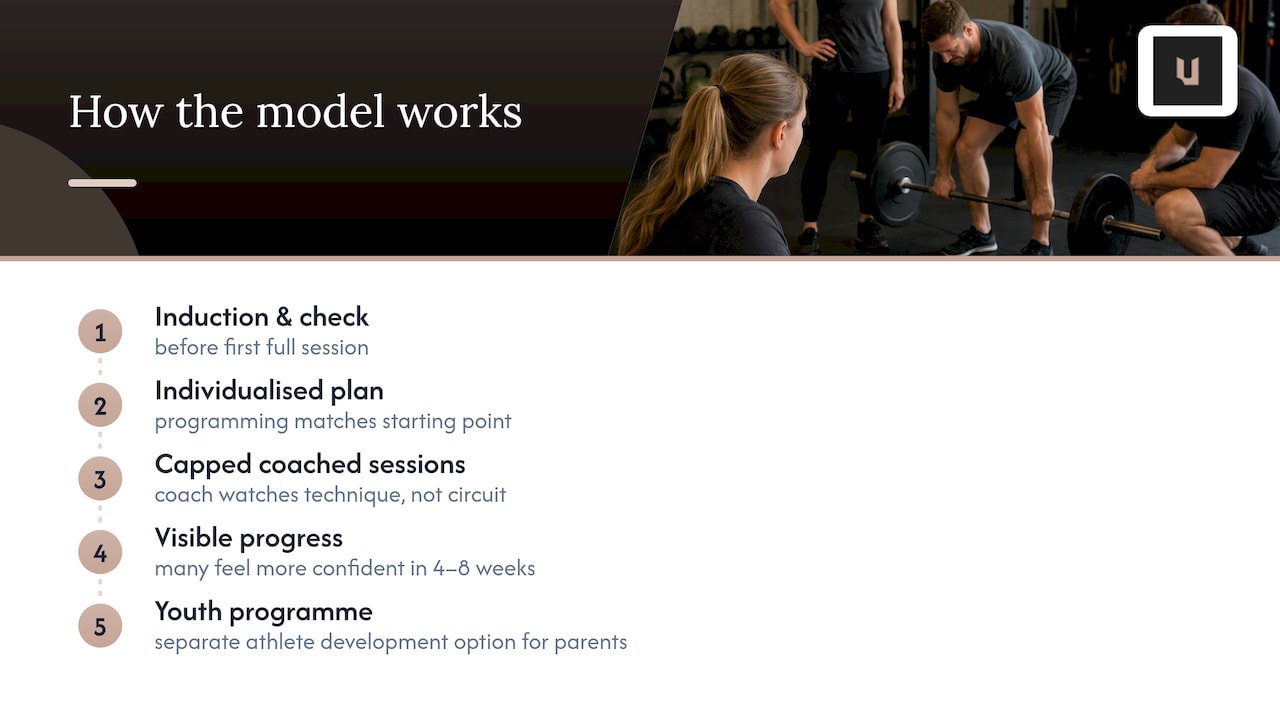
We run Small Group PT in Sheffield built around the same principles: capped groups, individualised plans and a coach who actually watches your technique, not a generic circuit. Many members have completed numerous workouts with us, and many report feeling noticeably more confident within 4 to 8 weeks of starting.
Every new member goes through an induction and movement check before their first full session, so programming reflects their actual starting point rather than a template. We also run youth athlete development programmes for parents looking for coaching beyond the adult SGPT model.
Before committing, visit a session and ask direct questions. The answers usually tell you more than any marketing page.
Pro Tip: Watch one full session before joining. If the coach never adjusts a rep, weight or range for anyone in the room, the “small group” label probably isn’t matched by the coaching.
Red flags include no screening at all, identical sessions regardless of ability, and groups advertised as “small” that are really closer to a packed class. If pricing isn’t transparent upfront, ask directly before booking.
I think SGPT is undersold as a compromise and oversold as a shortcut. It’s neither. For most adults who want proper coaching, consistent progression and a reason to actually show up, it beats solo training and often beats one-to-one PT on value. What I’ve seen in practice at Unit Health & Performance backs that up: people stick with it because the group holds them to it. If that sounds like what you need, a trial session is the easiest way to find out.
— Vitalij
If you want coached, individualised sessions without paying one-to-one prices, our Small Group PT programme in Sheffield is built exactly for that. Every member gets a proper induction, a progression plan, and a coach who knows their name and their numbers.
We also run Fitness Classes, Conditioning and Hybrid options if a slightly different format suits your week better, and a youth athlete programme for parents looking for speed, strength and agility coaching. Book a trial session through our Small Group PT page to see how it fits your goals.
This article is general information, not a substitute for advice from a qualified doctor. Consult a qualified healthcare professional about your own circumstances before acting on anything here.
The 3-3-3 rule isn’t a formally defined training standard, and definitions vary depending on the source. Some use it informally to describe three sessions a week, three main exercises per session, and three sets each, though no national guideline sets this as a requirement.
Small group training means coach-led sessions with a capped, limited number of participants, each following an individualised plan rather than one fixed workout for everyone. The exact cap varies by provider, but the defining feature is that the coach can still adjust technique and loads for each person during the session.
Group-based training is linked to a small but significant advantage for functional outcomes compared with individual-only approaches, according to a 2026 systematic review. It also embeds behaviour-change techniques, such as goal setting and social support, which are associated with better exercise adherence in systematic reviews of exercise programmes.
One-to-one personal training prices vary widely by location, coach experience and session length, and we don’t publish a universal figure here. For small group pricing specifically, Unit Health & Performance provides details on request through the Small Group PT page.