For fat loss, aim for a calorie deficit and set protein at about 1.6 to 2.0 grams per kilogram of bodyweight if you train regularly. The sections below show you exactly how to calculate these numbers and adjust them as you go.
TL;DR:
- Use a maintenance calorie estimate or tracking app, then subtract 300 to 600 calories; deficits above 500 can start to impair lean mass retention.
- Choose carbohydrate and fat amounts around training and appetite, while avoiding fat below about 20% of calories, which may increase hunger.
- Review weekly weight trends after 2 to 4 weeks; if logging is consistent but progress stalls, reduce intake by 100 to 150 calories daily.
- Older adults and people whose medication suppresses appetite may need help meeting protein needs; consult a clinician before an aggressive calorie cut.
Start by working out how many calories your body burns in a day, known as your maintenance or total daily energy expenditure. The Mifflin-St Jeor equation is the most widely used method: it factors in your weight, height, age and sex, then multiplies by an activity factor to account for exercise and daily movement. Most tracking apps calculate this for you once you enter your stats, so you rarely need to do the maths by hand.
Once you know your maintenance number, you need a deficit. The NHS recommends cutting around 600 calories a day as a safe, sustainable starting point for many adults, using typical reference intakes of 2,000 kcal a day for women and 2,500 kcal a day for men. A deficit in the 300 to 600 kcal range tends to work well for most people: large enough to see progress, small enough to stick with and protect muscle.
Here’s the step-by-step process:
A worked example makes this concrete. Say a man weighing 85 kg has a maintenance intake of 2,700 kcal and wants a 500 kcal deficit, landing at 2,200 kcal a day. At 1.8 g/kg, his protein target is 153 g, which equals 612 kcal.
For a woman weighing 65 kg with a maintenance of 2,100 kcal and the same 500 kcal deficit, her target is 1,600 kcal. At 1.8 g/kg, protein comes to 117 g (468 kcal), leaving 1,132 kcal for carbs and fat: around 44 g of fat (396 kcal) and 184 g of carbs (736 kcal).
| Example | Daily kcal | Protein (g) | Fat (g) | Carbs (g) |
|---|---|---|---|---|
| Male, 85 kg | 2,200 | 153 | 62 | 258 |
| Female, 65 kg | 1,600 | 117 | 44 | 184 |
Before locking in these numbers, check a few things: your real activity level (desk job versus physically active role), whether your weight has been stable or trending up or down recently, and any medication that affects appetite. If you’re on a GLP-1 medication, appetite changes can shift how much you naturally eat, so it’s worth checking with a clinician before setting an aggressive deficit.
Pro Tip: Round your macro targets to the nearest 5 grams. Chasing exact figures to the decimal point adds stress without adding results.
The deficit is what drives the scale down. The NHS confirms that calorie counting creates the energy gap needed for weight loss, and that principle holds regardless of which macro split you choose. Where macros genuinely matter is protein, because it protects the muscle you’ve worked to build while you’re eating less.
A meta-analysis on protein and resistance training found that higher protein intake, combined with resistance exercise, produces small but consistent increases in lean body mass. Protein intakes around 1.6 g/kg a day or higher are commonly linked to this benefit. The British Dietetic Association’s sport and exercise nutrition guidance supports this, recommending 1.4 to 2.0 g/kg for people who exercise regularly, well above the sedentary baseline of around 0.75 to 0.8 g/kg a day.
Carbs and fat are more flexible:
Older adults and those on weight-loss medication deserve extra attention on protein. Appetite suppression from GLP-1 medications can make it harder to hit protein targets through food alone, and the BDA notes that older adults benefit from protein intakes at the higher end of the active range to help offset age-related muscle loss. A coach or dietitian can help structure meals around this if you’re in either group.
There’s no single correct macro split, because the right one depends on your training, preferences and how you respond to different foods. Here are four starting points:
| Split (protein/carbs/fat) | Best suited for |
|---|---|
| 40/30/30 | Strength trainees prioritising muscle retention |
| 35/35/30 | Mixed training, balanced energy and satiety |
| 30/40/30 | Endurance training or higher activity days |
| 30/30/40 | Those who prefer more fat for satiety and simplicity |
Take the earlier 2,200 kcal example and apply a 40/30/30 split. Breakfast might be three scrambled eggs, 150g of fat-free Greek yoghurt and a handful of berries: around 35 g protein, 20 g carbs, 15 g fat, roughly 350 kcal. Dinner could be a grilled chicken breast (200g), 200g of boiled new potatoes and mixed vegetables with a drizzle of olive oil: around 55 g protein, 45 g carbs, 12 g fat, close to 500 kcal.
A few common UK foods make it easier to hit protein targets without overthinking every meal:
| Food | Serving | Protein (g) |
|---|---|---|
| Chicken breast | 100g cooked | 31 |
| Cottage cheese | 100g | 11 |
| Tinned tuna | 100g | 24 |
| Greek yoghurt | 150g | 14 |
| Lentils | 100g cooked | 9 |
When a meal falls short of your macros, fix protein first: add a scoop of whey, an extra egg or more cottage cheese. Once protein is sorted, adjust carbs and fat by swapping portion sizes of rice, potatoes or oils, rather than changing the whole meal.
Weigh yourself once a week, ideally first thing in the morning, and look at the weekly trend rather than any single reading, since daily weight swings with water and food volume. Every 2 to 4 weeks, take a tape measurement (waist, hips) and a progress photo in consistent lighting and clothing. These three data points together give a clearer picture than the scale alone.
Here’s a simple adjustment protocol:
A systematic review on energy deficits and resistance training found that deficits larger than around 500 kcal a day can start to impair lean mass retention, even when training continues. This is one reason a moderate, sustainable deficit tends to outperform an aggressive one over months rather than weeks.
Logging consistency matters more than precision. Use a tracking app, weigh portions with a kitchen scale for the first few weeks to calibrate your eye, and don’t fall into the trap of re-weighing yourself multiple times a day or adjusting macros after a single bad reading.
Pro Tip: Log your food the night before or first thing in the morning when meals are predictable. It takes less time and keeps you consistent on busy days.
We start every new member with a short assessment covering training history, current eating patterns and goals, then set an initial calorie target and protein range based on their activity and bodyweight. From there, we build the deficit gradually rather than starting aggressive, because adherence over months beats intensity over weeks.
Our coaching touchpoints typically include:
Members join a community that has completed many workouts together, with experience supporting numerous people through this process and adjusting targets as training and life circumstances shift.
Carbohydrates fuel higher-intensity training, so cutting them too aggressively often shows up first as flat strength sessions or low energy in the afternoon. Keeping carbs reasonably generous around training days helps you maintain output in the gym, which matters for preserving muscle during a deficit.
Fat plays a different role: it slows digestion, supports satiety between meals and helps you absorb fat-soluble vitamins. Dropping fat too low, often below around 20% of total calories, can leave you hungrier and more likely to snack outside your plan, even if the calorie maths looks fine on paper.
Neither nutrient needs to sit at a fixed percentage. Some people feel better with carbs higher and fat lower, especially if they train often; others do better reversing that balance. What matters most is whether the split you choose keeps you full enough, energised enough for training and able to stick with the plan for weeks rather than days. Clinical guidance consistently points to diet quality and satiety, not a single ideal split, as the real driver of long-term adherence.
If you find yourself constantly hungry or dragging through workouts, that’s usually a sign to shift the carb-to-fat ratio rather than cut calories further.
The most frequent mistake is chasing an exact macro split copied from someone else’s plan without adjusting it to bodyweight, training load or appetite. A 40/30/30 split that works for a 90 kg strength athlete will not suit a 60 kg office worker doing light cardio.
Another common error is setting protein too low while overloading carbs or fat, which undermines muscle retention even if total calories are correct. Protein should always be set first, in grams per kilogram, before the rest of the plan is built.
People also under-eat vegetables and fibre while hitting their macro numbers through processed, calorie-dense foods. This technically satisfies the macros but leaves you hungrier and short on micronutrients.

Finally, much give up too early after a single flat week on the scale, when water retention or an off day of logging is a more likely explanation than an actual lack of progress. Reviewing trends over 2 to 4 weeks, rather than daily, avoids this trap entirely.
Some people benefit from keeping carbs steady every day for simplicity, while others prefer shifting more carbohydrate to training days and slightly less on rest days, keeping protein constant throughout. This approach, sometimes called carb cycling, isn’t necessary for fat loss to work, but it can help some people perform better in heavier training sessions while still managing total weekly calories.
A practical version: on strength training days, allocate slightly more carbs around the session, perhaps an extra 20 to 30 g, and trim a similar amount from fat or carbs on rest days to keep the weekly average consistent with your deficit. Protein stays fixed at your g/kg target every single day, since muscle repair happens continuously, not just on training days.
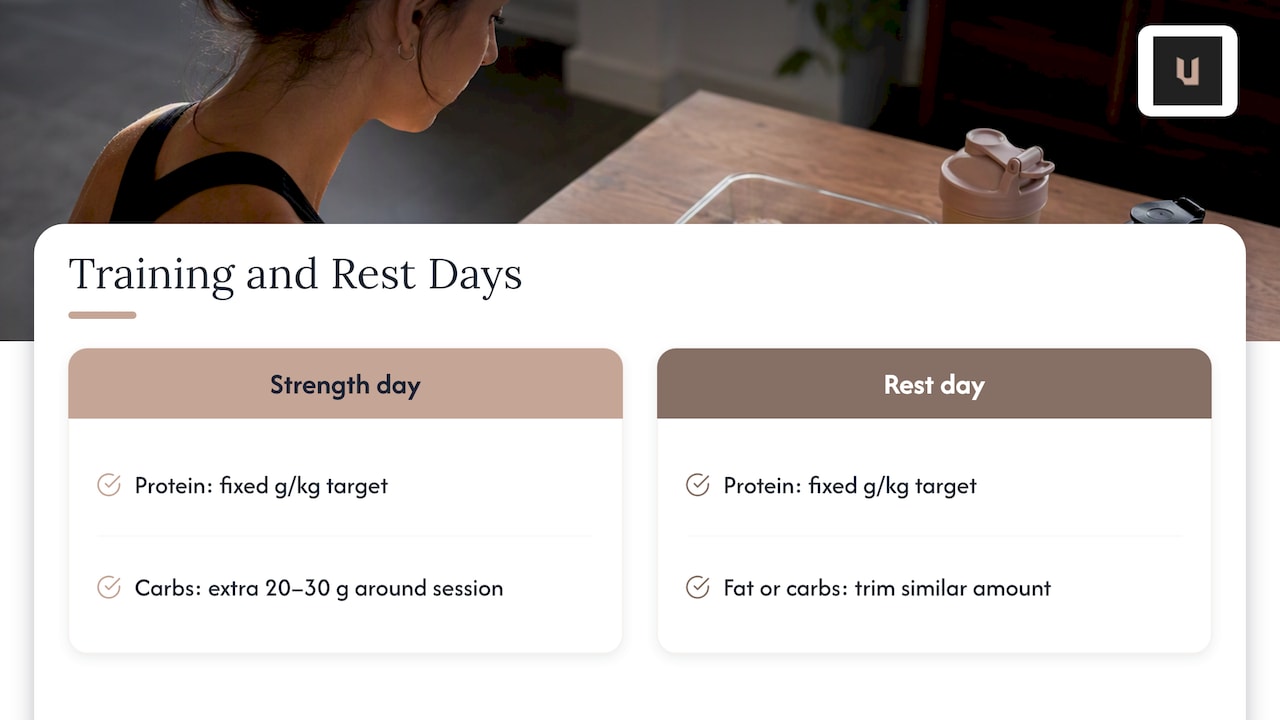
This isn’t essential for everyone. If tracking already feels like effort, keeping macros flat across the week is simpler and works just as well for most people. Reserve day-to-day variation for those who train frequently and notice a real difference in how they feel and perform when carbs shift around sessions.
Tracking macros alone is harder than tracking them with people around you doing the same thing. Small group training sessions create a natural structure for this: regular contact with a coach who can review your logging, flag patterns you might miss and adjust your targets based on how you’re actually responding, not just the theory.
Group accountability also helps with the behavioural side of tracking, things like remembering to log consistently or not panicking after one slow week. Training alongside others who are also working towards fat loss or strength goals tends to keep motivation steadier than training alone.
In a small group format, coaches can spot when someone’s energy has dropped in sessions, which often signals that carbs or total calories have been cut too hard, before it shows up as a stalled result weeks later. That kind of real-time feedback is difficult to get from an app alone.
A refeed day, where carbohydrate and overall calorie intake briefly rise closer to maintenance, can help some people manage hunger and training fatigue during longer fat loss phases, typically eight weeks or more. The idea isn’t to undo progress but to give a short psychological and physical break from sustained restriction.
A simple approach is to raise carbs and total calories to maintenance level for one day every one to two weeks, keeping protein unchanged. This isn’t necessary for shorter fat loss phases of a few weeks, where a steady deficit throughout tends to work fine without added complexity.
For people struggling with motivation or energy in week six or beyond of a longer cut, a planned refeed can support adherence better than gritting through constant restriction until willpower runs out. The goal is always the same: keep the plan sustainable enough that you’re still following it in month three, not just week one.
After years of watching people chase the “perfect” macro ratio, the pattern is clear: the split matters far less than whether you can actually follow it for months. A protein-forward plan with a modest deficit, paired with resistance training twice a week, protects muscle and keeps you functioning well enough to stay consistent.
Use the calculation steps above to set your numbers, then pick a split you can live with, not one you read was optimal somewhere. Accountability, whether from a coach, a training partner or a structured group, tends to matter more than the third decimal place of your carb target.
— Vitalij
Working out your macros is one thing. Sticking to them while training properly is another, and that’s where having a coach and a community around you changes the outcome. Our Small Group PT sessions combine individualised coaching with the accountability of training alongside others, which is exactly the structure that helps people stay consistent with both their nutrition and their training for months rather than weeks.

Based in Sheffield, we offer:
If you’re also managing appetite changes from a GLP-1 medication, resources like GLPCare’s guidance on muscle loss prevention cover the medical side well, while our coaching focuses on the training and nutrition structure around it. Book a discovery session with our team to work out a plan built around your numbers, your training and your life.
The macros that work best set protein at 1.6 to 2.0 grams per kilogram of bodyweight if you’re active, with the remaining calories split between carbs and fat based on preference and training needs. The calorie deficit itself, commonly a reduction of around 600 kcal a day, drives the actual fat loss, while protein protects muscle along the way.
A 40/30/30 split (protein/carbs/fat) works well for people who train with weights regularly and want a higher protein intake to support muscle retention during a deficit. It isn’t the only option, and splits like 35/35/30 or 30/40/30 suit people with different training styles or appetite patterns just as effectively.
Your exact macros depend on your bodyweight, activity level and chosen deficit, calculated by setting protein first in grams per kilogram, then dividing the remaining calories between carbs and fat. Using the BDA’s sport and exercise nutrition guidance for protein and a moderate 300 to 600 kcal deficit gives most active adults a solid, personalised starting point.
Higher protein intake can be prioritised with adjustments to the macro split, though very low fat may affect satiety and hormone-related nutrient absorption for some people.