Yes, you can build muscle after 40. You need three things: strength training at least twice a week, enough protein, and slow, steady progress. You don’t need long sessions, fancy kit or a young body. You need a plan you can stick to for about three months before you judge the results.
This guide explains what to do, how often, what to eat and how to avoid the mistakes that stall people. It is written in plain English for busy adults, with UK guidance behind it.
Yes. Muscle stays trainable for life. A large review of research, searching more than 6,000 publications, found that 10 to 14 weeks of resistance training increased muscle size by 2% to 14% in people aged 60 to 69 and 1% to 12% in people aged 70 to 79. Men and women responded in a similar way in the thigh muscles.
That is in people decades older than 40. If muscle still grows at 70, it will grow at 45.
Another review of 28 studies of adults aged 65 and over, reported by AARP, found that resistance training produced significant increases in muscle size and muscle fibre area. The same article says a realistic window to see meaningful improvement from regular resistance exercise and good nutrition is about three months.
So the honest answer to “is it too late?” is no. The thing that changes after 40 is not whether you can build muscle. It is how much attention you need to give to recovery, technique and food.
Nothing switches off at 40. But a few practical things shift:
The good news is that the basics are simple and don’t change with age: lift something challenging, do it regularly, eat enough, and increase the challenge slowly.
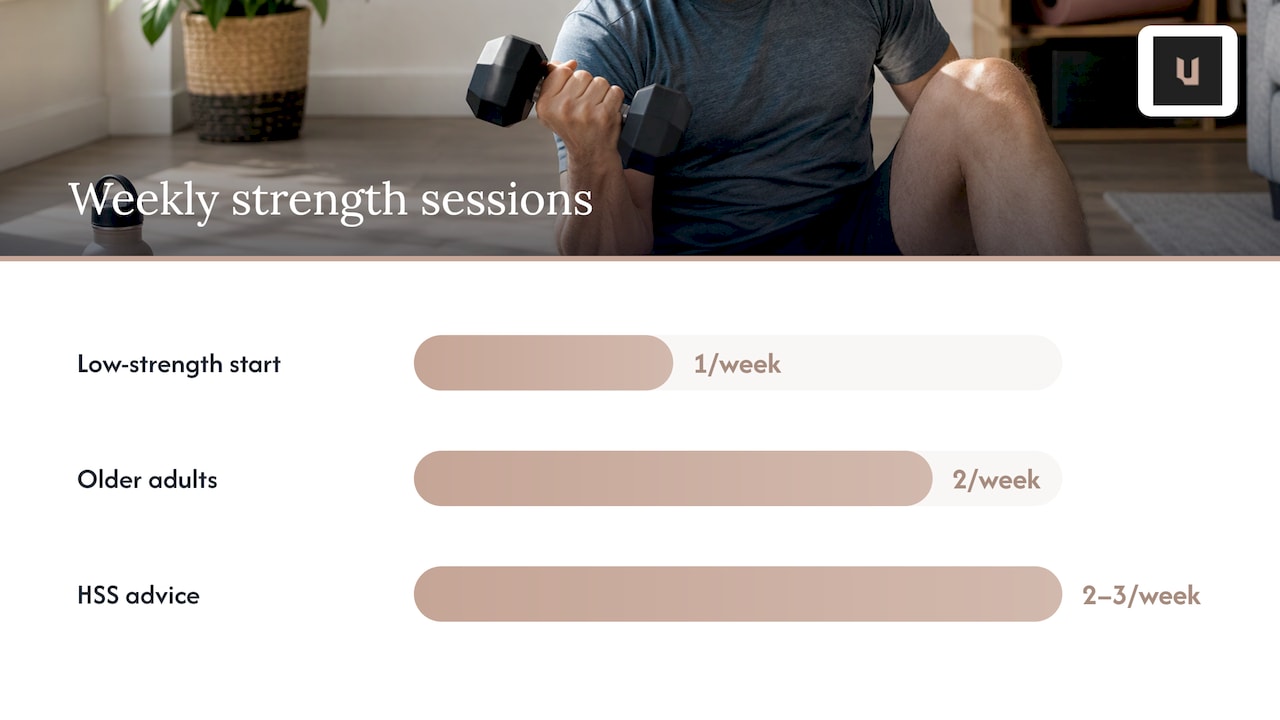
Two days a week is the proven starting point.
The NHS recommends strengthening activities for all the major muscle groups on at least 2 days a week. That means legs, hips, back, abdomen, chest, shoulders and arms. This sits alongside 150 minutes of moderate aerobic activity a week. Strength work doesn’t count towards those 150 minutes, so you need both.
Research from Glasgow Caledonian University suggests two sessions a week should be the standard for older adults. It also notes that more sessions don’t automatically bring bigger results, and that even one session a week helps people who start with low strength. Quality beats quantity.
If you want to go to three days, that is fine. A US sports medicine specialist at HSS suggests two to three sessions a week on the major muscle groups, and advises stopping before your form breaks down. Her aim is to finish your last rep still moving well.
Not sure whether to train your whole body each time or split it up? Our guide to full body versus split training explains which suits adults over 40. For a two-day set-up in more detail, see two sessions a week: UK backed strength training for over 40s.
Here is the simple version.
The US National Strength and Conditioning Association position statement for older adults goes a little further. It recommends working towards 2 to 3 sets of 1 to 2 multi-joint exercises per major muscle group, at 70 to 85% of your one-rep max, 2 to 3 times a week. It adds that a well-designed programme with good technique coaching and proper spotting is safe for healthy older adults.
Don’t worry about one-rep maxes. A simple rule: pick a weight where the last two reps of a set feel hard, but your form stays clean.

Multi-joint moves give you the most for your time. Think of five basic patterns:
If barbell deadlifts bother your back, there are plenty of options. We list nine safer deadlift alternatives for over 40s that train the same muscles.
Short on time? Here is a full-body plan you can do in about 45 minutes, twice a week. It follows the same pattern as a two-day full-body plan published by Women’s Health UK, which uses 2 sets per exercise (building to 3), 6 to 10 reps for big lifts, 8 to 12 for smaller isolation moves, and 48 to 72 hours between workouts.
| Exercise | Sets | Reps | Notes |
|---|---|---|---|
| Goblet squat | 2 to 3 | 8 to 10 | Sit back and down, keep your chest tall |
| Dumbbell bench press or press-up | 2 to 3 | 8 to 12 | Control the lowering part |
| Seated row or lat pulldown | 2 to 3 | 8 to 12 | Pull your shoulder blades back and down |
| Romanian deadlift | 2 to 3 | 8 to 10 | Soft knees, push hips back |
| Side plank or farmer’s carry | 2 | 20 to 40 seconds | Stay tall, breathe steadily |
Do this on, say, Monday and Thursday. Rest at least a day between sessions. Write down your weights so you can beat them next time.
If you are over 50, our twice a week strength plans for over 50s give two easy starting points. If joints are a worry, low impact strength training for 40+ shows how to build muscle in two to three sessions without pounding your knees.
Progress means making the work a little harder over time. That can be more weight, more reps, an extra set or slower, more controlled reps.
A UK consensus statement on osteoporosis recommends progressive resistance training at the heaviest weight you can lift 8 to 12 times, building up to three sets of each exercise. It also recommends starting with lighter exercise to learn good technique before you increase the intensity.
Here is a simple way to do that:
The most common mistake in midlife is coming back after a long gap and expecting to lift what you used to. The HSS advice is blunt and useful: start from where you are today, not where you were five or ten years ago, and build up with good form.
If your back tends to complain when you lift, learning how to lift without back strain is a sensible place to begin before you add load.
If you have a health condition, an injury, or you take regular medication, speak to your GP or a physiotherapist before starting. Tell them what you plan to do. Stop and get checked if you get sharp pain, chest pain, dizziness or unusual breathlessness.
Training gives the signal. Food provides the building blocks.
The official UK figure is 0.75 g per kg of body weight a day. Research suggests active adults may do better with more:
To make that real: if you weigh 80 kg, 1.2 g per kg is 96 g of protein a day. That is roughly 30 g at each of three meals plus a small snack.
A study of older adults in South Yorkshire, published in the British Journal of Nutrition, found that fewer than half met the UK minimum of 0.75 g/kg a day, and fewer than 15% reached 1.2 g/kg. Only one of 256 people reached 25 g of protein at all three meals. Protein was usually piled into one meal, mostly dinner.
Spreading protein across the day is an easy win.
Also eat enough overall. If you are training and still cutting calories hard, muscle will struggle to grow. If you want to lose some fat as well, see our guide to losing 5 to 10% of body weight after 40 with two strength sessions a week.
Muscle is built in the days between sessions, not during them. A few habits help, and they cost nothing:
Our guide on workouts for busy professionals shows how to fit this around a full diary.
Lifting does more than add size. It supports your bones and everyday strength too. Two of our other guides cover this: bone density exercises after 40 and grip strength over 40.
Be patient and track the right things.
Track your lifts in a notebook or on your phone. Take a photo once a month. Don’t rely on the scales alone, because muscle gained and fat lost can cancel out on the scale.
We see the same thing every week in our Sheffield gym: adults over 40 who think they have left it too late, then surprise themselves within a few months.
The main problem is rarely ability. It is usually a lack of a clear plan, a lack of coaching on technique, and no one holding them accountable on a busy week. Generic workouts from the internet don’t know about your sore shoulder, your desk job or your two kids.
That is why we built Unit around small group personal training. Each person gets an individual plan, but you train alongside others in a friendly, non-intimidating space. Our coaches make sure each session has a purpose: the right weight, the right exercise, and a steady step up over time. We add nutrition and accountability coaching, because training and food work together.
Our focus is on sustainable results and longevity, not quick fixes. Muscle is one of the best things you can invest in for the next 30 years, and it is never too late to start.
Vitalij
If you would rather not work it out alone, we can help. Our small group personal training is designed for adults over 40 who want to get stronger, leaner and fitter. You get an individualised plan, expert coaching and a supportive community.
We also run fitness classes, including conditioning and hybrid sessions, and offer nutrition and accountability coaching. If you have a teenager who plays sport, take a look at our youth athlete programmes. Visit our home page to get in touch and find out what suits you.
Yes. Research shows muscle keeps growing in response to resistance training well into older age, including in people in their 60s and 70s. Train at least twice a week, eat enough protein and give it around three months.
At least two days a week, working all the major muscle groups, as the NHS advises. Two to three sessions suits most people. More sessions don’t always bring better results, so focus on good quality work and enough recovery.
The UK minimum is 0.75 g per kg of body weight a day, but research on active older adults points to around 1.2 g per kg or more. For an 80 kg person, that is about 96 g a day. Spread it across your meals rather than eating most of it at dinner.
You need to lift weights that challenge you. A good guide is a weight you can lift 8 to 12 times with good form, where the last couple of reps feel hard. Build up gradually over weeks, and learn the technique with lighter loads first.
Speak to your GP or physiotherapist first, then train with a coach who can adapt exercises to suit you. Most people can find a way to strength train safely with the right guidance.