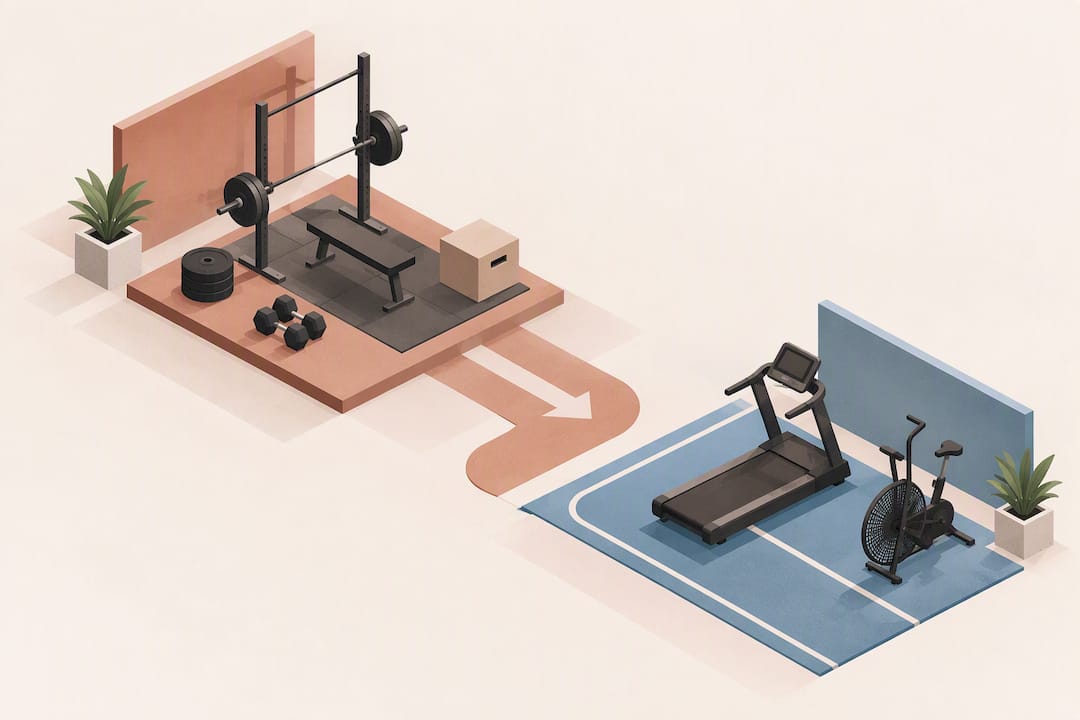
If your main goal is strength, lift first. If it’s endurance, do your cardio first. If it’s fat loss, the order barely matters, what matters is your weekly training volume and what you eat. The only real caveat: whichever comes second will suffer a bit, so put your priority first and protect your recovery around it.
TL;DR:
- When training for endurance, performing cardio first maximizes performance, but for fat loss or muscle growth, sequencing has minimal impact if weekly training volume is prioritized.
- Starting with a 5 to 10-minute easy warm-up is essential, and intense cardio before lifting can impair strength gains and increase fatigue markers like cortisol.
- Splitting cardio and lifting into separate sessions can enhance recovery when both are demanding, with a recommended gap of 6 to 8 hours to minimize interference effects.
- Individual coaching and flexible planning are crucial, as the optimal sequence depends on personal goals, recovery status, and the total weekly workload.
The rule is simple: whatever you care about most goes first, while your legs, lungs and nervous system are fresh. Here’s how that plays out in practice.
Three quick templates to work from: a strength-priority day (warm-up, heavy lifts, 15 to 20 minutes of easy cardio after), an endurance-priority day (warm-up, your run or ride, then light accessory lifting if you’ve got anything left), and a hybrid low-intensity day (moderate lifting followed by steady cardio, neither one pushed to the limit). None of this needs to be complicated. Pick the template that matches today’s goal and repeat it.
The clearest evidence comes from a systematic review and meta-analysis from Northumbria University, which pooled data on how sequencing affects strength, muscle growth and body composition.
The headline number: lifting before cardio produced a 6.91% greater improvement in lower-body dynamic strength than doing cardio first, a statistically significant gap.
That’s a meaningful difference if strength or power is your main target. But the same review found no significant effect of order on muscle growth, maximal aerobic fitness, or body-fat percentage. Order changes how much strength you gain. It doesn’t change how much muscle you build or how much fat you lose.
The mechanism becomes obvious in acute trials. Jones et al. (2016) had participants do endurance work before strength work, and measured what happened next. The results were stark:
Do the hard cardio first, and your lifting suffers that same day. It’s not that lifting becomes unsafe, it’s that you simply can’t push as hard.
A practitioner review published on PMC adds an important nuance: the size of this “interference effect” depends on training volume, intensity, how much rest sits between efforts, and the individual’s overall stress load. These studies mostly used moderately trained adults doing single sessions, so treat the numbers as a strong signal, not a universal law carved for everybody.
Every session should start the same way: 5 to 10 minutes of easy aerobic movement (walking, cycling, rowing) followed by movement prep specific to what you’re about to do. If you’re squatting, that means bodyweight squats and hip mobility work, not just a jog on the treadmill.
Beyond the warm-up, how you use cardio depends entirely on which adaptation you’re chasing:
Put it first, or move it to its own day entirely, rather than tacking it onto the end of something else.*
Three sessions to copy directly: a strength-priority day (10-minute warm-up, main lifts, 15 minutes of steady cardio to finish), an endurance-priority day (warm-up, 30 to 45 minutes of your main cardio effort, then light upper-body accessory work if you want it), and a hybrid day for weeks when nothing is peaking, moderate lifting followed by moderate cardio, both dialled to about 70% effort.

Splitting hard cardio and heavy lifting into separate sessions, or at least separate parts of the day, gives your nervous system and glycogen stores time to recover before the next big effort. That matters most when both sessions are genuinely demanding, not when one is a gentle walk.
If you have to fit both into one day, practitioner guidance generally suggests leaving a gap of roughly 6 to 8 hours between sessions where possible, or pushing one to a different day if your schedule allows it. The bigger the overlap in muscles used, think heavy running before heavy squats, the more that spacing matters. Light cycling before an upper-body session barely competes for the same resources.
Watch for these signs that you need more recovery, not a cleverer sequence:
If you’re a beginner or an older adult, don’t lose sleep over perfect sequencing. Research on older men found comparable strength and fitness gains regardless of which came first, provided intensity stayed moderate. Showing up consistently and progressing gradually matters more than which exercise you do at minute one.
Knowing the theory is one thing. Applying it session after session, around work, family, and whatever energy you woke up with, is where most people fall down. That’s where a coach earns their keep: reading how you’re recovering and adjusting today’s priority accordingly, rather than following a rigid plan that ignores how you actually feel.
At UNIT Health & Performance, small group sessions are built around individual goals rather than a one-size-fits-all class structure. If someone’s chasing strength this block, their coach front-loads the heavy work. If someone’s building toward an endurance event, the session flips. That kind of individual attention is one of the practical benefits people notice most in small group personal training.
Most articles on this topic treat sequencing like a universal law: lift first, full stop, end of discussion. That’s lazy reading of the evidence. Tell a marathoner to save their tempo run for after a heavy squat session and you’ve handed them a worse outcome, not a better one.

What’s genuinely underrated is how little order matters for fat loss and muscle growth, the two goals most gym-goers actually walk in chasing. People agonise over sequencing when they should be agonising over whether they trained at all this week, and what they ate afterwards. The interference effect is a strength-and-power story, not a fat-loss story.
My honest read: pick your priority for the day, put it first, and stop treating every session like it needs a perfect formula. Consistency across weeks beats precision within a single hour, every time.
— Vitalij
For readers who want to check the evidence directly: the NHS physical activity guidelines set out weekly aerobic and strength targets, the Northumbria meta-analysis covers sequencing effects on strength and body composition, and the Jones et al. 2016 trial, alongside a practitioner review on PMC, explain the mechanisms behind it.
It depends on your goal. If strength is the priority, lift first, evidence points to a meaningful advantage for lower-body strength gains when weights come before cardio. If endurance is the priority, do your cardio first and accept slightly reduced lifting performance afterwards.
This isn’t an established term in exercise science, and definitions circulating online vary considerably. Rather than chase an informal rule, stick to evidence-backed guidance: prioritise your main goal first in a session, and hit the NHS-recommended weekly targets for aerobic and strength work.
Twenty minutes after lifting is a solid way to add extra conditioning and calorie burn, but it isn’t a fat-loss shortcut on its own. What actually drives fat loss is your total weekly training volume and calorie balance, not the length of one post-lift cardio block.
Order makes little difference here. The Northumbria meta-analysis found no significant effect of sequence on body-fat percentage, so focus on consistent weekly training and nutrition rather than which exercise comes first in a session.