A good warm-up for strength training takes about 10 minutes. You raise your heart rate with easy movement, wake up the muscles you are about to use, loosen your joints with dynamic moves, then do a few lighter sets of your first lift before the heavy work. That is all it needs to be. Below you will find the routine step by step, why it works, and how to adjust it when you are short on time.
The word “warm” is meant literally. Medical guidance explains that warm muscles are more pliable and less likely to tear than cold ones, so your warm-up has to raise your muscle temperature. Standing around stretching gently does not do that. Moving does.
There are three practical benefits.
Your body gets ready. A warm-up raises muscle temperature, improves blood flow and lets muscles take in more oxygen. A 2025 Mayo Clinic Press publication says proper warm-ups can cut muscle injuries by as much as 30% to 50%. Treat that as an upper estimate, not a promise, but the direction is clear.
Your nervous system gets ready. The same source notes that a warm-up prepares your nervous system for faster reactions and helps you shift smoothly from rest to hard effort, which reduces early fatigue.
Your head gets ready. Ten minutes of focused movement is a switch between work, traffic or family life and the session. For many of our members, that mental reset is as valuable as the physical one.
Coaches agree. In a 2025 survey of strength and conditioning practitioners, 88% named injury prevention and 86% named better performance as the main aims of a warm-up.
If you want to see how a muscle-temperature warm-up looks in another training style, this guide to warming up for calisthenics shows the same principle applied to bodyweight work.
Longer than a minute, shorter than most people fear. The NHS says a warm-up routine should take at least six minutes, and you can go longer if you need to. The UK Strength and Conditioning Association (UKSCA) notes that most warm-ups last between 10 and 30 minutes.
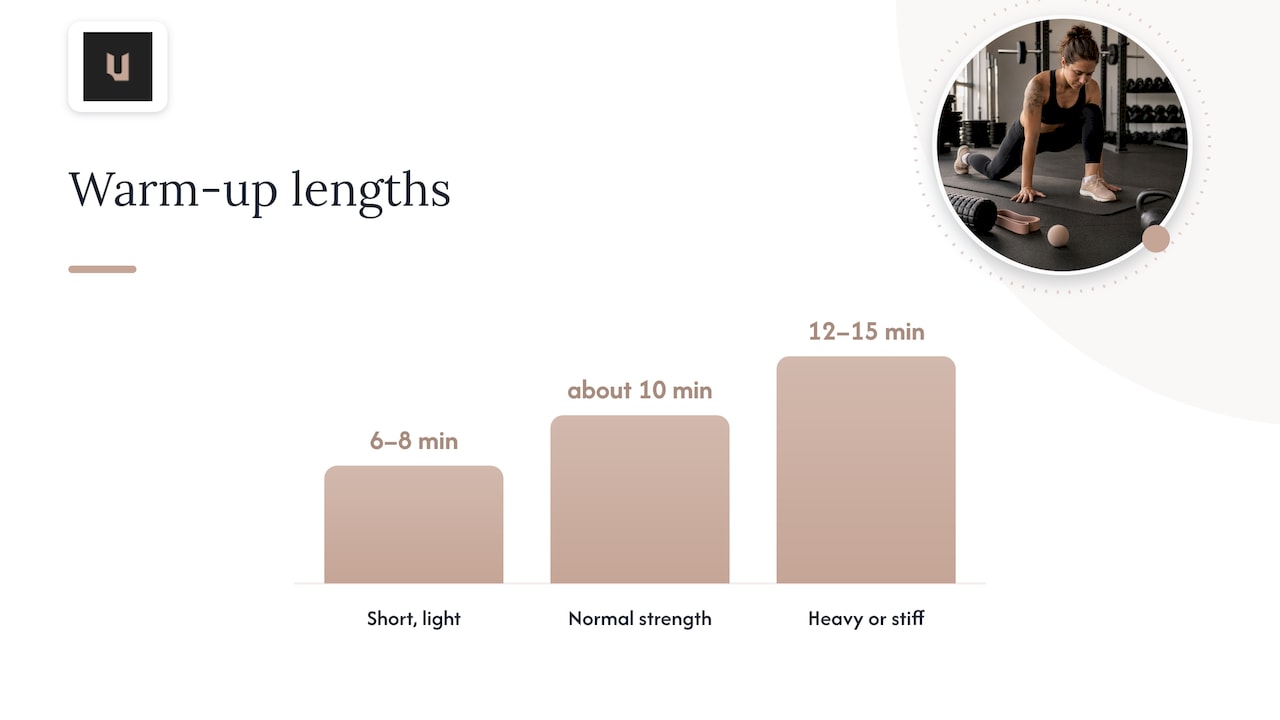
What do coaches actually do? In the 2025 survey, 47% of warm-ups lasted 10 to 20 minutes and 43% lasted under 10 minutes.
A simple way to decide:
| Your session | Warm-up length | What to focus on |
|---|---|---|
| Short, light session | 6 to 8 minutes | Easy cardio, joint circles, one or two lighter sets |
| Normal strength session | About 10 minutes | Full RAMP routine below |
| Heavy lifting day or stiff morning | 12 to 15 minutes | Extra mobility, more build-up sets |
| Cold gym or early start | Add a few minutes | Longer easy cardio phase |
For more vigorous activity, Mayo Clinic Press suggests 10 to 15 minutes of dynamic stretching and mobility work. Heavy squat or deadlift days fall into that group.
The UKSCA describes RAMP as a framework for building a time-effective warm-up. The letters give you the order:
The flow goes from general movement, to dynamic stretches and small activations, to exercises specific to your session. You never need to memorise more than that.
This is a general routine for a full-body or lower-body session. Keep everything easy to moderate. You should finish feeling warmer and looser, not tired.
Pick one:
You should feel slightly warmer and be breathing a little harder by the end. Then add a few sets of easy jumping jacks or step-ups if you like.
Do each of these for 8 to 10 reps, or 8 to 10 per side:
Research shows this is standard practice. In the 2025 survey, 97% of coaches used dynamic stretching and 88% used micro-activations such as mobility and band exercises.
If you are not sure what separates mobility from flexibility, our guide on flexibility vs mobility explains it simply.
Now rehearse the lift you are about to do. Mayo Clinic’s Dr Callie Davies suggests that lifters should do light sets of the planned lifts.
A simple build-up for a squat where your working weight is 80 kg:
| Set | Weight | Reps | Rest |
|---|---|---|---|
| 1 | Empty bar | 8 to 10 | Under a minute |
| 2 | 40 kg | 5 | About a minute |
| 3 | 60 kg | 3 | About a minute |
| 4 | 70 kg | 1 to 2 | 1 to 2 minutes |
| Work sets | 80 kg | As planned | As planned |
This is an example, not a rule. The point is that the steps get heavier while the reps get fewer, so you practise the movement without tiring yourself. Keep every warm-up rep smooth and technical.
No. In the 2025 survey, 55% of coaches prescribed warm-up sets, but only for the main exercises. That matches sensible gym practice:
There is also some evidence that specific warm-up sets help performance. A 2021 systematic review in Motricidade suggests that a specific warm-up with loads close to the maximum can help maximal strength and the number of reps performed. In plain terms: your last build-up set can be fairly close to your working weight, as long as it is not tiring.
Stick to dynamic stretching, which means moving through a range rather than holding a position. The UKSCA says dynamic stretching may be the most suitable method of mobilising during a warm-up, and static stretching can compromise muscle performance.
So save the long holds, such as a 30-second hamstring stretch, for the end of your session or a separate day. Before you lift, leg swings and bodyweight lunges do the job better.

What about foam rolling? A short roll can sit in the “mobilise” part of your routine. We cover how to do it in our post on foam rolling before a workout.
You do not need a long list. Match the mobility work to the lift:
| Lift | Where it tends to feel tight | Useful warm-up moves |
|---|---|---|
| Squat | Hips, ankles, upper back | Hip circles, bodyweight squat with a pause, ankle rocks |
| Deadlift | Hamstrings, hips, lower back | Glute bridges, good mornings with no weight, leg swings |
| Bench press | Shoulders, upper back | Band pull-aparts, arm circles, push-ups |
| Overhead press | Shoulders, upper back | Open books, wall slides, band pull-aparts |
| Rows and pull-ups | Shoulders, upper back | Scapular pull-ups, band pull-aparts |
Pick two or three moves per area. If a joint is always stiff, give it a little more time, but keep the whole warm-up under about 15 minutes.
Busy week? Do not skip the warm-up. Shrink it. The UKSCA’s advice is to choose movement-based exercises that mobilise joints and activate several muscle groups at once, so you do not need a separate block for each.
A six-minute version, in line with the NHS minimum:
The Springer survey also found that experienced coaches often judge readiness by asking how the athlete feels, rather than by measuring anything. You can do the same: if your first working set feels smooth, you were ready. If it feels stiff and heavy, add another build-up set next time.
We often see people over 40 arrive at the gym already tight from a day at a desk. They have either skipped the warm-up, or spent 20 minutes on random stretches that did not prepare them for anything.
In our small group sessions, the warm-up is part of the plan. It is short, it matches what is on the programme that day, and the coach watches how each person moves. If your hips are stiff today, your warm-up changes today. That is what individual attention in a small group allows, and it is hard to get when you are working out alone from a printout.
We built our approach around sustainable results and longevity. A good warm-up is one of the cheapest ways to keep training week after week, which is what actually builds strength.
Vitalij
If you train in Sheffield and want your warm-up, lifts and progress planned around you, our small group personal training is built for that. You get individualised coaching in a supportive, non-intimidating community, and the coach makes sure each session starts properly.

Prefer a class format? Take a look at our fitness classes, or if you are a parent of a young athlete, our youth athlete programmes cover speed, agility, strength and power. Not sure where to start? Get in touch via our homepage and we will point you to the right option.
If you are over 40 or over 50. Spend a little longer on the raise and mobilise phases, and take your build-up sets slowly. Our guides on low impact strength training for 40+ and strength training over 50 show how to structure the sessions around the warm-up.
If your joints are sore. Keep ranges comfortable and choose gentler options such as cycling and band work. See our joint friendly workouts for plans.
If you are a runner. Your warm-up for a strength session can borrow the same RAMP order. Our strength training for runners roadmaps show how it fits with your running week.
If you are a teenager or a parent of one. Technique and supervision come first. Read safe strength for teens and our injury prevention guide for young athletes.
If you do cardio and weights in the same session. Our post on lifting before cardio looks at the order, and your warm-up still comes first either way.
If you have a heart condition, are new to exercise after a long break, or have an injury, check with your GP before starting a new routine.
About 10 minutes suits most strength sessions. The NHS says at least six minutes, and heavier days may need 12 to 15. Add time if you are stiff or training in the cold.
The best one follows the RAMP order: easy cardio, activation and mobility, then lighter sets of your first lift. Choose movements that match the day’s exercises. A squat day needs hips and ankles, a press day needs shoulders and upper back.
Dynamic stretching is, such as leg swings and arm circles. Long static holds before lifting may reduce muscle performance, so do them after your session instead.
Yes, for your main lifts. Cardio raises your temperature, but it does not rehearse the movement pattern or the load. A few build-up sets let you practise technique and check how the weight feels before your working sets.
Shorten it rather than skip it. Two minutes of easy cardio, one round of squats, lunges, push-ups and band pull-aparts, and two lighter sets of your first lift can be done in around six minutes.