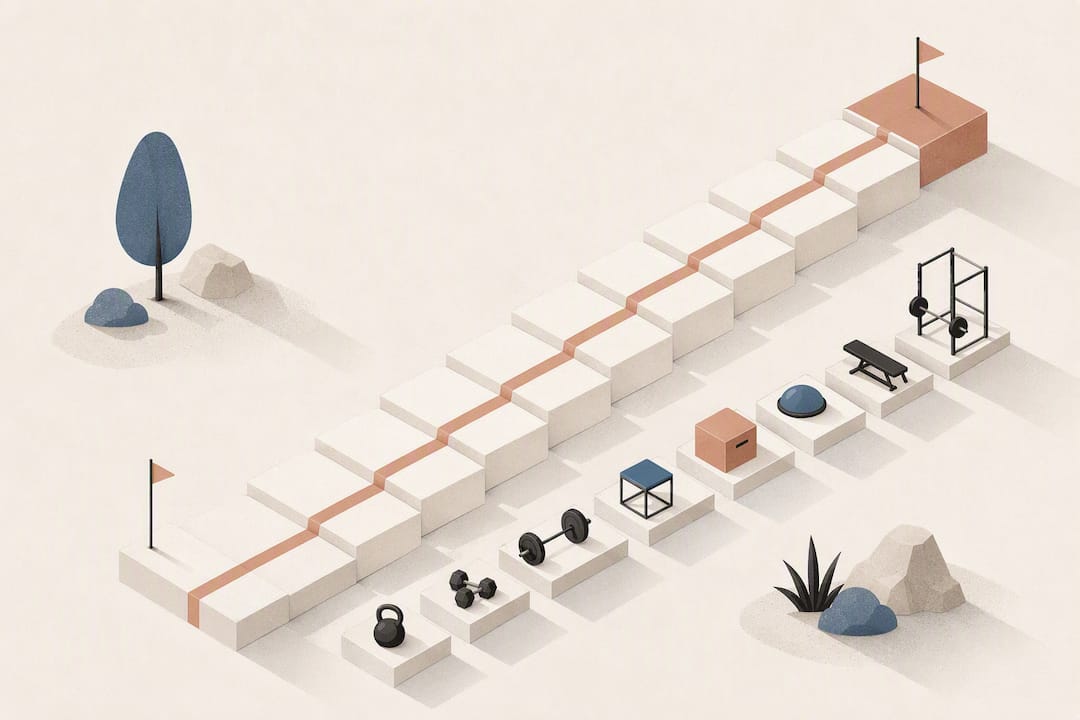
Yes, when it’s supervised and matched to your teenager’s stage of development, strength training for teens is safe and genuinely beneficial. The NHS, UK Chief Medical Officers, and the international consensus on youth resistance training all back this up. The first step is simple: find a coached, technique-focused introductory session rather than handing your teen a barbell and hoping for the best.
TL;DR:
- Strength training for teens is safe when supervised, technique-focused, and matched to their developmental stage, with strength gains averaging around 30% over 8 to 20 weeks.
- Proper supervision and correct form are critical, as most injuries occur due to poor technique or unsupervised training, not weight lifting itself.
- Teens should progress from bodyweight and light resistance to progressive loading only once their technique and maturity are sufficient, typically around ages 11 to 14.
- A well-structured program includes warm-up, movement pattern exercises, and cool-down, with rest and recovery essential for safe progress.
- Qualifying coaches with youth-specific credentials and careful supervision are crucial for ensuring safe and effective long-term training.
The evidence here isn’t thin or contested. It’s remarkably consistent. Position statements built on decades of youth training research conclude that well-designed resistance programmes improve strength, bone density, body composition, and even mental wellbeing in adolescents, provided the training is properly supervised and technique comes first, according to a review in the British Journal of Sports Medicine.
The old fear that lifting weights stunts growth or damages growth plates has been repeated so often it’s practically folklore. It isn’t supported by the research. What actually causes injuries in young lifters is poor supervision, sloppy technique, and programmes copied wholesale from adult routines. Take away the coaching and the safety data changes completely.
Adolescence, especially around puberty, is actually one of the best windows for building bone density, according to a UK government review of youth activity guidelines. Weight-bearing sports like football, gymnastics, and anything involving jumping are particularly effective at stimulating bone growth during this period.
Here’s what tends to happen when teens follow structured resistance programmes:
A closer look at the numbers: youth resistance studies report strength gains of roughly 30% over programmes lasting 8 to 20 weeks, a figure that holds across school and community-based interventions, according to the ASCA position stand on resistance training for children and youth.
Supervised programmes consistently outperform unsupervised ones on safety, not because unsupervised teens are careless, but because nobody is there to correct the small technical errors that compound into injuries under load.
Age on its own tells you very little. What matters is whether your teenager can follow instructions, hold focus for a set, and understand why a coach says “stop” mid-rep. Readiness is really about maturity and coachability rather than a birth certificate, according to JJ Strength’s guidance on starting age.
There’s no single correct age to begin. Progression should be gated by competence and training history, not by hitting a particular birthday, according to expert guidance from the Reading Children’s Orthopaedic Unit. A mature 11-year-old who can nail a bodyweight squat pattern might be more ready than an unfocused 15-year-old who can’t sit still through a warm-up.
Use these stages as a rough map:
Watch for these signals when deciding whether your teen needs coached sessions first:
A good teen session follows the same skeleton every time: warm up, do the main work, cool down. Consistency here matters more than variety.
Warm-up (5 to 10 minutes): light cardio like rowing or a jog, followed by activation drills such as bodyweight squats, glute bridges, and band pull-aparts. This wakes up the muscles that’ll be doing the real work.
Main session: organise it around movement patterns rather than individual muscles. That means covering a squat, a hinge (like a Romanian deadlift), a push, a pull, and a carry or core exercise in each session.
Cool-down: a few minutes of walking plus static stretching for the muscles worked that day.
Most teens do well with multiple strength sessions per week, leaving rest days between sessions that target the same muscle groups. If your teenager also plays a sport, strength work should complement practice, not compete with it. Scheduling a session the day after a match, rather than the morning of, avoids compounding fatigue.
Both programmes below assume no existing injuries and clearance from a coach or GP if there’s any doubt about readiness.
This suits early to mid teens starting formal resistance training for the first time, ideally under a coach’s eye.
Checkpoint: by week 8, your teen should be able to complete every set with controlled tempo and no compensation patterns (like knees caving in on a squat). If not, repeat weeks 5 to 6 rather than pushing forward.
For families without gym access, or teens easing in before committing to coached sessions.
Pro Tip: If your teen can’t maintain good form for the last two reps of a set, that’s the load ceiling for now. Chasing extra reps past that point is where sloppy technique creeps in.
If pain shows up anywhere beyond normal muscle fatigue, pause the programme and get it checked before continuing. And if progress stalls for more than two weeks despite consistent effort, that’s usually the moment to bring in a qualified coach rather than troubleshooting alone.
Progression for teens should never be about chasing a personal best on a single heavy lift. It’s about steady, boring consistency.
Technique gates work well as a mental checklist: can your teen maintain a neutral spine through the full range of a squat? Can they control the descent rather than dropping into the bottom position? If the answer’s no, that’s the priority, not adding weight.
The single biggest mistake parents and even well-meaning coaches make is copying an adult programme and scaling it down slightly. Teenage bodies aren’t smaller adult bodies. They need their own approach.
Stop training and seek professional advice if your teen reports persistent joint pain that doesn’t ease with rest, any numbness or tingling, or an acute injury during a lift. These aren’t things to work through.
Pro Tip: A coach-to-athlete ratio of roughly 1:6 or better lets a coach actually watch every rep, not just glance across the room occasionally. For more on structuring this properly, our guide to injury prevention training for young athletes covers practical drills that complement any programme.
Training adaptations happen during recovery, not during the session itself. That makes food and sleep just as important as the workout plan.
Worth remembering: recovery isn’t just rest days. It’s protein at the next meal, water throughout the day, and a consistent bedtime, all of which matter more than any single “recovery hack.”
Look for coaches with specific youth strength and conditioning qualifications, not just a general personal training certificate. Safeguarding checks should be standard, not something you need to request.
Before signing up, ask these questions:
Programmes worth considering are transparent about all four answers before you even ask. Unit Health & Performance’s youth athlete programme in Sheffield structures its speed, agility, and strength coaching around exactly this kind of small-group supervision, which reflects what the research consistently points to as the safer approach.
Patience beats intensity every time with teenage athletes. The programmes that work best aren’t the ones with the most impressive-looking loads. They’re the ones where a coach spends three weeks fixing a hip hinge before ever adding a plate to the bar.

What gets underestimated is how much a supportive group environment matters. Teens train harder and stick with it longer when they’re surrounded by peers doing the same work, not isolated on a machine with headphones in.
If you’re a parent weighing up options, choose qualified supervision over convenience. The consistency pays off over years, not weeks.
— Vitalij
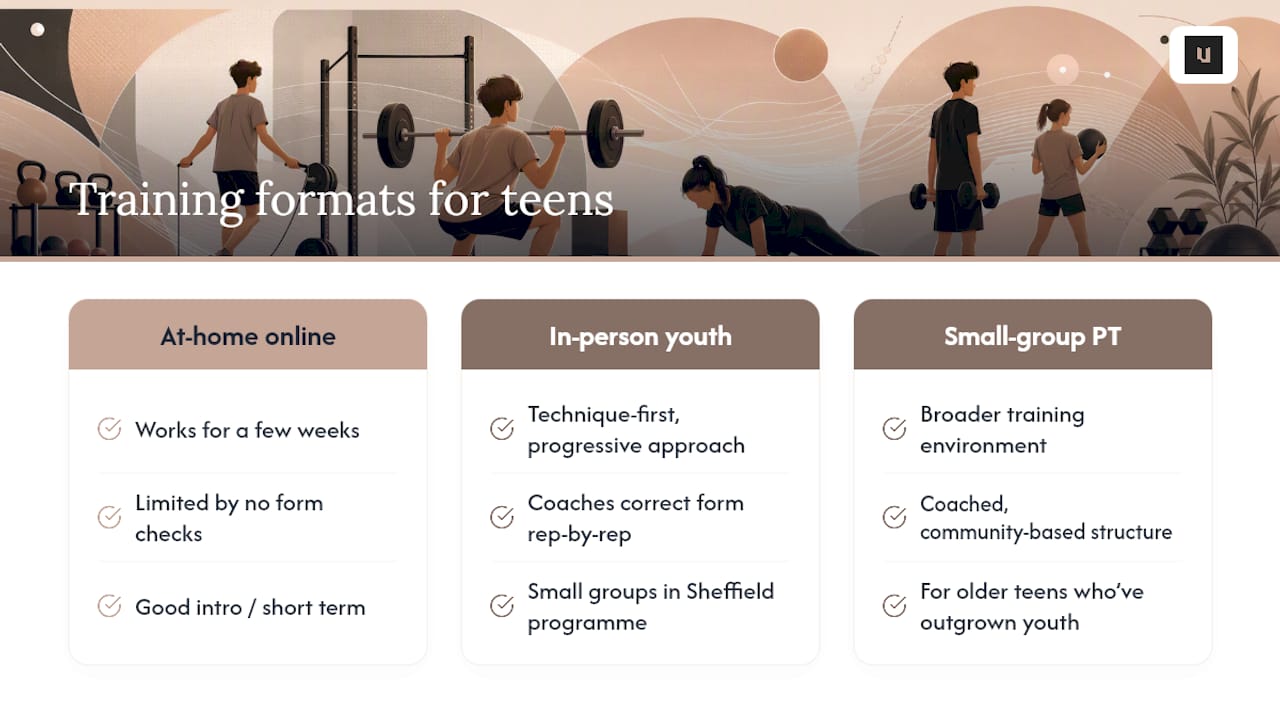
Following an online programme at home works for a few weeks, but most teens hit a ceiling without someone watching their form and adjusting the plan as they progress. That’s where a structured, in-person programme earns its keep.
Unit Health & Performance’s youth athlete programme in Sheffield runs small-group coaching focused on speed, agility, strength, and power for young athletes, built on exactly the technique-first, progressive approach covered throughout this article. Sessions stay small enough for coaches to correct form rep by rep rather than managing a crowd. For older teens ready for a broader training environment, small group personal training offers a similar coached, community-based structure once they’ve outgrown a purely youth-focused setup.
If you’re a parent in Sheffield wondering whether your teenager is ready to start, the simplest next step is booking an introductory session. Get in touch through the youth athlete programme page to arrange a taster and see how your teen responds to coached, age-appropriate training before committing to anything longer term.
This article is general information, not a substitute for advice from a qualified doctor. Consult a qualified healthcare professional about your own circumstances before acting on anything here.