For most adults, two to three fitness classes a week is the right place to start, and four or five is a sensible ceiling if the classes are hard and you recover well. Beginners should begin with two. Regular exercisers can build up. The best number is the one you can keep doing, week after week, for months.
This guide explains how to pick your number. We cover goals, experience, rest days, busy weeks and whether an unlimited membership is worth it. We keep the language simple and the advice practical.
There is no single magic number. The right number depends on three things: how long you have been training, how hard the classes are, and how much life you have around them.
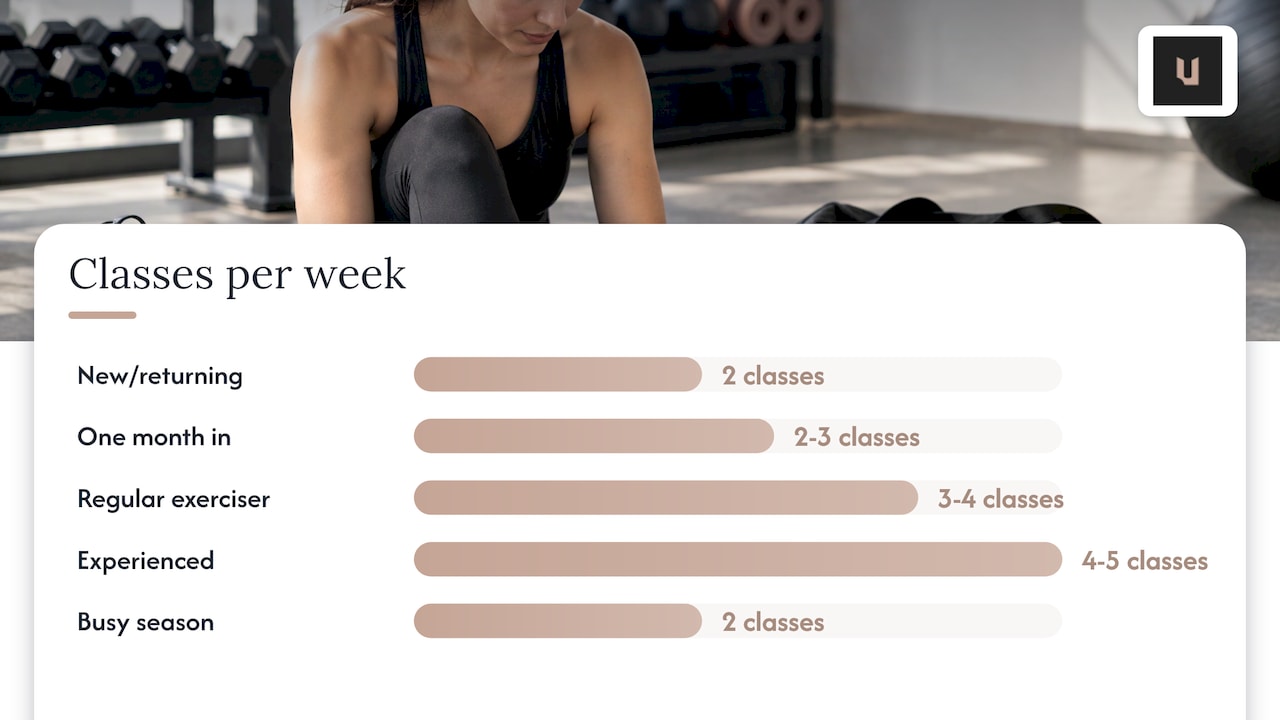
A useful rule of thumb comes from advice on getting the most out of exercise classes. It suggests beginners start with two sessions a week. After a month of two or three weekly, they can add another. Intermediate to advanced exercisers can aim for four to five higher-intensity classes a week.
Here is that in a simple table.
| Your situation | Classes per week | Notes |
|---|---|---|
| New to exercise or returning after a long break | 2 | Spend the first month learning the moves and getting used to it |
| A month or two in, feeling good | 2 to 3 | Add a third class only if you recover well between sessions |
| Regular exerciser, comfortable with effort | 3 to 4 | Mix hard and easier sessions |
| Experienced and training hard | 4 to 5 | Include one or two recovery sessions and plan rest days |
| Very busy season | 2 | Drop down rather than stopping completely |
These are starting points. Listen to your body and adjust.
Class numbers make more sense when you compare them with the national guidelines. The NHS guidelines for adults aged 19 to 64 say to do at least 150 minutes of moderate activity a week, or 75 minutes of vigorous activity. They suggest spreading it over four to five days, or every day.
The UK Chief Medical Officers also recommend that adults aged 19 to 64 do activities to improve muscle strength on at least two days a week.
Put those together and a simple weekly shape appears:
So three classes a week, if two of them include real strength work, already covers a lot of the guideline. You do not need to go every day.
Start with two classes a week. Your muscles, joints and tendons need time to get used to the work. Doing too much too soon is the most common reason new members drop out with sore legs and a bruised confidence.
In the first month, focus on three things: learning the movements, turning up on the same days each week, and finishing a class feeling you could have done a little more. That last point matters. You can always add later.
For strength, research on training frequency suggests that three sessions a week are suggested for beginners to build maximal strength, while two may be enough for people who are already trained. So a beginner who builds from two to three classes over the first couple of months is following sound logic.
If you have been exercising for a while, three or four classes can work well. The key is variety in effort. A hard strength class on Monday, a conditioning class on Wednesday and a steadier session on Friday gives your body a different job each time.
The same research suggests two, three and four weekly sessions beat one, five or six for building maximal strength. More is not automatically better.
Four or five classes a week is possible, but only if some of them are easier. A good mix includes one or two recovery sessions, such as yoga, stretching, a swim or a long walk, as set out in the exercise class advice above. Some athletes need two full rest days a week.
Many people assume that going more often means faster results. The evidence is more interesting than that.
A systematic review and meta-analysis of resistance training frequency found that higher frequencies tend to go with bigger strength gains, but this is largely down to total training volume, meaning the total amount of work done. When volume was matched, frequency itself made no significant difference.
In plain words: what counts is the total work you do across the week, not the number of separate visits. If two longer, well-coached sessions give you the same amount of quality work as four short ones, you can pick whichever fits your life. That is good news for busy people.
It also means that quality matters. One class where you are coached on technique and pushed at the right level can be worth more than three where you drift through.
You may see the letters FITT in fitness articles. They stand for frequency, intensity, time and type. FITT is a simple framework for planning workouts: how often, how hard, how long and what kind of exercise.
Class frequency is only the first letter. Here is how the four fit together:
The handy part is that you can change one letter at a time. If you want to do more but are tired, keep the frequency and make one class easier. If you hit a plateau, change the type of class before adding another day. This is also how we think about progress: one small change at a time beats a perfect plan.
Your body does not get fitter during the class. It gets fitter afterwards. Muscle repair and growth happen during rest and recovery rather than during the session itself.
Rest days can be especially helpful after a long or intense workout, and fatigue and extreme soreness can be signs you are pushing too hard. Watch for these:
If any of these show up, swap one class for an easier session or a full day off. If you have pain that is sharp, one-sided or does not settle, see your GP or a physiotherapist rather than training through it.
They are not the same thing. A passive rest day removes training stress completely. Active recovery means low-intensity movement, such as walking or yoga, that helps blood flow and tissue repair without adding tiredness, and it is meant to balance out hard training days.
A good week for a four-class exerciser might look like this:
| Day | Plan |
|---|---|
| Monday | Strength class |
| Tuesday | Walk or full rest |
| Wednesday | Conditioning class |
| Thursday | Gentle mobility or full rest |
| Friday | Strength or hybrid class |
| Saturday | Longer easy activity, such as a walk or a swim |
| Sunday | Rest |
If you want ideas for the easy days, we have a guide to low-load rest day routines. If you are over 40 and like the idea of steady, easy cardio on your off days, zone 2 training after 40 explains how to find a comfortable pace.
Most people do not fail because they picked the wrong number. They fail because the number did not survive a busy fortnight. A few habits help.
For a fuller plan built around a working week, see our realistic weekly plan for busy professionals.
Imagine you work long days, with a commute and a family. Four classes a week is a stretch. Here is a version that works:
This is modest, but it covers strength on two days, gives you movement spread across the week, and survives a bad week at work. Consistency of this kind beats an ambitious plan that lasts three weeks.
Strength matters more as we age, because muscle and bone both respond to regular loading. The good news is that you do not need many sessions to benefit. Two well-planned strength sessions a week is the baseline we build around, and it matches the UK guideline above.
Our guides go into more detail on how to do this:
If you are over 40, you may also find that recovery takes a little longer than it did at 25. That is normal. It is another reason to build in easy days rather than pushing for five hard classes a week.
An unlimited membership lets you go to as many classes as you like for one monthly fee. Whether it is worth it comes down to one question: how many classes will you really attend?
Here is a simple way to work it out. Take the monthly price of the unlimited option. Divide it by the price of one class in a pack or pay-as-you-go. The answer is your break-even number of visits. This is the same break-even method used when comparing class packs and unlimited memberships.
An invented example, just to show the sum: say unlimited costs £60 a month and one class costs £10. Your break-even is six classes a month. If you go twice a week, that is around eight to nine classes a month, so unlimited wins. If you go once a fortnight, it does not.
A few other things to think about:
If you plan to attend three or more times a week, unlimited usually makes sense. If you are not sure, start with a lower number and review after a month.
We coach people in Sheffield, many of them over 40 and many with busy jobs. The question we hear most is “how often should I come?” Our answer is nearly always: less often than you think, but with better coaching and a plan.
Our approach is small group personal training. That means a small group, a coach who knows you, and a plan built around your needs. In a small group, each session has a purpose. Two or three sessions a week with that focus can do more for you than five classes where nobody notices what you are doing.
We also pay attention to the mind as well as the body. People stay with training when it feels welcoming and not intimidating. A friendly room and a community who notice when you are missing is a big part of why our members keep turning up, and turning up is what delivers results.
For our adult members, we like to see a base of two strength-focused sessions a week, with extra classes added as energy and schedule allow. For young athletes, we build speed, agility, strength and power work around school and sport, and we plan their weeks so they recover as well as train.
The number on your weekly timetable matters less than whether you can keep it going for a year. Build a week you can repeat.
Vitalij
If you want help choosing your number, we can build it with you. At UNIT Health & Performance in Sheffield we offer small group personal training with individual plans, so your weekly sessions match your goals and experience. We also run unlimited fitness classes for adults, including conditioning and hybrid sessions, for people who like variety and want to come as often as suits their week.
If you have a young athlete in the family, our SpeedAcademy and SuperStrong programmes focus on speed, agility, strength and power, led by an experienced strength and conditioning coach. Get in touch through our website and tell us how many days you can realistically train. We will help you build the rest.
If you are still unsure, work through these steps.
For most people, there is no fixed limit, but warning signs matter more than numbers. If you have lasting soreness, poor sleep, low energy or your performance is dropping, you are doing too much for your current recovery. Cut back by one class or make one easier. Some very active people need up to two rest days a week.
Yes, for many people, especially beginners and busy adults. Two sessions a week can reduce the risk of heart disease or stroke, according to the NHS, and if both include strength work you meet the UK strength guideline of two days a week. Add a walk or a third class when you can.
You can, if most of the classes are easy or different in type, such as mixing gentle mobility with harder sessions. Several hard classes back to back leave little time for repair. Most people do better with one or two easier days or rest days each week.
It depends on the price. Divide the monthly cost by the price of a single class to find your break-even number of visits. If you go twice a week, you will make around eight or nine visits a month, so unlimited often comes out ahead if the break-even is lower than that.