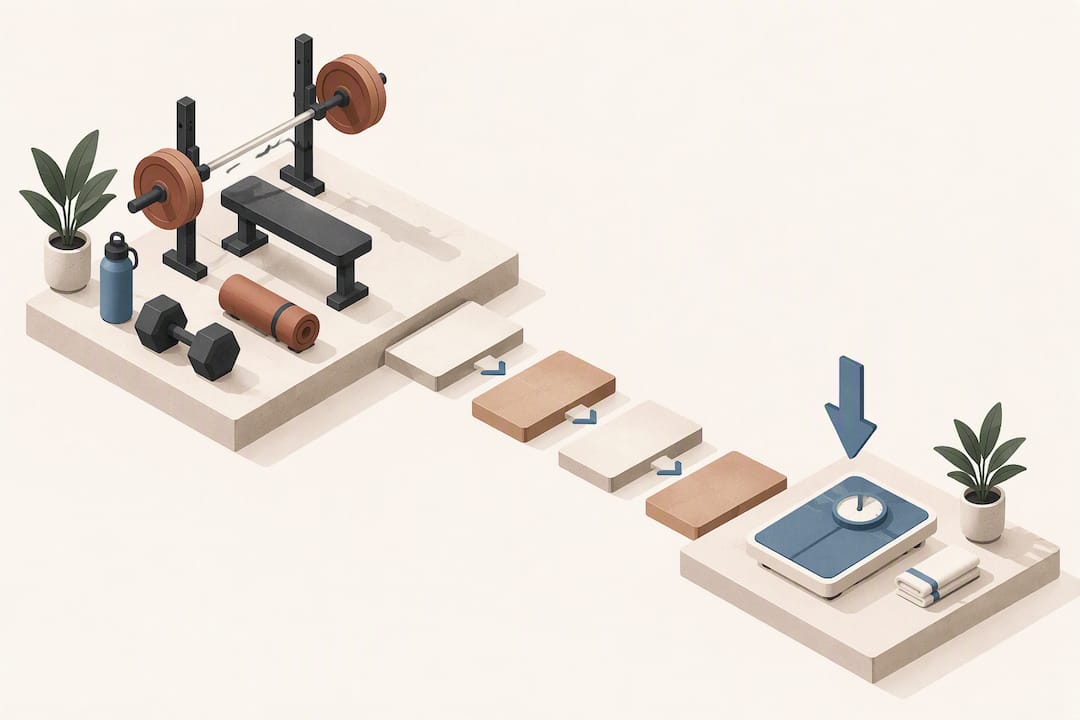
Farmer’s carries build grip, core stability and practical carrying strength while also giving your heart and lungs a solid conditioning workout. Picking up a weight in each hand and walking trains muscles the way daily life actually demands them. Heavier is not always better: technique and recovery matter more than the number on the weight. If you’re unsure where to start, a coached session can help you judge load and form safely.
TL;DR:
- Using lighter weights with proper form and controlled pace yields better strength and endurance benefits than lifting heavier loads with poor technique.
- The exercise emphasizes grip, core stability, and posture, directly improving everyday tasks like lifting luggage or handling boxes.
- Carrying loads over longer distances or time increases cardiovascular demand and trunk muscle activation more than static holds or head carriage.
- Variations such as suitcase or trap-bar carries target different muscles and imbalances, allowing tailored progressions based on goals.
- Training volume should be carefully managed to avoid overuse injuries, with one to three sessions weekly depending on recovery and goals.
The farmer’s carry is a loaded walk: you hold a weight in each hand, brace your core and walk a set distance or time. You might also see it called a farmer’s walk or loaded carry, and it shows up everywhere, from strongman competitions to Hyrox races to general strength classes, because it mimics something almost everyone already does.
That’s the appeal. The exercise trains the same muscles and movement patterns involved in:
Because it demands grip, posture and coordinated effort all at once, the farmer’s carry sits closer to real life than most gym machines ever will.
Good technique keeps the exercise safe and effective. Follow these steps:
Keep your shoulders back and down rather than hunched forward, and avoid taking a too-wide stance, which can throw off your balance and shorten your stride, as detailed in this advice on proper pitching posture benefits for young players that highlights safe posture cues during loaded movements.
Common mistakes include loading too heavy too soon, rounding the back during pick-up and letting the weights swing instead of staying close to the body. Each of these raises injury risk without adding any benefit.
Pro Tip: Treat the unload as part of the lift, not an afterthought: a controlled, hinged lower-down protects your back and toes just as much as a good pick-up does.
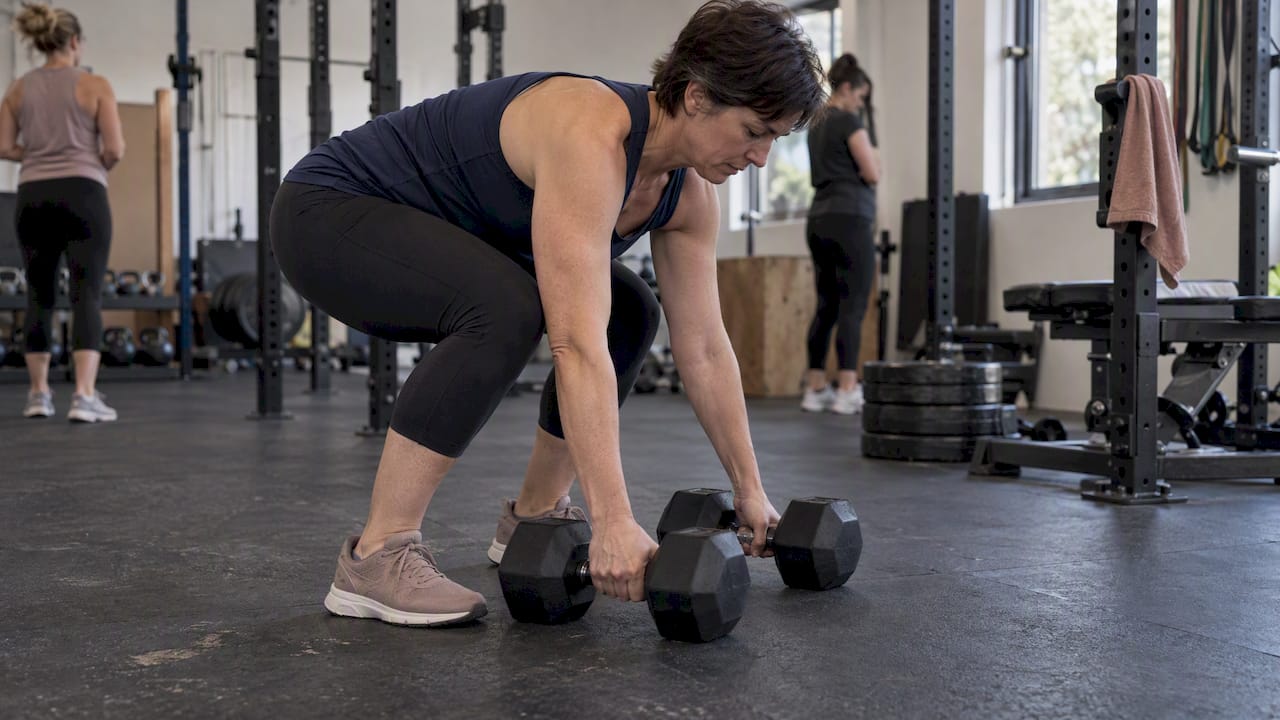
Build the habit of resetting your grip and posture before every rep rather than rushing straight into the next set.
Farmer’s carries recruit a wide stretch of the body at once:
A systematic review of strongman exercises found that farmer’s walks produce high activation in the trunk and back muscles compared with other loaded-walk variations, with notable differences in erector spinae and latissimus engagement. The same review is careful to note that muscle activation alone doesn’t prove an exercise delivers a specific real-world outcome: programming and recovery still decide the result.
A small gait study from Aston University found that carrying a load in both hands produced a walking speed of 1.02 metres per second, compared with 0.82 metres per second when the same load was carried on the head. That’s a meaningful difference in efficiency, though the sample size was small and the findings may not generalise to every population. The same research recorded a rise in heart rate during loaded walking compared with walking unloaded, pointing to a genuine cardiovascular demand built into the movement.
The physiology translates into benefits you’ll notice outside the gym.
Background research on dynamic carries indicates that walking with a matched load produces higher trunk muscle activation than holding the same load still, suggesting the movement under load trains the core differently to static exercises.
One systematic review found significant differences in lumbar activation and stride length between the farmer’s carry and the Zercher carry, which means your choice of carry variation genuinely changes what you train. These benefits transfer well to sports and daily tasks that involve carrying, pulling or stabilising under load, though they shouldn’t be mistaken for a guarantee against injury or disease: a carry is one tool among many in a balanced training plan.
Different carry variations suit different goals:
Choose suitcase carries when you want unilateral core work, and trap-bar carries when you want to protect a sensitive lower back while still loading the body.
For progression, increase distance or time before you increase weight. A simple four-week plan might move from two sets of 20 metres in week one, to three sets of 30 metres by week four, keeping the load the same throughout before adding weight in week five.
Start with a weight you can carry while keeping your posture and stride controlled throughout, not the heaviest load your grip can momentarily hold. Grip often fatigues before the rest of the body, so let it guide your starting point.
Two session styles work well:
One to three sessions a week is a sensible range depending on your goal and how well you recover between sessions. Military and civilian load-carriage research shows that ground reaction forces rise in proportion to the load carried, and that injury risk climbs when loads or training volume get excessive, even though lighter loads still produce a useful training effect.
Pro Tip: If your gait starts to break down, your grip gives out well before your legs do, or soreness lingers more than two days, treat that as a signal to deload rather than push through.
Watch for persistent lower-back discomfort, numbness in the hands or a noticeably uneven stride: any of these are reasons to scale back or get a coach to check your technique.
We build farmer’s carries into small-group training programmes gradually, focusing on safe technique and objective progression while monitoring for signs of fatigue or risk.
That kind of oversight helps members complete tracked workouts safely and effectively. We’ve written more on load selection and progression in our advanced strength class guide and on protecting movement quality under fatigue in our injury prevention guidance.
Farmer’s carries suit most adults chasing practical, everyday strength, and they’re forgiving enough to scale from light dumbbells to serious loads over time. If you have uncontrolled back pain, severe balance issues or a significant strength imbalance between sides, other exercises or guided rehab work deserve priority first. If you’re pushing load up quickly or feeling pain rather than fatigue, that’s the moment to bring in a coach rather than guess.
— Vitalij
Learning a loaded carry properly is far easier with someone watching your setup, pick-up and stride than working it out alone in a corner of a gym. Our Small Group PT sessions build carries into individualised plans, with coaches adjusting load and distance as your technique and recovery allow.

If you want a programme that progresses carries and grip work alongside your training, get in touch to check availability for a session.
Most sessions use distances of 15 to 20 metres per set, depending on whether you’re training for strength or conditioning. Shorter, heavier carries suit strength goals, while longer, lighter carries suit conditioning work.
The effect depends on consistent, well-programmed training rather than the exercise alone.
Daily heavy carries raise the risk of overuse injury, since load-carriage research links higher loads and training volume to increased ground reaction forces and injury risk. Lighter daily carries can be tolerable for some people, but most benefit from one to three sessions a week with proper recovery between them.
There’s no single ideal weight: the right load is one you can carry for the full distance or time while keeping your posture, stride and grip under control. Start lighter than feels necessary and progress distance or time before adding weight.