
What if the secret to your child’s next big performance isn't more time on the pitch, but more time spent building the resilience to stay there? It is heart-breaking to watch a talented young player sidelined by a preventable strain, especially when academy-level demands push growing bodies to the l...
What if the secret to your child’s next big performance isn't more time on the pitch, but more time spent building the resilience to stay there? It is heart-breaking to watch a talented young player sidelined by a preventable strain, especially when academy-level demands push growing bodies to the limit. We know you want to protect their health whilst helping them reach their goals, but finding the right injury prevention training young athletes need can be a challenge amongst so much conflicting advice. You want a clear path that balances progress with safety.
In this article, you will discover how to balance intense training with essential rest and why a coach-led environment is the safest way to boost performance. We will walk you through a practical plan to keep your child active, confident, and performing at their best throughout 2026 and beyond. Whether your child is just starting out or is already part of a professional academy, these steps will help you build a foundation that lasts a lifetime.
• Learn how the "growth spurt gap" creates hidden risks and how to adjust physical activity when bones grow faster than muscles can adapt.
• Discover why professionally guided strength sessions are the most effective form of injury prevention training young athletes can use to build long-term resilience.
• Apply the "10% rule" to manage training loads safely, ensuring your child avoids repetitive stress whilst maintaining their competitive edge.
• See why a coach-led environment provides the expert attention and safety that unsupervised, standard 24/7 gyms simply cannot offer.
Growing up is physically demanding. During a growth spurt, bones often elongate faster than the surrounding muscles and tendons can stretch to match. This biological "Growth Spurt Gap" leaves young players feeling temporarily clumsy and tight, which significantly increases the risk of sports injuries. Most issues aren't sudden accidents; they are overuse injuries. These happen when repetitive stress is applied to the body without giving it adequate recovery time. In Sheffield's competitive academy environments, the pressure to keep up often leads to a "too much, too soon" culture. We focus on building "robustness," which means developing a body that can handle the specific loads of high-level sport.
It's vital to distinguish between normal muscle soreness and "red flag" pain. If your child feels sharp, localised pain that doesn't fade after a warm-up, it's a sign to slow down. Common issues like Osgood-Schlatter (knee pain) or Sever’s disease (heel pain) frequently flare up during these growth phases. Catching these signs early during injury prevention training young athletes can stop a small niggle from becoming a months-long layoff. A professional coach often spots subtle changes in movement patterns before the athlete even feels the discomfort.
Focusing on one sport year-round might seem like the quickest path to the top, but it often leads to burnout. Research indicates that 88% of NFL draft picks were multi-sport athletes because varied movements build a more resilient nervous system. By joining a structured youth athlete program, children learn to move in ways their primary sport doesn't require. This variety is a core part of injury prevention training young athletes, ensuring they build a broad physical foundation rather than just repeating the same limited motions. Building this variety helps the brain and body organise movement more efficiently.
Many parents worry that lifting weights will stunt their child's growth. Modern sports science has thoroughly debunked this myth. In reality, age-appropriate resistance work is the ultimate proactive tool for safety. It builds "neuromuscular control," which essentially means we are teaching the brain to coordinate movements safely and efficiently. This is why our Youth Athlete Program prioritises these foundations long before adding significant weight. By building this muscular "armour," players in contact sports like rugby or football can better absorb impacts and protect their joints during collisions.
Success isn't just about getting stronger; it's about moving with precision. We focus heavily on teaching athletes how to land from a jump, decelerate quickly, and change direction without putting excessive strain on their knees or ankles. These are essential injury prevention tips for young athletes that translate directly to match-day performance. Technique is our non-negotiable rule. For instance, core stability is vital because it protects the spine during high-speed rotations. This technical focus is exactly why injury prevention training young athletes is so effective for long-term physical development.
Physical strength brings a massive boost in mental confidence. When a young person feels physically capable, they often lose that nagging fear of getting hurt. This allows them to play with more freedom and focus on the pitch. Coach-led sessions also foster a sense of discipline and body awareness that a standard, unsupervised gym environment simply cannot match. If you're curious about how a structured approach could benefit your child, feel free to chat with our coaching team about their specific sporting goals and how we can help them stay resilient.
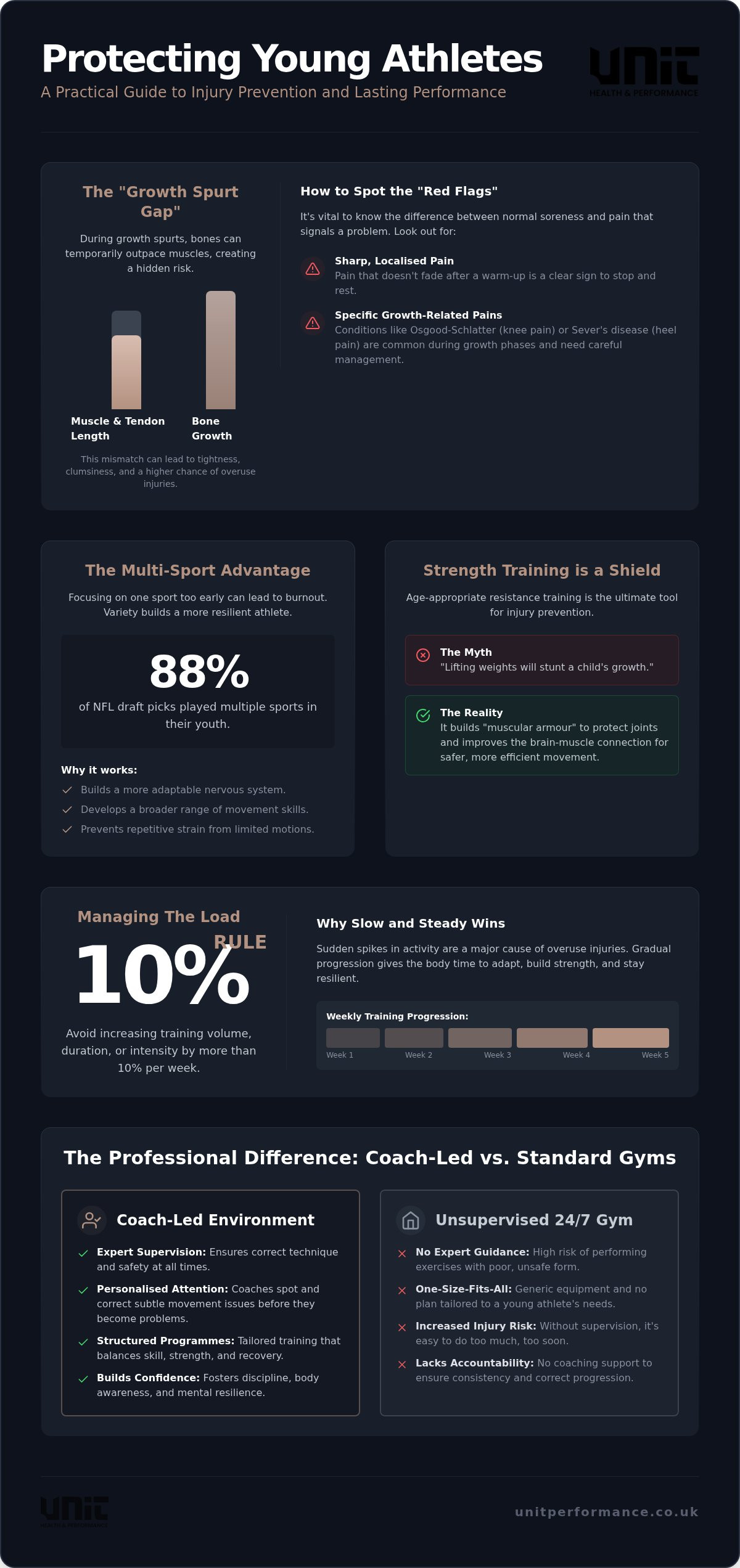
Load management is a simple way to track how much physical work your child is doing. One of the biggest risks for teenagers is a sudden spike in activity. We follow the 10% rule; avoid increasing training intensity or duration by more than 10% each week. This steady progression is a vital part of injury prevention training young athletes, allowing their bodies to adapt whilst staying safe. For a wider look at development, see our Youth Athlete Training Sheffield pillar guide.
Recovery isn't about expensive gadgets; it's about the basics. A growing body needs more rest than an adult's to repair tissues and process new movement patterns. We focus on three core areas to ensure every training programme is effective:
Aim for 9 to 10 hours to support physical and mental repair.
Prioritise whole foods to support growth and energy levels.
Use light movement to stay mobile without adding stress.
It's often a struggle to balance school PE, club practice, and gym sessions. We recommend including "deload weeks" every month or so. During these periods, we reduce the intensity to let the body catch up on repairs. You can monitor this at home using a Rate of Perceived Exertion (RPE) scale. Ask your child to rate their fatigue from 1 to 10 after a session. If they're always at a 9, they need a break.
Young athletes need time away from competitive pressure to focus on their development. The summer months are the ideal time to address physical imbalances and build a base for the coming season. This downtime is a key phase of injury prevention training young athletes, as it allows the nervous system to recover and prevents burnout. If you're unsure how to structure your child's week, contact our Sheffield team to discuss a tailored plan.
For many Sheffield parents, the idea of their teenager in a standard 24/7 budget gym is worrying. Without proper supervision, young lifters often mimic what they see on social media, which frequently leads to poor form and unnecessary strain. At Unit Health & Performance, we provide a professional, coach-led environment where safety is the non-negotiable priority. Our Small Group Personal Training (SGPT) model ensures every teen receives individual attention whilst training amongst a supportive community of peers. This unique blend of expert guidance and social motivation is why our injury prevention training young athletes programme is the ideal proactive solution for academy-level players.
Every session is structured to build skills progressively. We begin with a dynamic warm-up to prepare the nervous system, followed by specific movement skills like landing, jumping, or sprinting. The core of the session focuses on strength work, always ending with high-energy, fun finishes. We track progress through consistency and movement quality rather than rushing into heavy weights too early. Our commitment to Long-Term Athletic Development (LTAD) ensures we focus on building a robust foundation that serves the athlete for years, rather than chasing short-term gains that might lead to burnout.
Choosing a training environment is a significant decision. We invite you to visit our centre for a low-pressure look at the "vibe" and to meet our specialist coaches. We don't work in isolation; we often collaborate with local club coaches to ensure our injury prevention training young athletes supports your child's specific sporting goals. Seeing the facility first-hand helps reduce any anxiety about gym culture and shows how we foster a sense of belonging. If you're ready to help your child stay on the pitch and perform at their peak, book a consultation for your young athlete today.
Building a body that can withstand the demands of modern sport is a long-term commitment rather than a quick fix. By understanding the growth spurt gap and respecting the 10% rule for load management, you're already helping your child stay ahead of the curve. We've shown how structured, expert-led strength work acts as physical armour, protecting joints and boosting match-day confidence. Our specialised Youth Athlete Training programme in Sheffield is designed specifically to bridge this gap, providing the professional environment your child needs to thrive.
With a proven track record of supporting local academy-level sportspeople, our coaches focus on long-term health rather than short-term gains. We believe that injury prevention training young athletes is the smartest investment you can make in their sporting career. It's about keeping them on the pitch, happy, and performing at their absolute peak. Secure your young athlete's future; contact us for a consultation at our Sheffield facility. Your child has the talent; we have the expertise to help them protect it.
Strength training is exceptionally safe for children when supervised by qualified experts. Modern research proves it doesn't stunt growth; it actually improves bone density and strengthens tendons. We prioritise movement quality and bodyweight control before introducing any external resistance. This approach builds a resilient body that's better prepared for the physical contact found in rugby or football, making it a cornerstone of long-term athletic health.
Two or three sessions per week is the ideal frequency for most developing athletes. This schedule provides enough stimulus to build robustness without interfering with school PE or club matches. Consistency is the most important factor here. Regular sessions help the brain and muscles work together more effectively. We always monitor their total weekly workload to ensure they aren't doing too much during busy tournament periods or cup runs.
Structured gym work is often the best way to manage conditions like Osgood-Schlatter or Sever's disease. These pains occur when growing bones pull on tight tendons. Specific injury prevention training young athletes helps by strengthening supporting muscles and improving overall flexibility. This reduces the mechanical stress on sensitive growth plates. By addressing these imbalances in the gym, your child can often continue playing their favourite sports with significantly less discomfort.
Children can safely begin a structured programme from age seven or eight. The early years focus on "movement literacy," which involves mastering fundamental skills like balance, coordination, and landing technique. It's about making movement fun and building a positive relationship with the gym. As they mature, we transition into more specific injury prevention training young athletes to help them handle the increased intensity and physical pressure of competitive academy environments.
Overtraining shows up as persistent fatigue, irritability, or a loss of interest in sport. Whilst normal tiredness fades after a rest day, overtraining lingers and often comes with nagging "niggles" that won't heal. Watch for changes in sleep patterns or a sudden decline in performance. If your child feels constantly drained, they likely need a deload week where training volume is reduced to allow their nervous system to recover fully.