If your heels lift, your chest drops forward or you feel like you are falling backwards when you squat, stiff ankles are a common cause. The good news is that you can check them in two minutes against a wall. You can then improve them with a short routine done before your lower-body sessions. Most people need several weeks of steady work to see a lasting change.
This guide keeps things simple. You will learn how to test your ankles, what the result means, which exercises to do, how deep you should squat and when to get advice.
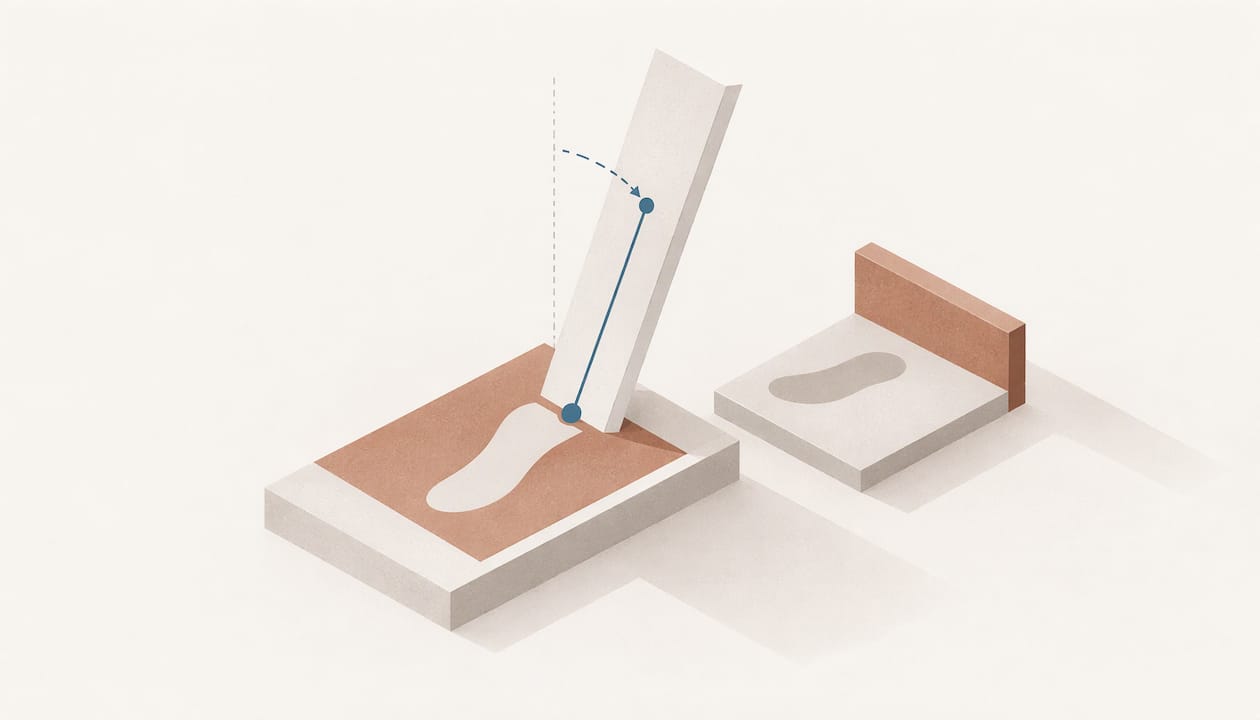
To squat, your knees travel forward over your toes while your heels stay down. The movement that allows this is called ankle dorsiflexion: your shin moving towards the top of your foot. If that movement runs out early, your body finds the range somewhere else. Your heels might lift, your chest might fall forward or your knees might drift inwards.
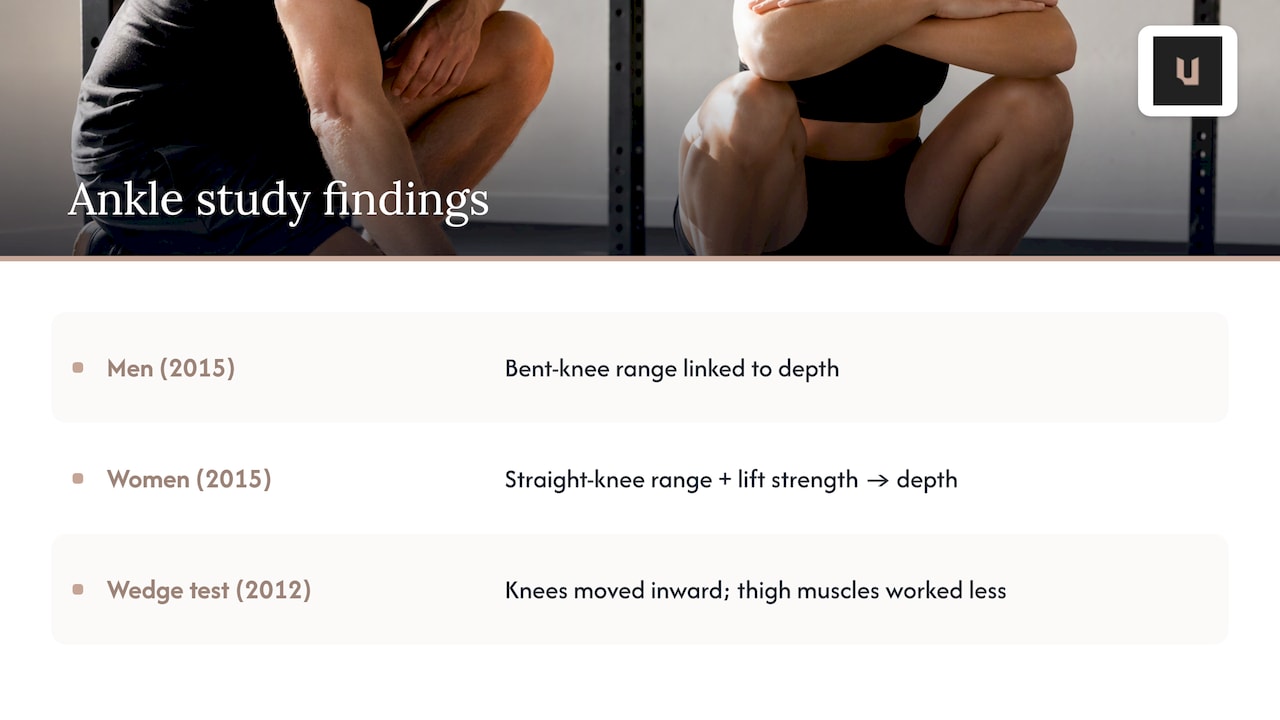
Research backs this up. A 2015 study found that ankle dorsiflexion range with a bent knee was linked to squat depth in men, while dorsiflexion with a straight knee and the strength of the muscles that lift the foot were linked to depth in women. In other words, both flexibility and strength at the ankle play a part.
There is also a knee link. In a 2012 laboratory study, researchers limited ankle dorsiflexion with a small wedge under the forefoot. During a double-leg squat the knees moved further inwards and the thigh muscles worked less. Those changes resemble what is seen in people with pain at the front of the knee.
A UK physiotherapy clinic describes the feel of it well. If you cannot hinge properly at the ankle, you may feel like you are falling backwards and struggle to keep your chest up. That can put extra strain through the hips and knees.
This does not mean every wobbly squat is an ankle problem. Hips, strength, balance and technique matter too. But the ankle is quick to check and often easy to improve, so it is a sensible place to start.
The simplest check is the knee-to-wall test, also called the weight-bearing lunge test. You need a wall, a tape measure or ruler and a bit of floor space.
A UK physiotherapy practice describes a distance of 10 to 12 cm as generally adequate for a full-depth squat without compensation.
Small details change the number. Researchers who looked at this test suggest four rules: keep your weight on the leg being tested, place the back foot in the same position each time, avoid cheating with the hips or trunk, and check that the heel does not lift. A friend can press a finger on your heel to feel it rise.
Use the same wall, the same footwear (or none) and the same time of day when you retest. Earlier work found the test to be highly repeatable, with a change of about 1 cm needed on one leg before you can be confident it is real and not just measuring noise. Another source puts the margin at 1.9 cm, so treat very small changes with care.
Use the table as a rough guide, not a diagnosis.
| Toe-to-wall distance | What it usually means | What to do |
|---|---|---|
| 10 cm or more on both sides | Enough ankle range for most squats | Keep the range with a short warm-up and look at hips, strength and technique if the squat still feels off |
| 9 to 10 cm | Around the lower end of normal | Add the routine below two or three times a week |
| Under 9 cm | Likely to limit depth | Do the routine before every lower-body session and retest every two weeks |
| More than 1.5 cm difference between sides | A meaningful gap between your legs | Work the tighter side a little more and see a physio if it does not shift |
The figures come from a 2025 review, which reports normal values of more than 9 to 10 cm on this test and treats differences between sides above 1.5 cm as clinically relevant. A UKSCA article notes that healthy people have scored anywhere from 9.5 to 14 cm. So your number is a starting point, and your own side-to-side balance matters as much as any target.
It also helps to know that you do not need your full ankle range to squat. A 2020 study found that the ankle angle used in a deep squat is smaller than the maximum the ankle can reach. Limited range can still hold you back, but you do not need to be extremely bendy.
The aim is a simple order: free up the joint, release the calf, then use the new range under load. A UK physio clinic frames it as a process, not a one-off fix. Range you do not use tends to disappear again.
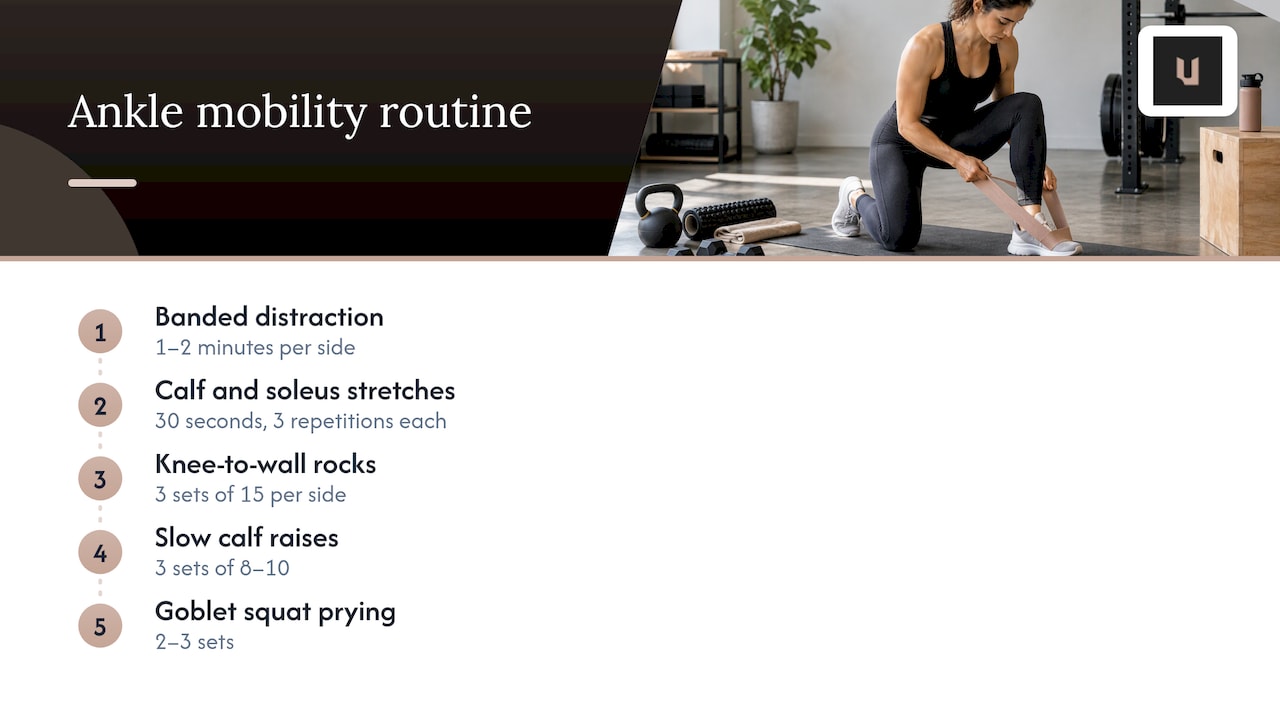
The routine below follows that order. It takes about 10 to 12 minutes.
Anchor a resistance band low and loop it around the front of your ankle, with the band pulling you backwards. Step forward to create tension, then rock your knee over your toes. The band gently pulls the ankle bone back to give the joint more room. Move slowly and keep your heel down.
The calf has two main parts. For the big outer muscle, stand with your back leg straight and your heel down, and lean into a wall. For the deeper soleus, keep the back knee bent while the heel stays down. Physiotherapists at a UK clinic suggest holding each stretch for 30 seconds and repeating it 3 times.
If you prefer to roll, a lacrosse ball or foam roller on the lower calf works for the soleus. Spend a minute on each leg on any tender spot, then move on.
Use the same set-up as the test. Rock your knee towards the wall, keeping your heel flat, then return. Go as far as you can with control. This is also a good moment to notice which side feels tighter.
Stand on the edge of a step. Rise up on two feet, then lower for 3 to 5 seconds. The slow lowering phase builds strength at the end of your range, which helps your body accept it. If this is easy, switch to one leg.
Hold a light dumbbell or kettlebell at your chest and squat down as deep as is comfortable. Sit in the bottom for a few seconds, pushing your knees gently out with your elbows and shifting your weight slightly from side to side. Then stand up. Adding a 3-second pause at the bottom of your normal squats does the same job under heavier work.
The UKSCA article says self-mobilisation work should be done firmly, at a level similar to a grade III or IV joint mobilisation, and that people should be screened by a medical professional before a joint mobilisation plan. It also says self-mobilisations may not work well if the limit comes from tight soft tissue. That is a good reason to see a physio if nothing changes.
For a wider warm-up that also covers hips and upper body, see our 10-minute warm-up for strength training. If you want ideas on how athletes move from joint mobility into loaded work, these warm-up routines for athletes show the same safe progression.
Do the routine before every lower-body session. On rest days, a shortened version of banded work, calf stretches and knee-to-wall rocks takes about five minutes.
Be patient. The same physio clinic says real, lasting change in connective tissue and joint mechanics typically takes 6 to 8 weeks of consistent input. One lifting blog reports that many lifters notice improvement in 3 to 4 weeks with a daily 10-minute programme. NHS guidance on ankle exercises is more cautious again: for ankle problems it is normal for it to take 6 to 12 weeks to see a good improvement in movement and strength.
So plan on about six weeks, retest every two weeks and judge progress by the trend. Write the numbers down. A move from 8 cm to 9.5 cm is real progress, even if it feels small.
The honest answer is: as deep as you can go while keeping your heels down, your back steady and your knees tracking over your toes, without pain. Depth is a range, not a target.
If you compete in powerlifting, there is a rule. In UK federations such as the UKIPL and the YNEPF, the top of the legs at the hip joint must go lower than the top of the knees. That is a sport rule, not a health standard.
For everyone else, a useful way to think about depth is in three levels:
If you are a beginner, start with a box or bench behind you and gradually lower the height. If you are over 40, you can take the same approach: use a depth you can control and build from there. Our guide to strength training over 50 shows how to start with two simple sessions a week.
You do not have to stop squatting while you work on your ankles. A few small changes can make the movement more comfortable.
If squatting makes your knees uncomfortable, change the movement rather than skipping leg training. Options that many people find friendlier include:
Our articles on strength training with knee pain and joint-friendly workouts set out plans in more detail. If you have been diagnosed with knee osteoarthritis, ask your GP or physiotherapist which exercises suit you, then bring that advice to your coach so the plan can be built around it. The hip hinge guide is a good companion for the hinge options above.
We see stiff ankles in our gym every week, and they are rarely the only thing going on. Someone who cannot sit into a squat might also have tight hips, a weak core or simply no practice. That is why we do not hand out the same mobility list to everyone.
In our small group personal training sessions, a coach watches how each person squats and adjusts the plan to suit them. One member might need a box and a slower tempo. Another might need a short ankle drill before they load up. Because the groups are small, those changes happen on the spot, not in a spreadsheet you read later.
We design our training for people who want to get stronger and fitter in a way they can keep doing for years, particularly adults over 40. That means building range and strength together, using weights you can control, and in a friendly environment where nobody is judging your depth.
If you are working on your ankles at home, keep it simple: test, do the routine, retest. If you would rather have someone watch and guide you, we are here.
Vitalij
Stiffness that eases with a good warm-up is usually nothing to worry about. Pain is different. The NHS suggests seeing a GP if ankle pain stops you doing normal activities, keeps getting worse or keeps coming back, has not improved after two weeks of home treatment, comes with tingling or loss of feeling in the foot, or happens in someone with diabetes who has foot pain.
The same NHS page says to call NHS 111 if the pain is severe, you feel faint or dizzy from it, your ankle or foot has changed shape or sits at an odd angle, you heard a snap or grinding noise when you hurt it, or you cannot walk. These can be signs of a broken ankle or an infection.
If you have done a few weeks of stretching and your range has not improved, a physiotherapist can look at the joint itself. The UK clinic advice is to see one if movement has not got better after a few weeks of stretching.
If you would like a coach to look at your squat, we can help. At UNIT Health & Performance in Sheffield, our small group personal training is built around the individual. Your coach checks how you move, adjusts your exercises and keeps every session purposeful, so you build strength and range at a pace that suits you.
If you prefer a more social session, our fitness classes offer another way to train in a supportive, non-intimidating community. Parents of young athletes can also look at our youth athlete programmes, which cover speed, agility, strength and power. You can also start at our home page to see what suits you.
Use a simple order: free up the joint with banded ankle work, stretch the calf and soleus, then load the new range with slow calf raises, goblet squats and pauses at the bottom. Do it before lower-body sessions and give it 6 to 8 weeks. Retest with the knee-to-wall test every two weeks.
Ideally yes, because it keeps your balance and lets you use the full range. A small heel lift at the bottom is a common cue and not usually serious. If your heels rise early, use a wide stance, a goblet hold or a short-term wedge while you improve your ankles.
Start with a box or bench at a height you can sit to and stand from comfortably, then lower it slowly over weeks. Depth below parallel is optional unless you compete in powerlifting. Control and pain-free movement matter more than how low you go.
Yes, gentle work such as knee-to-wall rocks and calf stretches is fine daily for most people. Keep it comfortable and stop if you feel sharp pain. If pain lasts beyond two weeks of home care, speak to your GP.
Try box squats, split squats, step-ups or sit-to-stands, and keep the weight light at first. Choose a depth that feels comfortable. If knee pain is persistent or you have a diagnosis such as osteoarthritis, ask your GP or physiotherapist what is right for you.