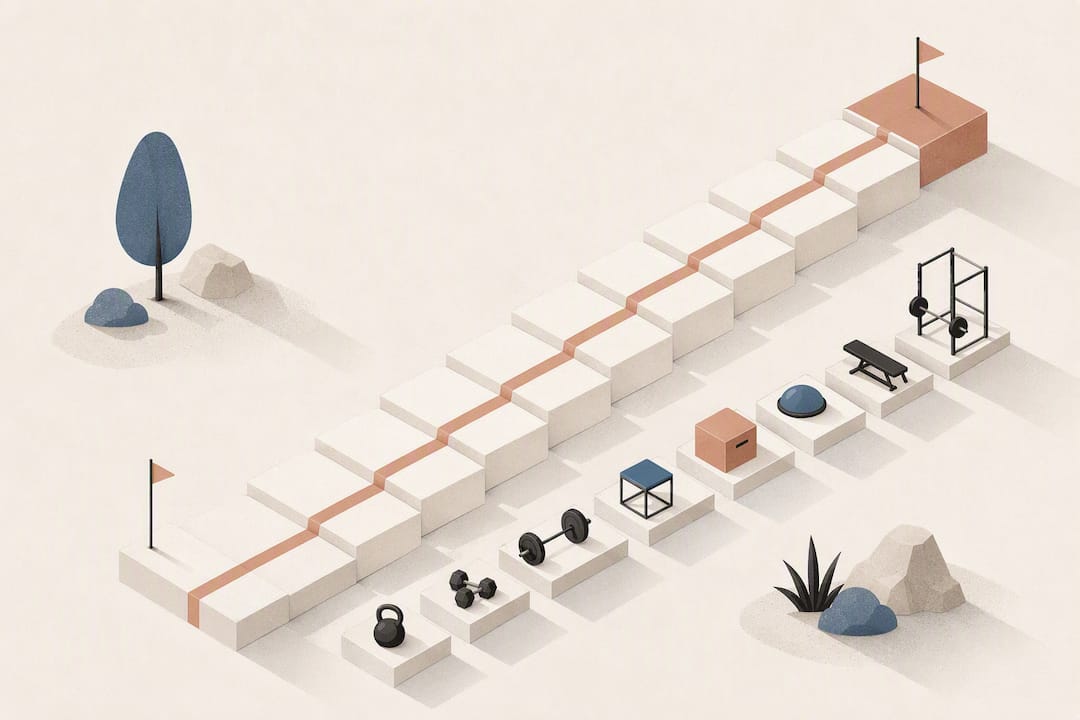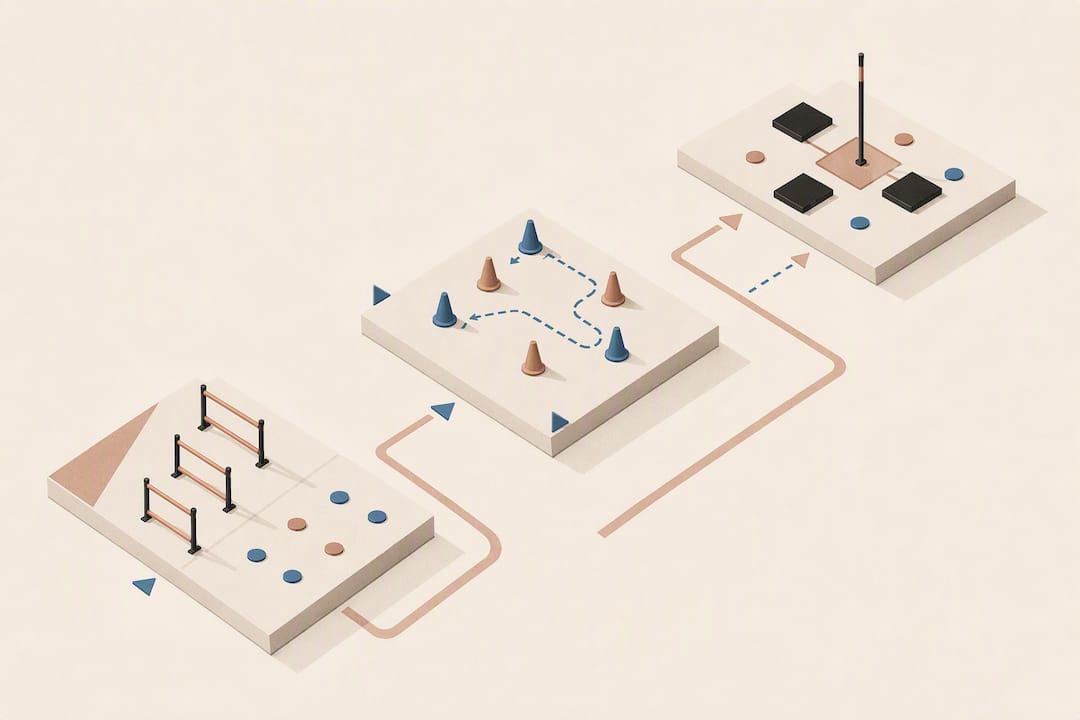
Start with fun, varied movement, not drills. Fundamental movement skills come first, followed by braking control and basic strength, with reactive, game-based agility layered in as children mature and can handle unpredictable decisions. Progress only when technique holds up under fatigue, and expect a staged programme, like the one UNIT Health & Performance runs for young athletes, to look very different at age seven than at fifteen.
TL;DR:
- Children should progress from fundamental movement skills to change-of-direction speed before adding reactive agility, with training stages tailored by age.
- Short, frequent agility sessions of 20 to 25 minutes are more effective than longer, less frequent ones for improving reactive agility in youth athletes.
- Injury prevention relies on mastering deceleration and braking control, emphasizing eccentric strength and neuromuscular stability before introducing unpredictable reactive drills.
- Play-based, game-like activities such as tag and animal runs are crucial for building agile movement patterns in children aged 5 to 8.
- Coaches and parents should prioritize proper sequencing, movement quality, and enjoyment over speed or complexity to ensure safe and effective agility development.
Agility training for youth means teaching a child to change direction, decelerate, and react to a moving situation, whether that’s a ball, a teammate, or an opponent. It sounds simple. It isn’t, because agility is really three different skills bundled into one word, and each develops on its own timeline.
The building blocks are fundamental movement skills (FMS) such as running, jumping, hopping, and landing; change-of-direction speed (CODS), which is the ability to plant, brake, and redirect at pace; and reactive agility (RAT), which adds a decision under time pressure. A systematic scoping review of youth agility research found that agility is genuinely trainable at every age, but the mechanisms behind improvement shift as children grow, so a drill that works brilliantly for a nine-year-old can fall flat, or even backfire, with a five-year-old who simply isn’t ready for it (PMC, 2022).
That’s the whole case for staging. Train FMS before CODS, and CODS before genuine reactive agility, adjusting the mix as the child’s body and brain catch up with each other.
Session length should track attention span as much as fitness. Younger children do best with 15 to 20 minutes of focused work wrapped inside a longer, game-heavy session; teenagers can sustain structured blocks of 20 to 25 minutes, which happens to match the session length that shows up repeatedly in the dose-response literature on agility training. Plyometrics enter gradually, hopping and landing games from around age 7, low box jumps and skater hops from around 9 to 10, and only once a child can land a jump with control should you add horizontal speed or reactive elements on top. Basic strength work, bodyweight squats, lunges, and simple carries, fits naturally alongside this from the pre-teen years, well before anyone touches a barbell.
The confusion between FMS, CODS, and reactive agility causes more wasted training time than almost anything else in youth sport. FMS is the raw movement vocabulary, running, jumping, landing, changing levels. CODS is a planned, pre-rehearsed change of direction, like a shuttle run where the athlete knows exactly where to turn. Reactive agility only exists when a decision is forced by something the athlete can’t predict, a defender’s fake, a ball’s bounce, a teammate’s call.
A quick fact worth remembering: meta-analytic work on agility training shows reactive agility improvements often peak around 7 to 8 weeks of targeted training, and higher-frequency sessions of roughly 20 to 25 minutes tend to outperform fewer, longer ones (JSSM meta-analysis).
The reason perceptual factors matter more with age is straightforward: younger children simply haven’t built the pattern recognition needed to read a moving situation quickly. As they mature, the physical side of agility, raw strength and speed, becomes proportionally less important than the ability to read and react (PMC, 2022). That’s why cramming reactive drills into a seven-year-old’s session rarely pays off; the nervous system isn’t ready to process the stimulus fast enough to make it useful.
Injury prevention sits inside this same staging logic. Better eccentric braking, the ability to decelerate under control, and stronger neuromuscular control both correlate with reduced joint stress during sudden direction changes, and reactive-agility work appears to sharpen the inhibitory control that helps a young athlete stop safely rather than crumple (Frontiers in Sports and Active Living, 2026). The coaching implication is to favour representative, game-like practice over rigid, over-coached patterns. A child who has only ever run pre-set cone patterns will struggle the first time a real opponent does something unexpected.
Here’s a practical drill bank, split by the three broad stages, with cues and safety notes built in rather than bolted on afterwards.
Ages 5 to 8: play disguised as training
Ages 9 to 12: adding control and basic CODS
Ages 13 and up: reactive, sport-representative work
Pro Tip: Never progress a drill’s speed and its unpredictability at the same time. Add one variable, let the athlete master it, then add the next. Two new stressors at once is how technique breaks down and injuries creep in.
Frequency and duration matter more than most parents expect. The evidence points to shorter, more frequent sessions, roughly 20 to 25 minutes, beating fewer marathon sessions for reactive agility gains, provided volume and intensity are monitored sensibly (JSSM meta-analysis).
A sample 7 to 8 week block might run like this:
A single session, once the block is running, might look like: 5 minutes of dynamic warm-up (skips, lunges, ankle bounces), 10 minutes of skill or CODS work, 10 to 15 minutes of small-sided games or reactive tasks, then 5 minutes of cool-down and stretching.
Monitor load with simple tools rather than anything clinical: ask how hard that felt (a basic 1 to 10 effort scale works fine even with children), watch for lingering soreness the next day, and keep an eye on movement quality, if landings start looking sloppy or a child starts favouring one leg, that’s the signal to regress the session, not push through it.
Deceleration is the unglamorous half of agility, and it’s the half that prevents most of the injuries. Eccentric control, the muscle’s ability to lengthen under load while braking, underpins safe landings and sharp direction changes; early evidence suggests eccentric-dominant exercises can improve that braking capacity once basic strength competency is already in place (PMC, 2022).
A few progression rules keep this safe in practice:
Pro Tip: Persistent pain, or any noticeable asymmetry between left and right sides, is never something to “train through.” Stop the session, rest the area, and get it checked by a physiotherapist or sports medicine professional before returning to agility work. Strength progression that sits alongside agility work, rather than replacing it, is covered well in this practical six-week strength blueprint, useful for coaches building complementary sessions.
You don’t need a kitted-out facility to run good agility sessions. A handful of cones, some flat markers, and one cheap agility ladder cover almost everything in this article; chalk lines or jumpers-for-goalposts work fine as substitutes when budget is tight.
Agility training asks a lot of a developing nervous system, and that system runs on fuel just like muscles do. A young athlete who turns up to training under-fed will show slower reaction times and sloppier landing mechanics well before they show obvious tiredness.
Practical basics matter far more than supplements here. A meal with carbohydrate and some protein two to three hours before a session, porridge with fruit, or a sandwich with lean protein, gives working muscles and the brain enough glucose to sustain sharp decision-making through a full session. Water matters just as much: even mild dehydration blunts reaction time and coordination, so encourage regular sips before, during, and after training rather than one big drink at the end.
Recovery meals matter for growing bodies that are simultaneously repairing training stress and building new tissue. A combination of protein and carbohydrate within an hour or two of finishing, milk and cereal, yoghurt with fruit, or a simple pasta dish, supports both muscle repair and the glycogen restocking needed before the next session. There’s no need for sports drinks, protein powders, or specialist supplements at this age; a varied diet built around regular meals covers what a young athlete actually needs. Parents worried about fussy eating are usually better off focusing on consistency and variety than chasing any single “performance” food.
The best agility programme in the world is worthless if the child dreads showing up. Motivation in young athletes runs on very different fuel to adult motivation, curiosity, play, and social connection tend to matter more than measurable progress or long-term goals.
Games beat drills for a reason beyond fun value: they hide repetition inside variety, so a child performs dozens of direction changes without ever feeling like they’re doing “the same thing” over and over. Letting children help choose or invent variations of a game builds ownership, and ownership sustains effort far longer than instruction does. Small, achievable challenges, “beat your time on this shuttle,” “land that jump without wobbling”, work better than vague encouragement, because they give a concrete target a child can actually see themselves hitting.
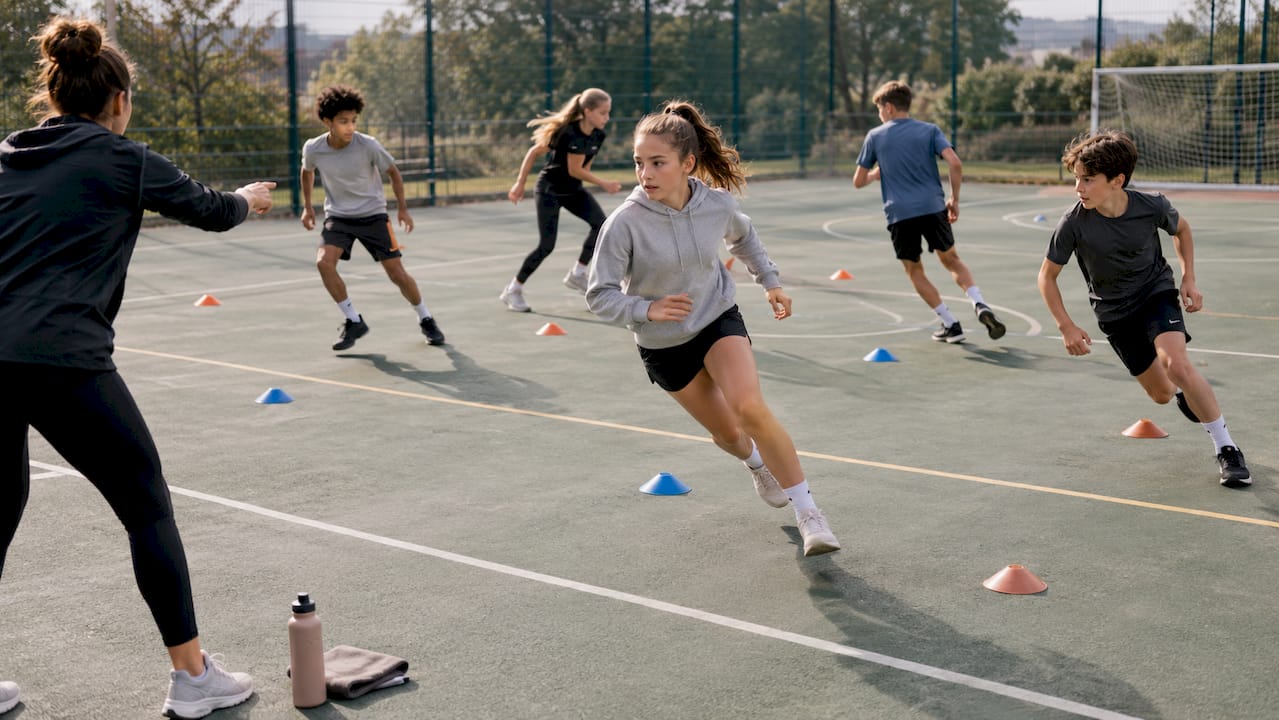
Praise effort and technique, not just outcomes. A child praised for trying a hard skill and landing it with control learns that competence comes from practice, while a child praised only for winning learns to fear losing, which tends to backfire the moment training gets genuinely challenging. Group training also does real psychological work here: training alongside peers of similar ability builds social motivation that solo drilling simply can’t replicate, which is part of why small-group formats tend to hold attention better than one-on-one repetition for this age group.
Coaches carry the technical responsibility, structuring sessions, spotting technique breakdown, and knowing when to hold a child back rather than push them forward. That last skill matters more than people realise. A good coach resists the temptation to add speed or complexity just because a drill “looks easy” for the group; readiness is judged by the least advanced child in the session, not the most advanced.
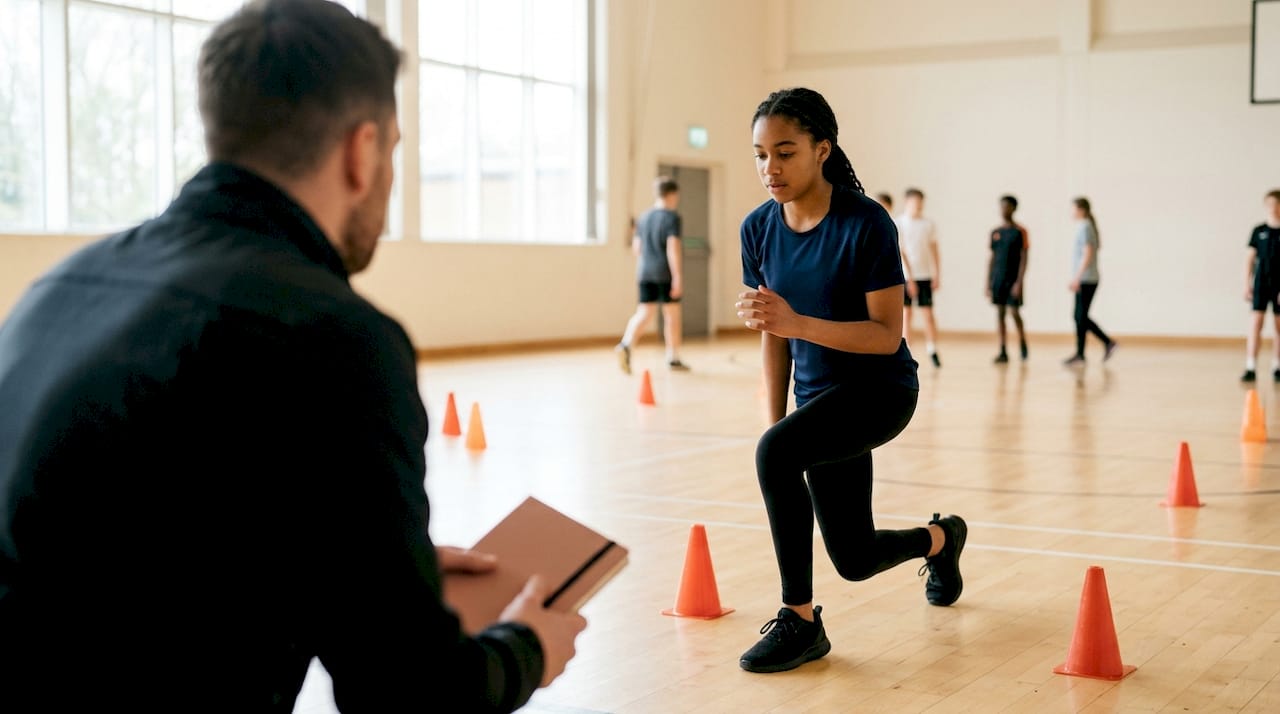
Parents carry a different, equally important job: consistency, encouragement, and restraint. Getting a child to sessions regularly matters more than almost any single drill choice, since the dose-response evidence behind agility gains depends on sustained, repeated exposure over weeks, not one heroic session. Encouragement should focus on effort and enjoyment rather than comparison with siblings or teammates, comparison is one of the fastest ways to kill a child’s interest in a sport.
Where coaches and parents genuinely align is in resisting early specialisation. A child who plays multiple sports and games through childhood tends to build a broader, more transferable movement vocabulary than one locked into a single discipline’s drills from age seven, a point echoed in long-term athletic development guidance from bodies like Athletics Canada. Parents don’t need to understand the biomechanics behind eccentric braking or perceptual-motor coupling; they need to trust a staged process, ask good questions of the coach running it, and resist the urge to accelerate a child past where their body and brain currently are.
At UNIT Health & Performance in Sheffield, our youth athlete programme builds speed, agility, strength, and power around exactly this staged logic, movement quality first, then braking control and basic strength, then reactive, game-based decision-making as young athletes mature.
A typical week might include sessions combining various agility components, always finishing with small-sided games to keep training genuinely enjoyable. Our coaches assess movement quality before adding load or speed, and parents are welcome to ask how a specific child’s programme maps to their age and stage before committing.
The biggest mistake I see in youth sport isn’t a lack of enthusiasm, it’s sequencing. Coaches and parents alike want to see a child running reactive drills against a live opponent because it looks impressive, but the research is fairly blunt about the order things need to happen in. A ten-year-old with poor landing mechanics doesn’t need more reactive complexity; they need more time on basic hops and controlled landings before anyone adds a decision-making layer on top.
What gets underestimated most is how much the “boring” stuff, tag games, animal walks, simple ladder rhythm, is actually doing. Parents sometimes ask why their child isn’t doing “real” agility drills yet, and the honest answer is that games are the real work at that age. The nervous system is being built through unstructured, playful movement long before any cone pattern matters.
The other gap worth naming is between what looks like progress and what actually is progress. A child running a shuttle faster this month than last isn’t necessarily developing agility, they might just be getting used to a predictable pattern. True agility development shows up when a child can react well to something they haven’t seen before, which is exactly why the later stages of any good programme lean so heavily on unpredictability rather than more of the same drill, run faster.
— Vitalij
A dedicated youth athlete programme is run, built around the staging this article describes: movement quality and fun first, braking control and basic strength next, then reactive and sport-specific work layered in as a child matures. Unlike a generic weekend camp that runs the same drills regardless of age, sessions here are structured around where each young athlete actually is, not just how old they are.

If your child is between structured team training and needs dedicated work on speed, agility, and injury resilience, the Youth Athlete Program is built exactly for that gap. Parents managing their own fitness alongside a child’s training might also find our small group personal training sessions a useful complement, same coaching philosophy, adult focus. Get in touch to ask which stage your child’s programme should start at, and book a first session to see how the staging works in practice.
Key evidence behind this article includes the scoping review on agility trainability, dose-response meta-analysis on session frequency and duration, NSCA’s long-term athletic development position, and reactive agility research on neuromuscular control, each grounding a specific staging or safety recommendation above.