
Get the energy right and everything else follows. The single most useful thing a parent or coach can do is make sure a young athlete eats enough, from whole foods first, to cover school, training and growth all at once. Watch for warning signs of underfueling, known clinically as RED-S, and treat every child as an individual rather than a smaller version of an adult. If something feels off, a GP or registered dietitian should be the next call, not a supplement aisle.
TL;DR:
- Young athletes require individualized daily energy intake that covers growth, training, and normal activity, with no single cutoff point reliably indicating underfueling.
- Macronutrients should be adjusted based on session intensity, with carbohydrates topping 3 to 10 grams per kilogram of body weight and proteins spread evenly throughout the day.
- Bone health relies heavily on sufficient vitamin D, calcium, and iron, especially during puberty, with seasonal testing and dietary sources prioritized before supplementation.
- Monitoring growth and performance, along with food intake and energy levels, offers practical early warning signs of underfueling more reliably than fixed thresholds.
- Coaches and parents should incorporate routine fueling, hydration, and sleep checks into weekly practice, avoiding adult-based dieting rules and instead fostering low-drama, consistent routines.
Youth sports nutrition is not adult sports nutrition scaled down. A growing 13-year-old training three evenings a week has different needs from a 17-year-old doing the same sessions, and both are different again from an adult on an identical programme. The reason is energy availability, or EA: the energy left over for growth, bone development, hormone production and immune function once the cost of exercise has been subtracted from what a child eats.
Adults have finished growing. Children and teenagers have not, and that changes the maths entirely. Applying adult calorie or macronutrient guidelines to a young athlete risks quietly starving the systems responsible for height, bone density and puberty, even while the child looks perfectly capable of running around a pitch for 90 minutes. Research on energy and macronutrient needs in young athletes makes the point clearly: this age group needs individualised intake that covers daily living, training and competition, and growth, as three separate demands rather than one blended figure.
There is no single number that reliably flags a problem. Adult research uses a threshold below 30 kcal per kilogram of fat-free mass per day to define low energy availability, but that figure was never validated for children and should be treated with real caution in this age group.
What does underfuelling actually look like day to day?
The number that matters: there’s no youth-specific energy availability cutoff doctors can point to with confidence. That’s precisely why growth charts, training performance and how a child actually feels carry more weight than any formula.
Monitoring doesn’t need to be clinical. Plotting height and weight against standard growth charts every few months, and simply asking how training feels compared to a month ago, catches most problems early. A child who used to finish sessions strong and now fades in the last ten minutes is telling you something.
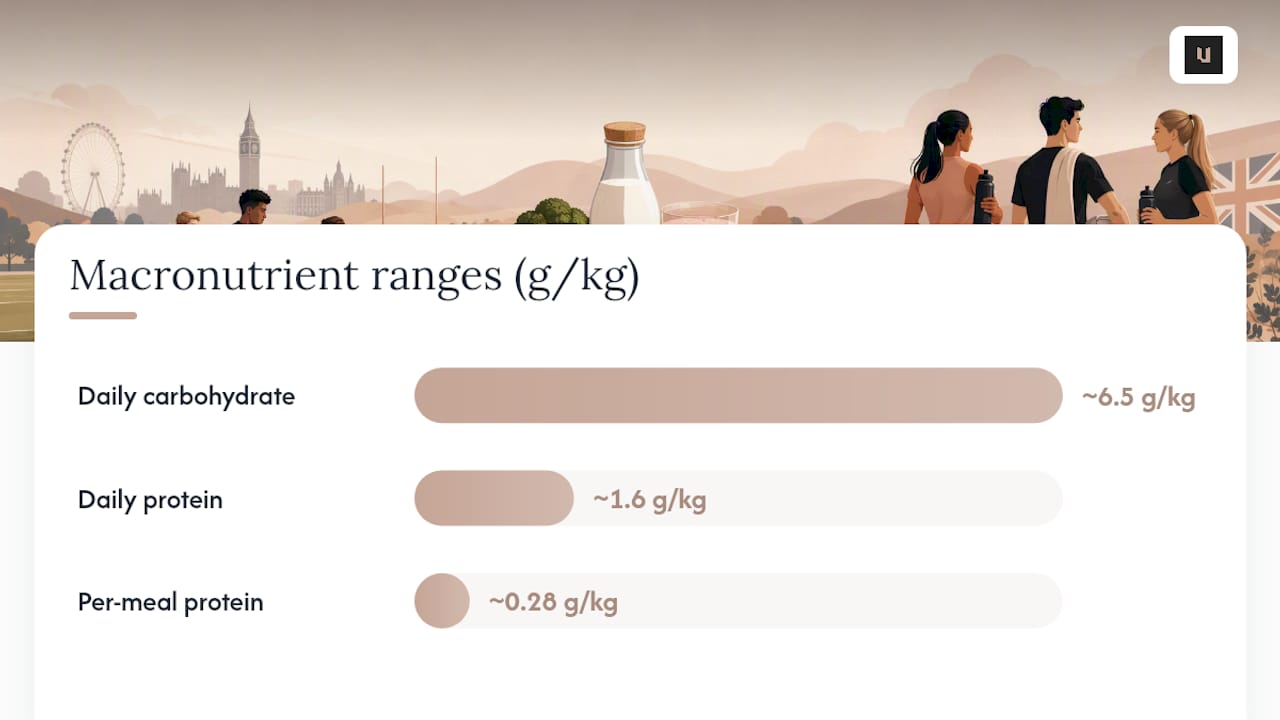
Carbohydrate is the primary fuel for most youth sports, and how much a young athlete needs depends heavily on session length and intensity. Guidance drawn from research into adolescent athlete macronutrients puts the practical range at roughly 3 to 10 grams of carbohydrate per kilogram of body weight per day, scaling up for longer or harder training and down on rest days. A light skills session doesn’t need the same fuelling as a tournament weekend with three matches.
Protein works differently to how most parents assume. Rather than one large protein-heavy meal, smaller, more frequent doses spread across the day tend to work better for muscle repair and growth in young athletes, at roughly 1.2 to 2.0 grams per kilogram of body weight daily, split into meals and snacks providing around 0.22 to 0.33 grams per kilogram each time.
Fat should sit at roughly 25 to 35% of total daily energy, mostly from whole foods such as oily fish, nuts, seeds, avocado and olive oil; with saturated fat kept in check. Fat is not the enemy here. It supports hormone production during puberty and helps absorb fat-soluble vitamins, so cutting it too aggressively backfires.
Practical food examples for a 40kg 11-year-old footballer or a 65kg 16-year-old rugby player look different in portion size but similar in structure:
Pro Tip: A small protein-containing snack before bed, such as a glass of milk or a pot of yoghurt, can support overnight recovery in growing athletes without needing a large meal late in the evening.
Bone health during adolescence depends heavily on three nutrients: vitamin D, calcium and iron. Miss these and growth, energy and recovery all suffer, often quietly.
Vitamin D is the one most families overlook. In the UK, sunlight exposure between October and March simply isn’t strong enough to maintain healthy levels, and research on youth winter sports athletes confirms this seasonal dip is a genuine risk for young athletes training indoors or outdoors through winter. A GP can arrange a simple blood test if you’re concerned, and supplementation is often appropriate for at-risk children during these months.
Iron deserves attention particularly in adolescent girls once periods start, and in any young athlete showing unexplained fatigue or a sudden dip in performance. Heavy periods, a diet low in red meat or iron-fortified foods, and high training volumes all raise the risk. Worth testing for, rather than guessing about, if symptoms persist.
Calcium needs peak during the adolescent growth spurt, when bone mineral density is being laid down for life. Dairy, fortified plant milks, tinned fish with bones, and leafy greens cover most of it through food alone.
Government dietary reference values give useful baseline figures for these nutrients across childhood, and the UK government’s dietary recommendations are a sound anchor point for checking whether a child’s diet is broadly on track.
Thirst is a lagging indicator, not an early warning system. By the time a young athlete feels thirsty, mild dehydration has usually already set in, so the better guide is urine colour: pale straw is good, dark yellow means drink more.
Eating little and often, roughly every three to four hours, keeps energy steadier through school and training days than three large meals with long gaps. This rhythm also makes it far easier to hit daily protein and carbohydrate targets without any single meal feeling excessive, a pattern backed by practical guidance on eating frequency for young athletes.
Theory is easy. Tuesday evening, with training at 6pm and homework still not started, is where most nutrition plans fall apart. Here’s what a realistic day looks like at two different ages.
Around age 10, non-training day: Breakfast: wholegrain cereal with milk and fruit. Mid-morning: apple and a small handful of nuts. Lunch: sandwich, yoghurt, carrot sticks. Afternoon snack: oatcakes with cheese. Dinner: shepherd’s pie with vegetables.
Age 14 to 16, training evening: Breakfast: eggs on toast with beans. Mid-morning: banana and a granola bar. Lunch: chicken pasta salad, fruit. Pre-training snack (4pm): toast with jam. Post-training (7:30pm): milk-based smoothie plus a proper dinner of stir-fry with rice once home.
Packed lunches and club-bag snacks need to survive a school bag and still look appealing at midday. Reliable options include wraps rather than sliced bread sandwiches (they travel better), homemade flapjacks made with oats and a little less sugar than shop versions, cheese and crackers, and fruit that doesn’t bruise easily such as satsumas or grapes.

For heavier training weeks or growth spurts, when appetite alone doesn’t cover the extra demand, boosting energy density beats forcing bigger portions. Full-fat dairy instead of low-fat, a spoonful of nut butter stirred into porridge, or adding oats to a smoothie all lift calories without adding bulk that a child struggles to physically eat. This is a far safer route than reaching for a supplement shake, and it’s the approach performance nutrition guidance from the UK Sports Institute consistently recommends for developing athletes.

RED-S, Relative Energy Deficiency in Sport, happens when what a young athlete eats doesn’t cover the combined cost of exercise and normal body function. Left unaddressed, it can affect bone density, delay puberty, disrupt periods, weaken immunity and stall growth, sometimes with consequences that last well beyond the teenage years.
Around 1 in 3 young female athletes may show signs consistent with problems in this area, according to figures referenced in NHS-affiliated clinical guidance on RED-S, though estimates vary depending on the sport and how symptoms are assessed. The same guidance is clear that restoring energy balance, sometimes alongside a short reduction in training load, sits at the centre of recovery.
Signs that warrant a GP or dietitian referral rather than a wait-and-see approach:
First steps while waiting for professional input: increase overall food intake, particularly energy-dense whole foods, ease training volume slightly rather than pushing through, and keep conversations about food supportive rather than restrictive. Body image pressure in youth sport is real and can push a child toward under-eating long before performance suffers visibly, so how adults talk about food and bodies matters as much as what’s on the plate.
Most nutrition advice fails not because it’s wrong, but because nobody has time to act on it during a normal week. The fixes that stick are boring and practical.
Batch-cooking a few portions on Sunday, keeping a snack stash in the car or kit bag, and prepping overnight oats the night before a 7am training start solve more problems than any meal plan. Talking about food should focus on energy and performance, not weight or appearance. Saying “that snack will help you finish strong” lands very differently to any comment about body shape.
Coaches can run a simple weekly checklist covering four things: is the squad fuelling before sessions, are water bottles actually full, is anyone showing signs of poor sleep, and has anyone’s performance dropped without an obvious cause. None of that requires a nutrition qualification, just attention.
Pro Tip: If a child’s relationship with food or training starts to feel complicated, involve a registered sports nutritionist early rather than waiting for a crisis. Early, low-key input is far easier than a later intervention.
The most common mistake in grassroots clubs is not a bad diet. It’s applying adult logic, cutting carbs, watching weight, chasing leanness, to bodies that are still growing. That mindset creeps in from well-meaning coaches who’ve trained adults for years and simply transfer the habit downward.
Working with young athletes alongside adult small-group training has made one thing obvious: families who do best treat nutrition as a shared, low-drama routine rather than a strict plan. Nutrition accountability works best woven into the same structure as athlete development programmes, where progress gets checked alongside training load rather than in isolation. Growth and performance are not competing goals. Get the fuelling right and both tend to look after each other.
— Vitalij
Reading the guidance is one thing. Applying it consistently across school, club training and family life is another, and that’s exactly where most families need a second pair of hands. A youth athlete programme combines speed, agility, strength and power coaching with nutrition and accountability support, so the eating habits covered here get reinforced session by session rather than left to a leaflet.

The programme is built for parents who want more than generic advice, and for coaches who’d rather bring in specialist input than guess. Sessions focus on individualised plans rather than one-size-fits-all drills, which matters just as much for nutrition as it does for training load. If you’re weighing up whether your child’s current routine covers growth, recovery and performance properly, the youth athlete programme page has the details on how to get started and book an initial consultation. Families already training with UNIT Health & Performance’s small group personal training can also ask about adding youth sessions alongside their own membership.
This article is general information, not a substitute for advice from a qualified doctor. Consult a qualified healthcare professional about your own circumstances before acting on anything here.
Created with BabyLoveGrowth to grow search and AI visibility