Trap bar deadlifts typically let you lift more weight, generate higher power, and put less strain on your lower back, while barbell deadlifts do more work for your hamstrings and match the exact demands of powerlifting. Neither wins outright. Research from Swinton et al. shows the trap bar produces a measurably higher one-rep max and lower lumbar stress, while some coaches find the barbell irreplaceable for building raw hip-hinge strength. Most lifters benefit from training both, at different points in a programme.
TL;DR:
- The trap bar deadlift produces about an 8.2% higher one-rep max and greater power output than the barbell deadlift, according to research.
- Trap bar pulls reduce lumbar stress and increase quadriceps activation, benefiting lifters with lower back issues or knee pain and improving overall load efficiency.
- For power and sports performance, prioritize trap bar training with moderate to heavy loads and relative speed work; for strength and hypertrophy, favor barbell deadlifts.
- The main biomechanical difference lies in torso posture and joint loading, with trap bars promoting a more upright torso and less spinal load but higher knee and quad involvement.
- Beginners and older lifters should start with the trap bar for safer technique development, progressing to barbell deadlifts for sport-specific and posterior chain strength.
The two lifts feel different because the bar sits in a different place relative to your body, and that single change reshapes almost everything downstream.
With a conventional barbell, the bar rests over your mid-foot before you pull. Your shins are close to the bar, which forces a more horizontal torso angle at the start of the lift. That position stretches the lever arm between the bar and your hips, which is exactly what makes the barbell deadlift such a potent hip and hamstring builder. It also increases the moment (the rotational load) placed on your lower back and hips.
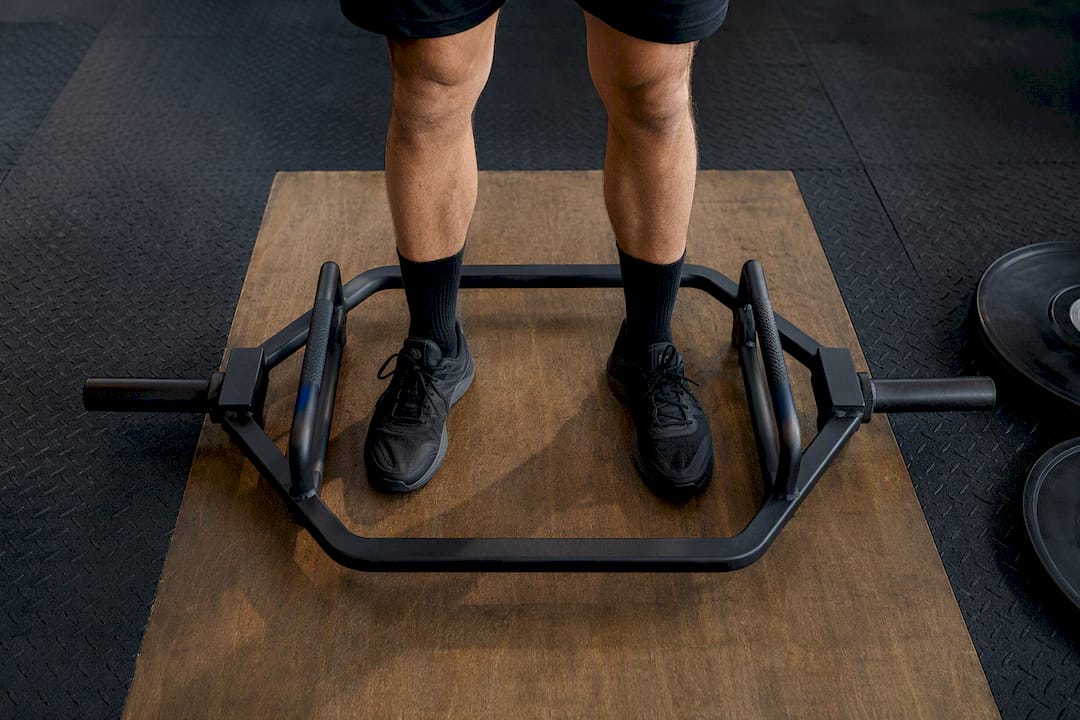
A trap bar changes the geometry entirely. You stand inside the frame, so the load sits closer to your centre of mass rather than out in front of your shins. Your torso stays more upright, your knees travel further forward, and the whole movement starts to resemble a hybrid between a squat and a hinge. That’s also why so many people ask “is a trap bar deadlift basically a squat?” It isn’t one, but the more vertical torso and greater knee flexion do borrow from squat mechanics more than a conventional pull does.
This shift in geometry has a direct, measurable effect on joint loading. The HFE breakdown of the trap bar vs conventional deadlift confirms that trap-bar pulls increase quadriceps activation while easing the load on the spine, a pattern that lines up with what biomechanics researchers have measured directly.
Practical implications follow straight from the mechanics:
Swinton and colleagues measured this directly: hexagonal bar pulls produced lower peak moments at the lumbar spine, hip, and ankle, but a higher peak moment at the knee. That’s the trade-off in one sentence. You shift stress away from your back and towards your quads. For some lifters that’s a relief. For others training specifically for a barbell pull, it’s a reason not to rely on the trap bar exclusively.
The most cited comparison in this space comes from Swinton and colleagues, who put 19 trained male lifters through both hex-bar and straight-bar deadlifts using submaximal loads and full biomechanical analysis.
Study snapshot: Trained lifters produced a one-rep max of 265 ± 41kg with the hex bar versus 245 ± 39kg with the straight bar, roughly an 8.2% advantage, alongside significantly higher peak power output (4,872 ± 636W vs 4,388 ± 713W). Both differences were statistically significant (p < 0.05), according to Swinton et al., published in the Journal of Strength and Conditioning Research.
That power gap matters more than the raw 1RM number for most athletes. If your sport rewards how fast you can move a heavy object, not just how much you can technically lift once, the trap bar’s power advantage is the more relevant figure.
EMG and kinematic work backs this up from a different angle. Muscle activation studies consistently show trap-bar pulls lean harder on the quadriceps, while conventional barbell pulls demand more from the hamstrings and spinal erectors, a pattern also summarised by StrongerByScience’s review of trap bar mechanics. Neither activation pattern is objectively superior. It depends entirely on what you’re training for.
A few caveats are worth knowing before you treat these numbers as gospel:
What’s robust: the direction of every effect. Lower spinal moment with the trap bar, higher knee moment, higher achievable load, higher power, more quad involvement. What’s more conditional: the exact size of those differences, which varies by lifter, load, and equipment.
Pick your primary variant based on what you’re actually training for, then use the other as a supporting tool rather than an afterthought.
Inside a periodised block, plenty of coaches use the trap bar during accumulation phases (when volume is high and bar speed matters) and switch to the barbell as competition or testing approaches, when movement specificity takes priority over everything else. This isn’t an either/or decision; it’s sequencing.
Pro Tip: Track bar velocity, not just load, when you switch between variants. A trap bar 1RM doesn’t map directly onto a barbell 1RM, so use relative percentages and movement quality (not the number on the bar) to judge whether strength gained on one implement is actually transferring to the other.
Trap bar set-up starts with foot position: stand centred inside the frame, hip-width apart, with your shins close to vertical. High handles shorten the pull and suit taller lifters or those with mobility restrictions; low handles increase range of motion and better mimic a barbell pull for lifters using the trap bar as a training tool for competition deadlifts.
Conventional barbell set-up demands the bar sits directly over your mid-foot before you touch it. Take the slack out of the bar by creating tension through your lats before you pull, and think about pushing the floor away rather than yanking the bar upward.
Common faults show up in similar ways across both lifts:
Straps become useful once grip becomes the limiting factor rather than your legs or back, particularly during higher-rep trap bar work. A weightlifting belt supports intra-abdominal pressure on heavier barbell sets. Blocks or a slight deficit can be used to overload specific ranges of motion once your form is genuinely solid, not before.
Some Small Group PT sessions typically introduce new members to the trap bar first. The upright posture and lower lumbar demand make it a practical starting point, especially for clients over 40 returning to strength work after time away from the gym.
As technique and confidence build, many members progress toward barbell pulls to develop posterior chain strength more specifically. The gym has supported many members through completed workouts using this progression model, and the same power-focused principles from the research feed directly into youth athlete development, where trap-bar variations often form part of speed and strength programming for younger athletes.

Reading about joint moments and EMG data is one thing. Feeling whether your hips are shooting up too early, or whether your knees are caving on a heavy trap bar pull, is another, and that’s exactly where a second pair of eyes earns its keep. Some Small Group PT sessions are built around individualised coaching rather than generic templates, so programmes are shaped around goals, joints, and training history rather than a one-size-fits-all sheet.

Whether you’re managing a cranky lower back, training for raw strength, or simply want someone watching your bar path so you’re not guessing at your own form, small-group coaching gives you structured progression without the intimidation of a crowded gym floor. Members work through both trap bar and barbell variations as part of a plan tailored to what their body actually needs, with real accountability built into every session. If you want a straightforward next step, book a Small Group PT session and get an honest assessment of where your deadlift technique stands today.
They’re equally valid, just built for different outcomes. Trap bar pulls typically allow a higher one-rep max and greater power output, with Swinton et al. measuring roughly an 8.2% 1RM advantage, while barbell deadlifts do more targeted work for the hamstrings and posterior chain.
The main downside is specificity: if you compete in powerlifting, trap bar strength doesn’t transfer perfectly to a barbell pull, since contest rules require a straight bar. The trap bar also increases knee moment, which may not suit lifters managing knee pain, according to Swinton et al.'s biomechanical findings.
Yes, trap bar deadlifts build genuine strength and power, and many lifters can handle heavier absolute loads with a hex bar than with a straight bar. That strength carries over well to sports and general fitness, though it needs to be paired with barbell-specific practice if your goal is a barbell 1RM.
Not quite, though it shares some squat mechanics. The trap bar’s centred load position allows a more upright torso and greater knee flexion than a conventional deadlift, which is why it feels like a hybrid movement, but the hip hinge pattern still dominates the lift rather than a true squat pattern.
The trap bar generally suits beginners better because the more upright posture and lower lumbar demand make the movement easier to learn safely. Coaches often introduce new Small Group PT members to the trap bar first before progressing them toward barbell-specific work.