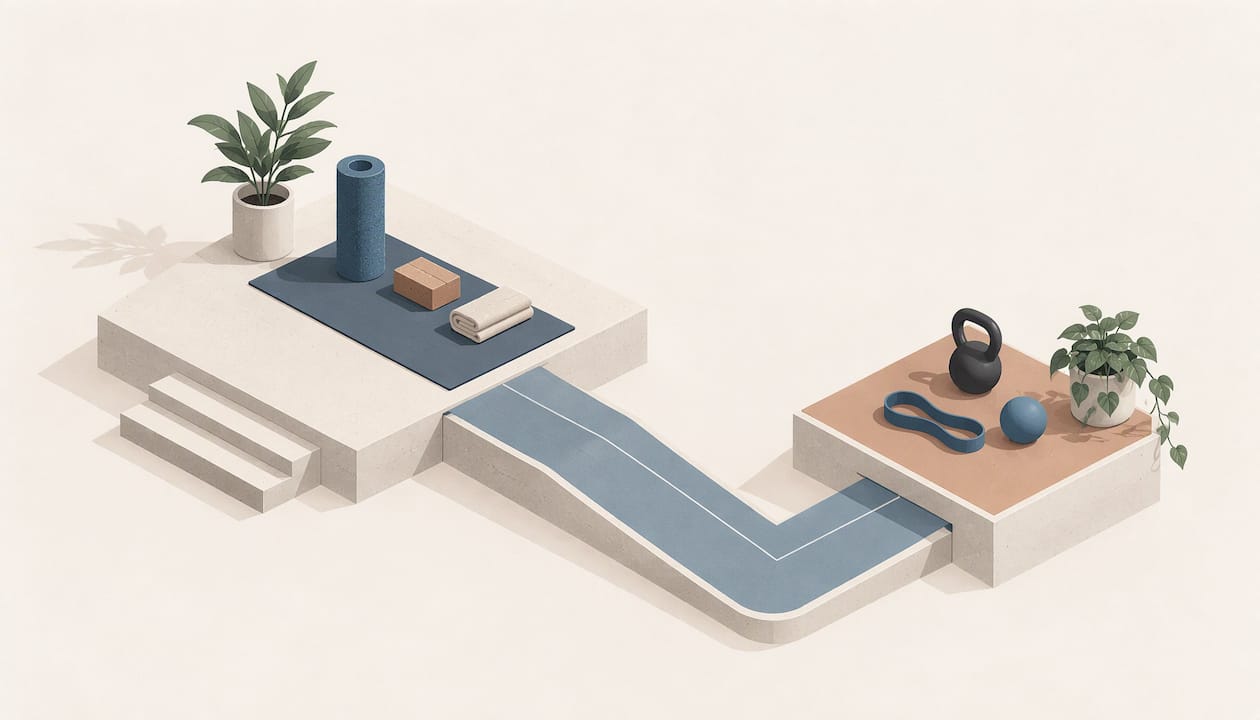
Mobility training over 40 means practising controlled movement through your joints’ full range, a few times a week, so everyday life and strength training feel easier. You don’t need long sessions. Fifteen minutes, two or three times a week, covering your neck, spine, hips, shoulders and calves, is a sound place to start. It works best alongside strength work, which is where small group coaching at Unit Health & Performance in Sheffield comes in. Below you’ll find what mobility is, a routine you can follow, how often to do it, and when to stop and get advice.
Mobility is how well you can move a joint through its range, with control. Flexibility is how far a muscle can lengthen. You can be flexible and still wobble in a deep squat, because mobility also needs strength and coordination at the end of the range. We cover the difference in more detail in flexibility vs mobility.
Mobility training is simply practising those movements on purpose. That might be slow circles at the shoulder, rocking the hips back into a deep squat, or turning the upper back while kneeling. The aim is to keep the movements you need for daily life: reaching a high shelf, getting up from the floor, looking over your shoulder when you reverse the car.
Why start at 40? Most people don’t suddenly lose movement. It fades through long days at a desk, driving, and fewer reasons to get on the floor. By 40 many people notice stiff hips in the morning, a tight upper back, or shoulders that complain overhead. These are easy to work on early, and the habit pays off for decades.
The evidence for staying active is strong, and it is not only about joints. The NHS says regular exercise can reduce the impact of conditions such as osteoporosis, diabetes, high blood pressure, heart disease and stroke, ease arthritis-related pain, improve sleep, help prevent falls and fractures, and lift mood and memory.
A falls prevention service in the NHS also notes that the older you are, the more likely you are to benefit from regular exercise. Benefits it lists include better balance, coordination, strength and flexibility, better posture, and less pain from conditions like arthritis.
Two practical points follow from this:
So a mobility routine is a good use of 15 minutes, and so is getting out of your chair every half hour.
This routine is built from the movements NHS leaflets use for neck, side and calf work, plus three common movements for the hips, upper back and shoulders. Move slowly. Breathe out as you stretch. Stay in a range that feels like a stretch, not a pinch.
Walk on the spot or around the room, swing your arms, and roll your shoulders. Your joints move better when you are a little warm. If you plan to lift weights afterwards, our 10-minute warm-up for strength training covers that side too.
Sit tall. Turn your head slowly towards one shoulder, hold for 5 seconds, then return. The NHS flexibility exercises suggest 3 rotations on each side. Keep your shoulders down and relaxed.
Tilt your head towards one shoulder while gently holding the opposite shoulder down. Hold for 5 seconds and repeat 3 times each side, as in the NHS leaflet for older people.
Stand or sit tall. Slide one hand down the side of your leg, hold for 2 seconds, and come back up. Do 3 on each side. Don’t lean forward or back. Think of sliding between two panes of glass.
On hands and knees, round your back up towards the ceiling, then let it sink and lift your chest. Do 8 slow rounds. If kneeling hurts your knees, put a folded towel under them.
On hands and knees, place one hand behind your head. Turn your elbow down towards the opposite arm, then open it up towards the ceiling, following it with your eyes. Do 6 each side. Upper back stiffness is common after years of desk work. A Royal Devon NHS Trust leaflet suggests doing thoracic mobility exercises at least 3 times a week.

Kneel on one knee with the other foot in front. Squeeze the buttock of the back leg and shift your weight forward slightly until you feel a stretch at the front of that hip. Hold for 20 to 30 seconds, then swap. Sitting shortens this area, so most people over 40 feel it.
Stand with your feet a little wider than your hips. Lower into a squat as far as feels comfortable, holding on to a door frame or sturdy post for support if you want. Rock gently side to side for 30 seconds. Over weeks, the depth usually improves.
Stand tall and reach one arm up and across, then rotate it outwards in a slow arc. Do 6 slow circles each way per arm. If your shoulder pinches, make the circle smaller.
Step one leg back, keep it straight with the heel down, and lean into a wall. The NHS suggests 3 on each side. Tight calves can limit how far your knees travel forward in a squat or lunge.
The NHS advises that for chair-based exercises you choose a stable, solid chair without wheels, sit with your feet flat and knees at right angles, and avoid chairs with arms because they restrict movement. Items 1 to 3 and 9 can all be done this way.
The official guidance is written for adults aged 65 and over, but it makes a sensible benchmark for anyone building a habit in their 40s and 50s. The NHS says older adults should do activities that improve strength, balance and flexibility on at least 2 days a week, alongside 150 minutes of moderate activity a week.
The NHS leaflet for older people suggests trying its flexibility and mobility exercises at least twice a week, building up slowly and adding repetitions over time. Some falls services advise more: one NHS falls leaflet says a minimum of 5 times a week, and notes that benefits are lost when you stop exercising regularly.
A realistic pattern for most busy people:
| Week | What to do | Time |
|---|---|---|
| 1 to 2 | Items 1 to 3 and 9 only, twice a week | 5 to 8 minutes |
| 3 to 4 | Add cat-cow and the hip flexor stretch, three times a week | 10 to 12 minutes |
| 5 onwards | The full routine, three times a week, plus a few minutes on stiff days | 15 minutes |
If 15 minutes feels like too much, start smaller. UK guidelines say there is no minimum amount of activity needed to get some benefit, and that 10 minutes at a time can be a good goal for people starting from low activity.
For static stretches, a hospital leaflet for people with Parkinson’s disease suggests holding stretches 10 to 30 seconds, and 30 to 60 seconds for older adults, repeating each 2 to 4 times. That is a wide range, so start at the shorter end and hold longer as it feels easier. For movement drills such as cat-cow or shoulder circles, 6 to 10 slow repetitions is plenty.
A mobility routine opens up your range. Strength is what lets you use it and protects the joints at the ends of it. Public Health England’s evidence review says adults should do a programme at least twice a week that includes resistance training, some impact exercise and balance training, tailored to fitness and physical function.
Age UK says it gets harder to maintain muscle as we age, and that strengthening your muscles helps mobility, flexibility and bone strength. It suggests starting with light weights and bodyweight moves like squats and lunges, and building up gradually.
In practice that means pairing your mobility sessions with two strength sessions a week. Our guides on strength training over 40, bone density exercises and low impact strength training show how.
Balance is the third leg of the table. The UK guidelines list standing on one leg, walking backwards and three-dimensional movement as balance activities. Adding a few minutes of balance training for seniors style exercises after your mobility work, such as a 20-second single-leg stand near a worktop, costs you almost no extra time.
Everyone starts somewhere different. These rules keep the work useful.
Start too little, not too much. An NHS Scotland sheet says the most common mistake is trying to do too much at the start. It is better to do too little, manage it comfortably, and then increase gradually.
Use a pain guide. The same sheet suggests aiming to keep pain under 5 out of 10 during exercise. If it goes higher, reduce the range, repetitions, speed or weight, or take more rest. A small rise in symptoms is normal and should settle quickly.
Check the next day. NHS Scotland’s musculoskeletal service says symptoms should return to your pre-exercise level within 30 minutes, and you shouldn’t feel more pain or stiffness the next morning. If you do, ease off. If it doesn’t settle with less exercise and more recovery, contact your GP or another health professional.
Take extra care with certain conditions. A Royal Devon NHS Trust leaflet says that if you have osteoporosis or a spinal condition such as scoliosis, the technique may need to be modified. If that is you, ask your GP or physiotherapist which movements suit you before you begin. If you have sore joints, our joint friendly workouts guide gives two plans.
See your GP first if you’ve been inactive. The NHS advises that if you haven’t exercised for some time, or you have a medical condition or concern, speak to a GP first so your activity and its intensity suit your fitness.
There is reassurance too. The Moving Medicine consensus notes that when activity is increased gradually, the risk of serious adverse events is very low, even for people with long-term conditions.

Stop and seek medical review if you notice any of these during or after exercise, according to the Moving Medicine risk consensus:
Age UK adds that if you have chest pain or feel faint, stop immediately and contact your doctor. With back or neck exercises, the Royal Devon leaflet says to stop and seek urgent medical attention for new chest or back pain, new changes in sensation, or new changes in bladder or bowel function. Call 999 in an emergency.
At Unit, we work with people over 40 who want to get stronger, leaner and fitter, and we see mobility as part of that picture rather than a separate hobby.
A stretch routine on its own is a good start. But we design our training so that mobility, strength and effort all sit in the same session, in small groups where the coach can see how you move and adjust the plan to you. That is the idea behind small group personal training: individual attention, with the energy of a group.
We also think the setting matters. Many people tell us they feel put off by big, busy gyms. Our aim is a non-intimidating community where you can build habits that last, which is why we focus on sustainable results and longevity, not quick fixes.
The NHS notes that doing activities with other people can help both physical and psychological wellbeing. We agree, and it is a big part of why people stay with it.
Vitalij
If you’d rather not piece a routine together yourself, our small group personal training in Sheffield gives you an individualised plan, expert coaching and a supportive group, all in one session. It is designed for people over 40 who want to move better and get stronger. You can see how it works on our Small Group PT page, or look at our adult fitness classes if you prefer a class setting.
More than 100 members train with us. If you’re returning to exercise after a break or have a health condition, tell us when you get in touch so we can plan around it. Your GP can advise on anything medical first.
Yes. Regular activity that improves strength, balance and flexibility is linked by the NHS to fewer falls and fractures, less arthritis-related pain, better sleep and better mood. You can start small, and a few minutes counts. Pairing mobility with strength work gives you the most from it.
Two days a week is the minimum in NHS guidance for strength, balance and flexibility work. Three short sessions a week suits most people and is easier to keep up. If you feel stiff, a few minutes more on those days is fine, provided it doesn’t leave you sore the next morning.
Good starting points are neck rotations, side bends and calf stretches from the NHS leaflets, plus cat-cow, thoracic rotations, a hip flexor stretch and a supported deep squat. Choose the ones that match where you feel stiff. Do them slowly, and keep the effort comfortable.
Start with a short warm-up and gentle mobility drills before training. Hold longer stretches after your session when you are warm. If you have a medical condition or an injury, check with your GP or physiotherapist which movements are suitable.