Did you know that nearly 50% of all sport-related trips to A&E involve children and adolescents? It's a sobering statistic for any Sheffield parent watching their child give their all on the pitch or court. You naturally want them to succeed, yet the fear of burnout or "over-training" often feels li...
Did you know that nearly 50% of all sport-related trips to A&E involve children and adolescents? It's a sobering statistic for any Sheffield parent watching their child give their all on the pitch or court. You naturally want them to succeed, yet the fear of burnout or "over-training" often feels like a constant shadow. You might even feel confused about whether your child should be lifting weights or if they're simply doing too much too soon.
We understand that you're looking for more than just extra drills; you want a safe, professional environment where your child can truly thrive. This guide to long term athletic development Sheffield reveals how a structured, age-appropriate pathway helps young athletes build elite speed and confidence whilst staying injury-free. We'll walk you through the 2026 England Athletics age group updates and provide a clear roadmap for physical success. You'll discover how the right coaching vibe can transform their performance and ensure they stay in the game for the long run.
• Learn why a structured long term athletic development Sheffield pathway is the secret to helping your child reach their peak performance whilst avoiding the common pitfalls of early burnout.
• Understand the difference between your child's age in years and their physical maturity level to ensure their training intensity always matches their actual stage of growth.
• Discover the modern sports science that proves supervised strength training is safe for juniors and essential for building the robust foundation needed to prevent injuries.
• Get a practical checklist for finding a quality youth training environment where small group sessions and a supportive community vibe keep teenagers inspired and consistent.
LTAD isn't just a fancy acronym; it's a carefully structured framework designed to help your child reach their physical peak without the wheels falling off. In a city like Sheffield, where the sporting bar is set high by world-class football academies and the English Institute of Sport (EIS), long term athletic development Sheffield is the bridge between raw talent and professional standard. It ensures that every sprint, jump, and lift is age-appropriate, protecting their growing joints whilst they sharpen their skills.
Many parents fall into the 'Early Specialisation Trap'. This happens when a child plays only one sport year-round, such as football or swimming, without any variety. While it might seem like the fastest route to success, it often leads to overuse injuries and mental burnout before they even reach their teens. Investing in long term athletic development Sheffield means giving your child the tools to stay in the game for life. We advocate for the 'Empowering Specialist' approach, where our coaches act as mentors who build self-belief alongside a physical engine. We want them to feel capable and in control of their journey, not just another cog in a team drill.
In our Youth Athlete Training sessions, we prioritise 'learning to move' over 'moving heavy loads'. Before a teenager ever touches a barbell, they must master fundamental motor skills like running, jumping, and landing safely. These basics are the bedrock of every sport, from netball to rugby. Mastering these mechanics first creates a resilient body that's ready for the demands of elite competition. For a deeper dive into how we structure these sessions for peak performance, check out our resource on Youth Athlete Training Sheffield.
Every young person grows at a different rate. While your child might be 12 on paper, their body could be closer to 10 or 14 in terms of physical maturity. This is the difference between chronological and biological age. An effective long term athletic development Sheffield pathway must distinguish these two factors. If a coach treats every 13-year-old the same, they risk pushing a late bloomer too hard or failing to challenge an early developer who is already physically advanced.
By understanding these growth patterns, we can target specific "Windows of Opportunity". These are periods during growth spurts where the nervous system is most receptive to developing speed and coordination. According to the NSCA's Practical Application of LTAD, matching training to these developmental milestones is vital for long-term health. Our Youth Athlete Program is designed to adapt to these individual growth rates, ensuring no child is left behind or held back by a "one size fits all" approach.
At this stage, the focus is purely on agility, balance, and coordination. We use game-based "deliberate play" to keep things engaging and high-energy. It isn't just about fun; it's about building a "favourite" relationship with exercise that lasts a lifetime. When kids enjoy moving and feel successful in their efforts, they're far more likely to stay active as they grow.
As they move into the development phase, we introduce structured strength and conditioning. This is where the long term athletic development Sheffield model really starts to take shape. The vibe remains supportive and inclusive, but the focus shifts toward technical proficiency. We teach them how to move efficiently in the gym and on the field, building a robust engine for their specific sport. If you're unsure which stage your child is currently in, feel free to chat with our coaching team for some friendly, expert advice.
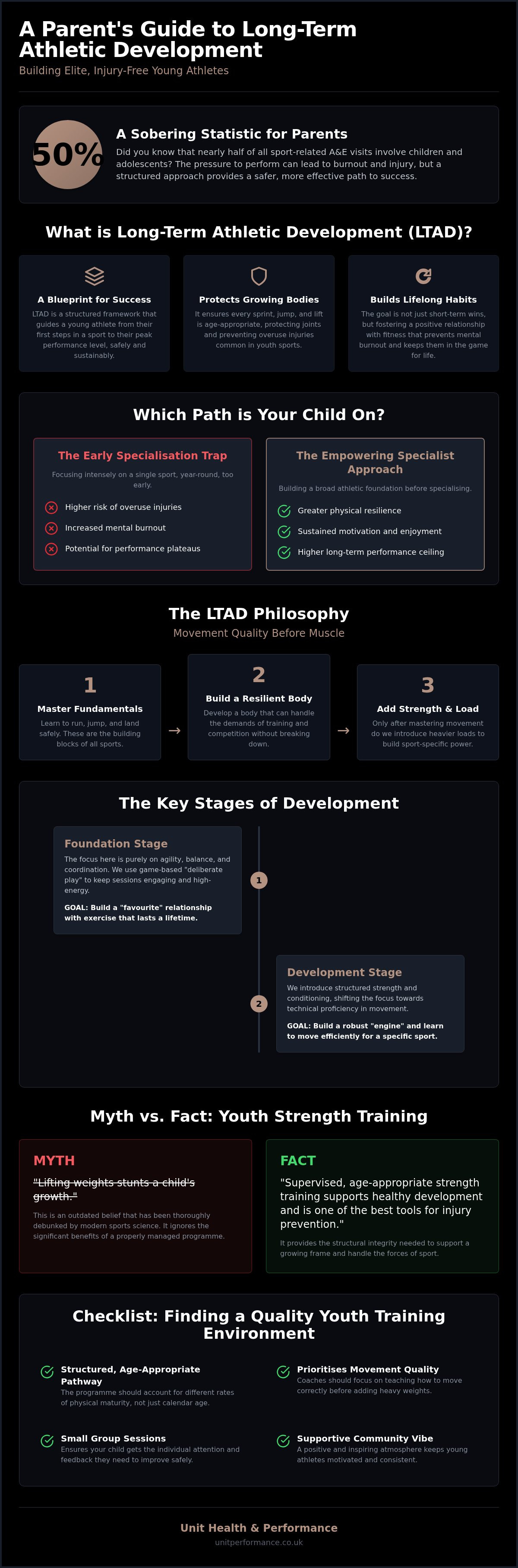
Let’s address the elephant in the room: the old wives' tale that lifting weights stunts a child's growth. Modern sports science has thoroughly debunked this, proving that age-appropriate strength training actually supports healthy development. When integrated into a programme for long term athletic development Sheffield, supervised resistance training is not just safe; it's a game-changer for physical resilience. It provides the structural integrity needed to support a growing frame during those awkward teenage years.
Beyond just building power, this approach is vital for injury prevention training for young athletes. By strengthening the muscles around vulnerable joints, we significantly reduce the risk of common issues like ACL tears or chronic ankle sprains. It’s about building a robust body that can handle the high-impact demands of weekend matches and school sports. We don't just train them to be faster; we train them to be harder to break.
We steer clear of "drill-sergeant" tactics. Our coaches create a professional-casual vibe where teenagers feel respected and empowered rather than barked at. This environment ensures they learn the "why" behind every movement, fostering a sense of ownership over their progress. It’s the difference between blindly following orders and becoming a student of their own performance. If you're ready to see how professional coaching can transform your child’s confidence, get in touch with our Sheffield team today.
Controlled loading is the secret to long-term health. During adolescence, the body is highly responsive to physical stress. Applying the right amount of weight improves bone mineral density and tendon stiffness, making the skeletal system much harder to break. To ensure this is done safely, we utilise Small Group environments. This allows our expert coaches to maintain a watchful eye on every rep, ensuring perfect technique whilst keeping the energy levels high amongst the group. It is this level of detail that makes our approach to long term athletic development Sheffield the gold standard for local families.
Finding the right facility for long term athletic development Sheffield is about more than just proximity or price. You need a space that balances high performance standards with a welcoming, non-intimidating atmosphere. For parents, this means looking for a specific set of criteria to ensure their child is in expert hands. Use this checklist when visiting local gyms:
Ensure the staff specialise in youth development and understand the nuances of growing bodies.
Individual attention is vital for correcting technique and building confidence in every session.
A clear, progressive plan is far more effective than a collection of random, unorganised workouts.
The community vibe at Unit Health & Performance is what truly sets us apart. Many teenagers drop out of sport when it feels like a chore or becomes overly competitive. We create a supportive movement where they feel they belong, which keeps them consistent whilst their peers might lose interest. You can even lead by example; whilst your child is training, you can join our Small Group Personal Training. It’s an efficient way to work on your own goals in the same professional environment, making the gym a shared family priority.
There is a massive difference between a gym with equipment and a coach-led facility. We bridge the gap between the high intensity of academy football and the casual nature of local club sports. By providing elite-level guidance in a friendly setting, we offer a sense of "aspirational realism". Your child sees what is possible with hard work, but they are supported every step of the way by mentors who care about their journey. If you want to see our methodology in action, book a consultation for our Youth Athlete Program today and help your child take the first step toward long-term success.
Long term athletic development Sheffield isn't just about winning the next match; it’s about ensuring your child stays active, healthy, and confident for decades to come. By moving away from the early specialisation trap and focusing on the science of growth, you're giving them a significant head start. We've seen how the right coaching can turn a nervous junior into a robust athlete who understands the value of technique and hard work.
At Unit Health & Performance, we provide the mentorship and professional environment required to bridge the gap between amateur play and elite performance. Our specialised Youth Athlete Training curriculum is designed to respect their growth rates whilst building a powerful engine for any sport. Don't leave their physical future to chance or unsupervised drills. Start your child's athletic journey at Unit Health & Performance today and become part of a community that values progress, safety, and long-term success. Let's help them build a foundation they can be proud of.
Children can typically begin a structured long term athletic development Sheffield pathway from as early as 8 or 9 years old. At this Foundation stage, we focus on agility and coordination through play rather than formal gym work. It's about building a broad base of movement skills that will support any sport they choose later. Starting early helps them develop a positive relationship with exercise whilst their nervous system is most adaptable.
Supervised strength training does not stunt growth or damage joints; in fact, it often does the opposite. Modern science shows that controlled loading improves bone density. It's essential to have expert supervision to ensure perfect technique. By building a stronger physical frame, your child becomes more resilient against the high-impact stresses of competitive sport and common growth-related aches.
Most young athletes find that training 1 or 2 times a week outside of their main sport is the "sweet spot" for progress. This frequency allows them to build strength and speed without risking burnout or over-training. It's important to balance these sessions with their team practice and school commitments. Consistency over months and years is far more valuable than a high-intensity burst that leads to fatigue.
Yes, a solid physical foundation is a huge advantage for those aiming for professional academies like Sheffield United or Wednesday. Scouts look for players who aren't just technically gifted but also possess the speed, agility, and robustness to handle elite-level training. Our long term athletic development Sheffield programme builds the "engine" that allows their skills to shine on the pitch, making them more attractive prospects for top-tier clubs.
LTAD is a multi-year framework tailored to a child's physical maturity, whereas regular personal training often focuses on short-term goals. Standard training might just involve a set of exercises. In contrast, LTAD considers "windows of opportunity" for speed and coordination. It's a holistic approach that prioritises movement quality. This ensures your child develops at a pace that's right for their body, not just their age.