To get faster for football, prioritise short acceleration drills, reactive change-of-direction practice and low-volume strength work with long rests. Place these at the start of a session, 10 to 15 minutes, three sets per drill, with rest periods significantly longer than the work time to allow full recovery. Stay consistent and most players notice sharper first steps and better game speed within four to six weeks.
TL;DR:
- Focus on short, maximum effort sprints of 6 to 12 seconds with full recovery to develop explosive acceleration and prevent fatigue-related technique breakdown.
- Incorporate reactive change-of-direction drills, such as chaos mirror and gate sprints, to better replicate game scenarios and improve decision-making speed.
- Prioritize posterior-chain strength exercises like deadlifts and hip thrusts, combined with plyometrics, to enhance acceleration, deceleration, and overall speed durability.
- Limit speed training to two or three weekly sessions early in the workout, ensuring sufficient rest and avoiding volume overload that risks injury or fatigue.
- Get coached feedback on key mechanics like plant foot position, lean angle, and arm drive during acceleration drills to accelerate progress and reduce injury risk.
Football rarely rewards flat-out top speed. It rewards how fast a player reaches full speed from a standing start, and how quickly they can stop, plant and go again. Match analysis backs this up: the demands are built on repeated short accelerations and decelerations, not sustained sprinting, which is why training built around soccer speed, endurance, and power separates speed work from conditioning rather than blending them.
Five qualities drive football speed: acceleration, deceleration, repeated-sprint ability, movement skill and posterior-chain strength. Training should chase quality over fatigue. That means the ATP-CP energy system, which fuels explosive efforts, needs a work-to-rest ratio close to ten times the work duration to stay sharp, and speed work belongs early in a session, before legs get tired.
A rushed warm-up is the fastest way to blunt a speed session or pick up a strain. Build it in four stages: general movement to raise body temperature, dynamic mobility through the hips and ankles, activation of the muscles you’re about to load, then potentiation drills that switch on the nervous system for sprinting.
Youth athletes and older players need the same structure but less intensity.
Pro Tip: Wall drives (leaning into a wall and driving knees up in a running rhythm) do double duty as activation and technique rehearsal. Ninety seconds before a sprint block primes both the muscles and the movement pattern.
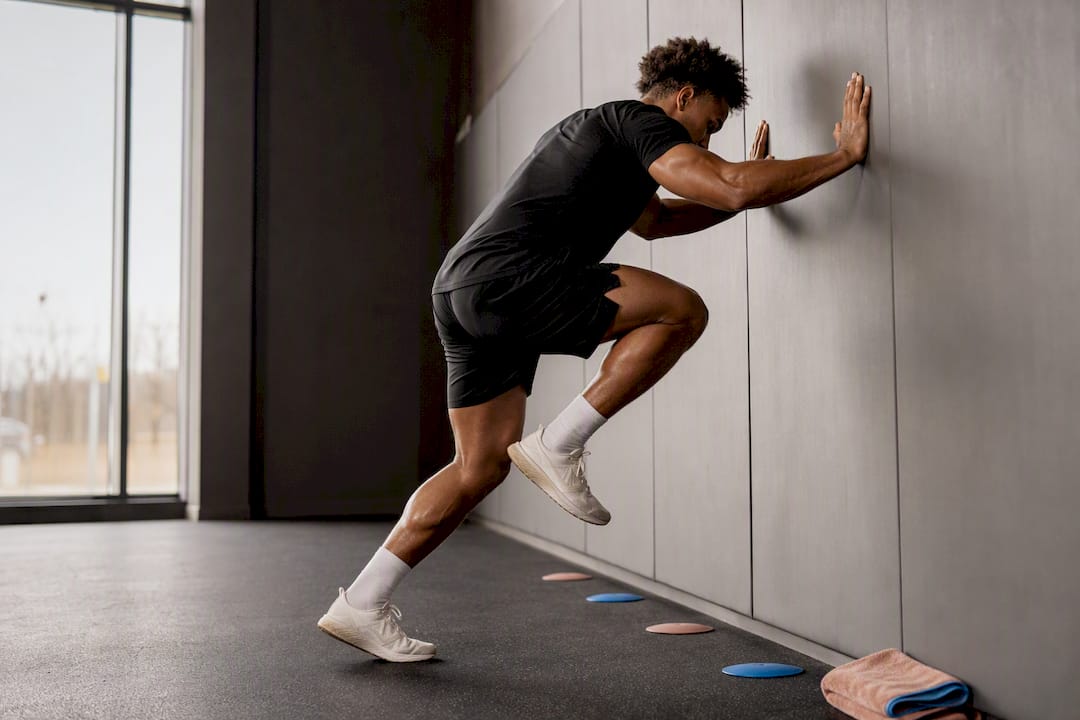
Acceleration is where matches are won and lost, since most sprints in a game last under six seconds. A well-known guideline suggests speed work stays within short, maximal bursts of 6 to 12 seconds with full recovery, which is exactly the window these drills target.
The coaching cues matter more than the drill itself. Football-specific guidance from coaching resources on speed training exercises for soccer players consistently flags three things: a 45 degree forward lean out of the start, contact on the toes rather than the heel, and an aggressive, opposite-arm drive. Technique coach Margot Wells has long argued that acceleration mechanics are trainable skills, not fixed talent, which is worth remembering when a player looks “naturally slow” out of the blocks. Regress any drill by shortening the distance to 5 metres for beginners or youth athletes still learning the lean.
Cone drills teach footwork, but reactive drills teach the decision-making that actually shows up on a pitch. Football rewards players who can process a cue and change direction in the same instant a defender or ball does, which is why pre-planned patterns are only half the picture.
The 5-10-5 shuttle is the standard test and drill: sprint 5 yards right, plant and drive 10 yards left, plant and sprint 5 yards back to the start. The most common mistake is standing too upright on the plant step, which slows the transition. Coach players to bend the knee and hip on the plant, almost like sitting into a chair, before driving off in the new direction. Progress it by starting from different stances or adding a ball.
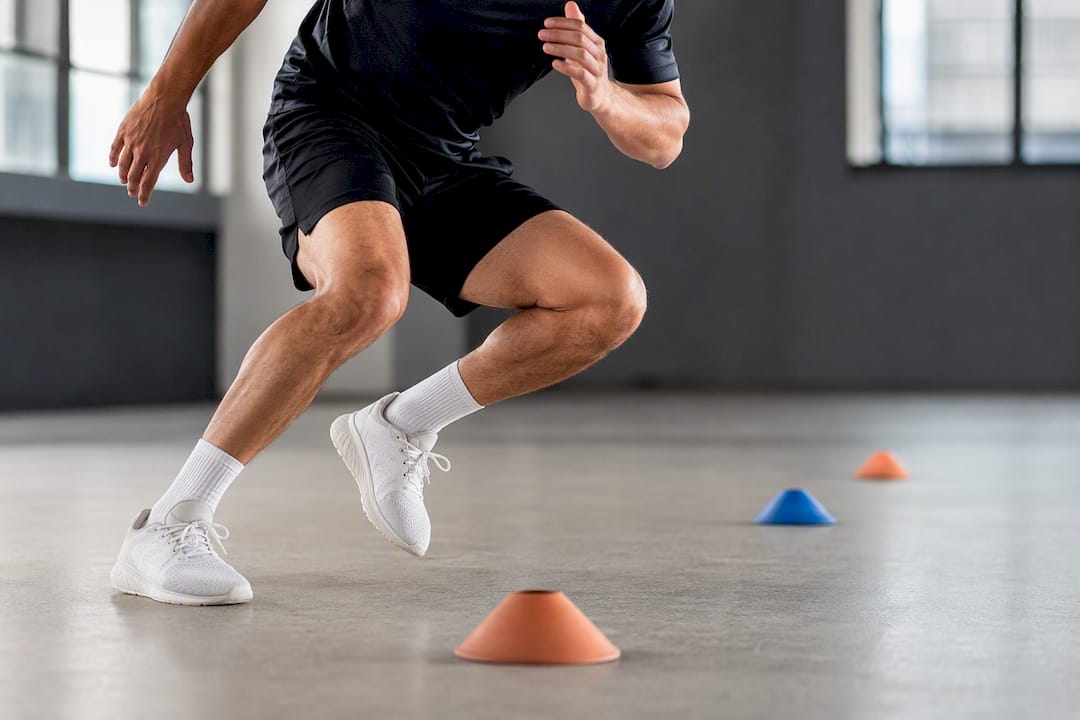
The T-drill and zig-zag cone runs build on this by adding multiple direction changes and forward, lateral and backward movement in sequence.
Reactive drills push things further. A “chaos mirror” (one player mirrors a partner’s random movements) or coach-cued gates (sprint to whichever cone the coach points at) force split-second reads. Research into reactive agility shows unpredictable, reactive drills transfer better to match situations than fixed patterns alone, because they train the same read-react loop players use against a live opponent.
Pro Tip: Add a ball to any reactive drill once footwork is clean. Chasing a rolled ball on a random cue is closer to match speed than chasing a cone ever will be.
Speed on the pitch is built in the gym as much as on grass. Force production and the ability to decelerate without breaking down both come from posterior-chain strength and controlled plyometric work.
Keep plyometric volume low, since the nervous system fatigues fast. Pair strength and plyometric work on the same day as acceleration drills rather than conditioning, and always sequence it after the speed work while the legs are fresh. A gym programme like Unit Health & Performance’s youth athlete development coaching can help players build this posterior-chain resilience safely under supervision.
Two to three short speed sessions a week, never more, is enough to see progress without frying the nervous system. Each session runs 10 to 15 minutes of genuine speed work: several maximal reps with full recovery between each, done early while players are fresh.
Progress the plan over 4 to 6 weeks by adding distance, resistance or reaction complexity gradually rather than all at once. Watch for signs of overload: a drop in sprint times, heavier legs on repeat efforts, or reluctance to go full intensity. Any of these means back off volume before adding more. A three-day training structure like this also works well for balancing speed, strength and conditioning across a youth athlete’s week.
Doing these drills alone works. Doing them with a coach watching your plant foot, your lean angle and your landing mechanics works faster, and more safely.
Speed sessions are demanding on the nervous system, not just the muscles, so recovery matters as much as the drills themselves. A player who trains hard but sleeps five hours a night and skips protein will plateau regardless of how sharp their acceleration mechanics look on paper.
Protein intake supports the muscle repair that follows sprint and plyometric loading. Spreading 20 to 30 grams across three to four meals a day, rather than loading it all at dinner, gives muscles a steadier supply of building blocks. Carbohydrates matter too, since they replenish the glycogen that fuels repeated maximal efforts. A player doing three speed sessions a week needs more carbohydrate around training days than on rest days, not a flat daily amount.
Sleep is the most underrated recovery tool in football conditioning workouts. Seven to nine hours lets the nervous system recover from the high-intensity demands of sprint work, and chronic short sleep shows up as slower reaction times and sloppier deceleration mechanics before it shows up anywhere else.
Hydration affects speed directly, since even mild dehydration reduces power output and reaction time. Drinking consistently through the day, not just before training, keeps output steady across a session.
Active recovery, easy movement like walking, swimming or light cycling, on non-speed days helps clear soreness without adding fatigue. Avoid stacking a heavy leg day straight after a maximal speed session; give the posterior chain at least a day to recover before loading it again with strength work.
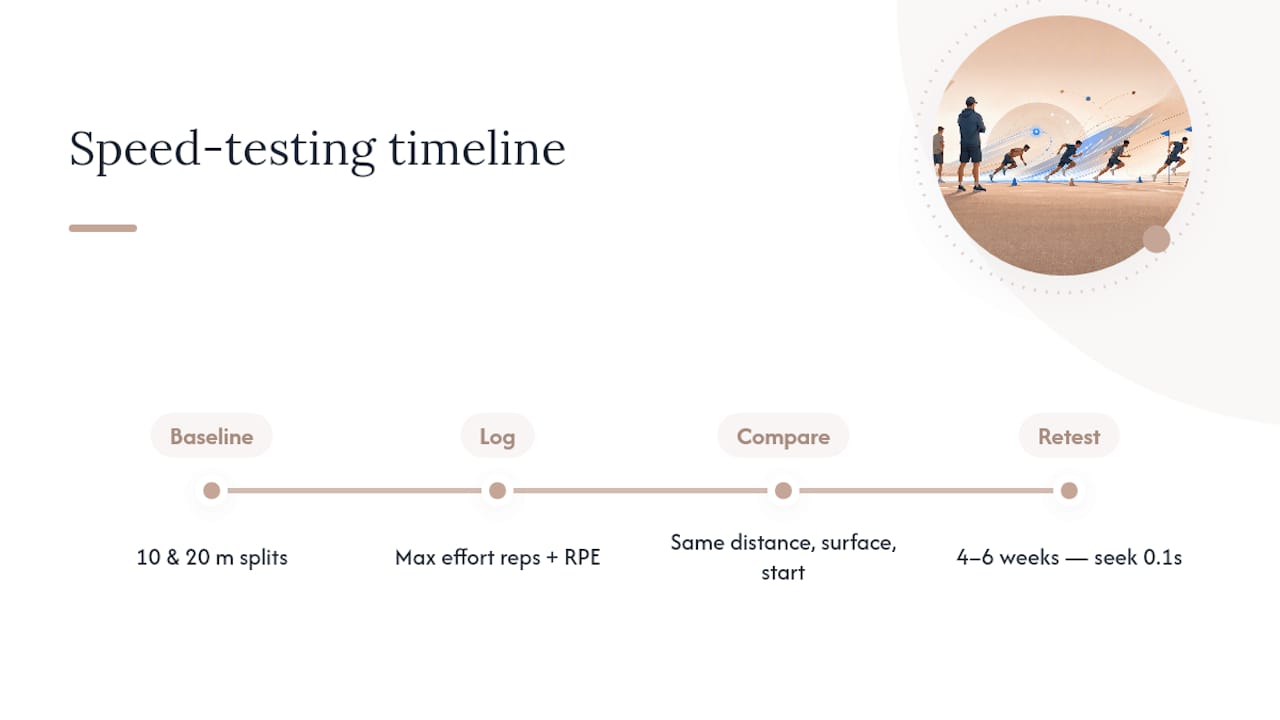
Timing sprints consistently is the simplest way to see whether a programme is working. Use the same distance, same surface and same starting method every time, ideally 10 and 20 metre splits, since these capture acceleration separately from anything approaching top speed.
A stopwatch works, but hand timing carries enough error to mask small improvements. Basic timing gates or a smartphone app that uses video frame counting gives more reliable numbers, and consistency in method matters more than the exact tool. Professional clubs go further, using GPS units and testing to individualise workloads, tracking output data to group players by current capacity rather than age or position alone.
Beyond the stopwatch, track reps completed at full intensity, not just the fastest time. A player who hits their best 10 metre split once but fades on reps four through six is not actually faster, they are just less consistent. Logging session RPE (rate of perceived exertion) alongside times helps spot when a player is grinding out fast times through effort rather than genuine improvement.
Retest every four to six weeks rather than every session. Speed adaptations take time to show, and testing too often adds fatigue without adding useful data. Look for small, steady gains, a tenth of a second off a 10 metre split is meaningful progress, not a rounding error.
The biggest mistake is training speed while tired. Sprint mechanics fall apart under fatigue, and practising bad mechanics at speed just grooves the fault deeper. Speed work belongs at the start of a session, full stop, never tacked onto the end of a conditioning block.
The second mistake is treating speed sessions like conditioning. Short rest periods between sprints turn a speed session into an endurance session, and the ATP-CP system never gets the recovery it needs to fire at full output on the next rep. If a player is gasping for breath, the rest was too short.
Skipping the deceleration side of training is a quieter but costly error. Most hamstring and knee injuries in football happen while slowing down or changing direction, not while sprinting flat out. Programmes that ignore eccentric strength work and landing mechanics leave players fast but fragile.
Volume creep is another common trap, especially with enthusiastic youth athletes who want to do more. Piling on extra sprints beyond several quality reps does not build more speed, it just builds fatigue and raises injury risk. More reps at declining quality is worse than fewer reps done well.
Finally, skipping the warm-up’s potentiation phase, those buildup strides before a max-effort sprint, sends players into top-speed efforts with genuinely cold sprint mechanics. It takes ninety seconds and prevents easily avoidable soft-tissue strains.
Most speed training content still leans heavily on ladder drills and cone mazes because they look busy and photograph well. They teach coordination, nothing more. A player can be brilliant at a ladder pattern and still be slow off the mark against a real opponent, because a ladder never asks anyone to read a cue and react.
The bigger gap is in programming, not drill selection. Coaches will happily teach a falling start correctly, then bolt it onto the end of a fitness session where the legs are already cooked. That single sequencing error undoes most of the technical work. Speed training only works when it is protected, early in the session, full recovery, low volume.
Reactive agility deserves more attention than it gets. Pre-planned cone patterns are useful early on, but a player’s ceiling on the pitch is set by how fast they read and react, not how fast they can memorise a T-drill. Coaches who never progress past fixed patterns are leaving genuine game-speed gains on the table.
If you take one thing from this: protect the acceleration work, protect the rest periods, and stop treating agility as a warm-up gimmick. Everything else is refinement.
— Vitalij
Reading about falling starts and 5-10-5 shuttles is one thing. Having someone watch your plant foot on rep four and correct it before it becomes a habit is another. Unit Health & Performance runs small group personal training in Sheffield built around exactly this kind of individualised feedback, so acceleration mechanics, deceleration strength and reactive agility all get coached, not just described.

For adult players wanting sharper first-step speed alongside general strength and conditioning, the Small Group PT programme blends personalised coaching with the accountability of training alongside others working towards similar goals. Parents of younger players have a dedicated route too: the youth athlete development programme applies the same speed, agility, strength and power principles covered here, scaled properly for growing bodies. If you want to see how a coached session differs from a solo cone drill in the park, get in touch to ask about booking a trial session or requesting a full programme breakdown.