A calorie deficit means eating fewer calories than your body burns, forcing it to use stored fat for energy. The NHS recommends a daily deficit of around 500 to 600 kcal, which typically produces 0.5 to 1 kg (1 to 2 lb) of weight loss per week. Protecting muscle during this process takes enough protein and regular resistance training, and anything below 800 kcal a day needs medical supervision.
TL;DR:
- The typical recommended deficit of 500 to 600 kcal per day usually results in 0.5 to 1 kg of weight loss weekly, but larger deficits increase muscle loss and hunger risks.
- About a quarter of weight lost in a calorie deficit may come from lean mass rather than fat, especially without resistance training or sufficient protein intake.
- A modest deficit combined with adequate protein and regular resistance training better preserves muscle and sustainable fat loss than focusing solely on calorie reduction.
- Progress can plateau due to metabolic adaptation, but it is often due to other factors like muscle loss or inconsistent training rather than a slowed metabolism alone.
- Individuals considering very low-calorie diets below 800 kcal per day should seek medical supervision to avoid health risks.
Your body runs on energy balance: calories in versus calories out. When you eat more than you burn, the surplus gets stored, mostly as fat. When you eat less than you burn, your body has to find that missing energy somewhere else, and it turns to stored fat and, to a smaller degree, muscle tissue.
Not all weight lost in a deficit is fat. Research on the composition of weight loss suggests that about a quarter of the weight lost during dieting can be lean mass, not fat. This is why two people can lose the same number of kilograms and end up looking very different.
Your body also adapts to a sustained deficit, a process called adaptive thermogenesis, where metabolism slows slightly beyond what reduced body weight alone would explain. A 2022 systematic review found this effect in many studies, though better-designed trials tend to report it as smaller or not statistically significant, and it often fades once weight stabilises.
What this means in practice:
Before you can create a deficit, you need to know your maintenance calories, known as your total daily energy expenditure (TDEE). This starts with your basal metabolic rate (BMR), the energy your body needs at rest, then adds an activity multiplier for how much you move.
Deficit size matters for sustainability, not just speed. A 500 to 600 kcal daily deficit is the NHS’s benchmark for steady, maintainable loss of around 0.5 to 1 kg a week. Larger deficits speed things up, but increase muscle loss risk, hunger and the chance of giving up.
Say someone with a TDEE of 2,100 kcal eats 1,500 kcal a day: that’s a 600 kcal daily deficit, in line with NHS guidance, and should produce close to 1 kg (around 2 lb) of weight loss per week for most people, though individual results vary with starting weight, sex and activity levels. Whether 1,500 kcal is an aggressive deficit depends on your personal daily energy needs, so targets should be individualized rather than based on fixed numbers.
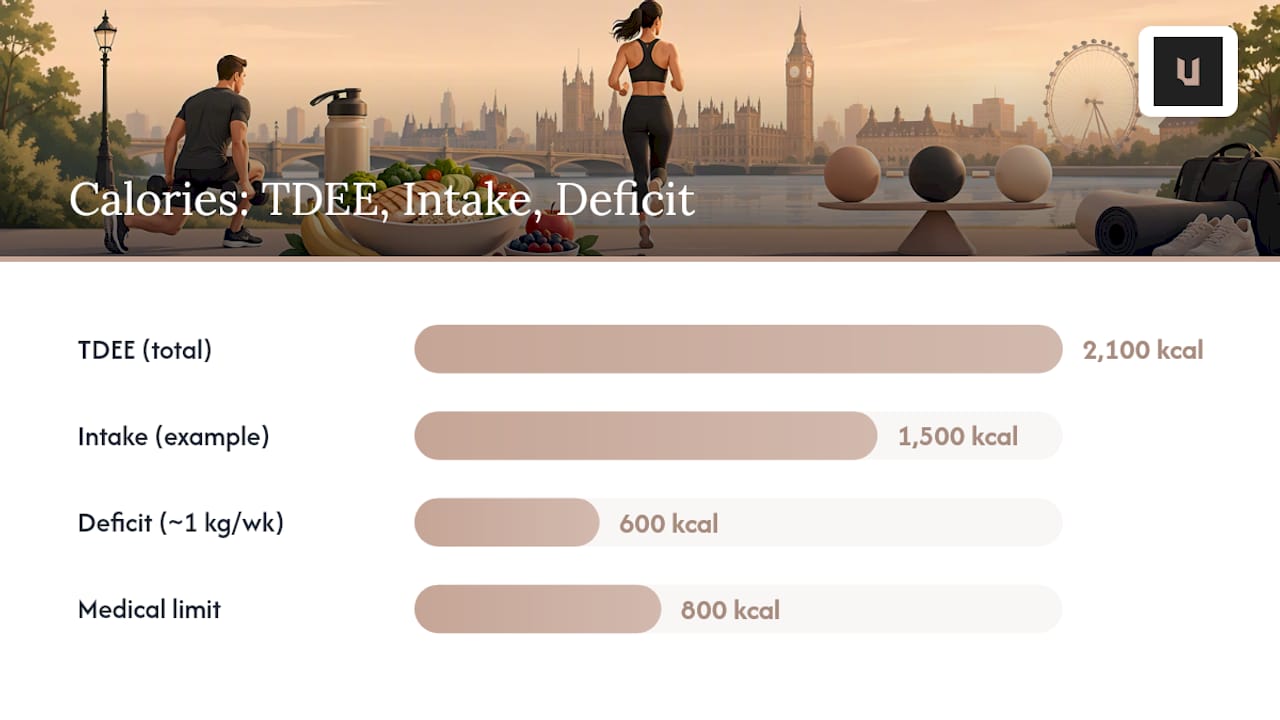
Anyone considering a deficit below 800 kcal a day should only do so under medical supervision, since very low-calorie diets carry health risks that outweigh the faster results.
Losing fat without losing strength depends on two things: enough protein and enough resistance training. Hospital nutrition guidance suggests protein supports satiety and helps preserve muscle, with some clinical guidance recommending 80 to 100 g of protein a day for people on weight-loss medicines, drawn mainly from whole foods. For general dieters, research summarised in a protein and weight-loss review protocol suggests intakes of at least 1.2 grams per kilogram of bodyweight, or about 20% of total energy from protein, as the range used in studies to preserve muscle during calorie restriction.
Practical targets:
Resistance training is the other half of the equation. Two to three full-body sessions a week with progressive overload is generally enough to preserve most lean mass for recreational trainees, and our strength training classes guide covers how these sessions are structured. Recovery matters too: muscle adapts during rest, not during the workout itself, so skipping sleep or training too often on a reduced calorie intake can backfire.
Pro Tip: Weigh out one meal’s protein portion once, just so you know what 30 g actually looks like on your plate.

Anyone with existing kidney disease should get medical advice before increasing protein intake, since higher protein loads can carry risks for that group specifically.
Adaptive thermogenesis is real but usually modest, and the effect tends to shrink once weight stabilises, according to the 2022 review of the evidence. It’s rarely large enough to explain a total stall in progress on its own, so a plateau usually points to something else first.
The most common pitfalls are avoidable:
A sensible monitoring plan tracks more than the scale: weekly weight trends (not daily swings), strength numbers on key lifts, waist or hip measurements, and how you feel day to day. If weight loss stalls for two to three weeks despite consistent tracking, or if strength and mood are dropping noticeably, it’s worth adding a one to two week maintenance phase before resuming the deficit.
A small group personal training gym applies these principles by offering individualised training plans rather than generic workouts, paired with nutrition and accountability coaching, which addresses the biggest gap in most DIY deficits: nobody adjusts the plan when progress stalls or muscle starts disappearing alongside fat.
Small group coaching also keeps resistance training consistent, the piece most home dieters drop first when motivation dips. The gym reports a community built around sustained, guided training rather than one-off effort.
Most advice on calorie deficits treats the number as the whole story, when it’s really the starting point. The maths of eating less than you burn is simple, but the outcome depends far more on what you eat, whether you train and how you handle the inevitable plateau than on the size of the deficit itself.
The biggest overrated factor is deficit size. Chasing a bigger daily shortfall for faster results is the single most common way people lose muscle alongside fat and burn out within a few weeks. The underrated factor is consistency through the adaptation phase: sticking with a moderate deficit, protein intake and resistance training through a plateau matters more than any clever tweak to the numbers.
If you take one thing from this, prioritise protein and strength training before you touch the calorie target again. A deficit that preserves muscle and energy levels is one you can actually sustain long enough to see it through.
— Vitalij
Working out your own TDEE, protein targets and training plan is doable alone, but it’s easy to lose muscle or momentum without someone checking in. Small Group PT at Unit Health & Performance pairs individualised programming with nutrition and accountability coaching, so your deficit and your training work together rather than against each other.

An initial enquiry typically includes an assessment of your current training, goals and eating patterns, followed by a plan built around them rather than a generic template. This suits:
Find out more about Small Group PT in Sheffield and book an initial session.
This article is general information, not a substitute for advice from a qualified doctor. Consult a qualified healthcare professional about your own circumstances before acting on anything here.
A calorie deficit works by making your body burn more energy than you take in through food, so it draws on stored fat, and some muscle, to make up the shortfall. The NHS recommends a deficit of around 500 to 600 kcal a day for steady, sustainable results.
It depends on your maintenance calories: 1,500 kcal only creates a 500 to 600 kcal deficit, in line with NHS guidance, if your TDEE is around 2,100 kcal. For someone with a higher TDEE, 1,500 kcal could create a much larger deficit, which speeds up loss but raises the risk of muscle loss and burnout.
Estimate your maintenance calories (TDEE), then subtract 500 to 600 kcal a day, the range the NHS links to roughly 0.5 to 1 kg of weekly loss. Pair this with adequate protein and two to three resistance sessions a week to protect muscle while you lose fat.
A daily deficit larger than the 500 to 600 kcal range the NHS considers sustainable can tip many people below the very low intakes that need medical supervision, particularly below 800 kcal a day. For most people, a smaller, steadier deficit paired with resistance training protects muscle and energy far better than an aggressive cut.