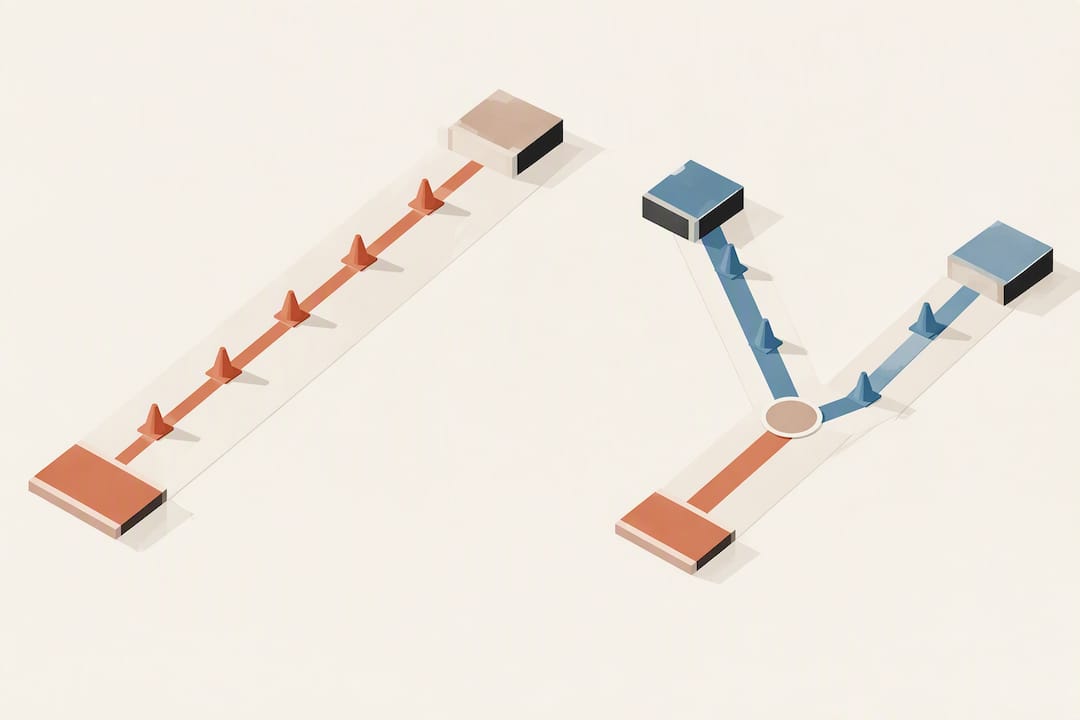
Agility is the ability to react and move to a stimulus, using perception and decision-making alongside physical execution. Change of direction, often shortened to COD, is the pre-planned ability to decelerate, turn and re-accelerate without needing to read anything first. Research treats them as related but separate qualities, which means testing and training them the same way leaves gaps in either athletic profile.
TL;DR:
- Reactive agility tests show only weak to moderate correlation with pre-planned change of direction times, indicating they measure distinct skills.
- Isolating COD ability using deficit scores helps avoid confounding raw sprint speed and provides a clearer picture of turning proficiency.
- Training should progress from technique-focused, pre-planned drills to reactive exercises once mechanics are solid, with an emphasis on avoiding early reactive work.
- Consistent testing every four to six weeks, including reaction time and movement variability, improves tracking of genuine progress over simply measuring total time.
- Precise terminology in coaching prompts targeted training, ensuring reactive decisions are layered onto solid COD mechanics rather than replacing technical work with ambiguous cone drills.
Agility research commonly frames it as a rapid whole-body movement with a change of velocity or direction made in response to a stimulus, which is the definition used in the widely cited agility literature review covering classification and testing approaches. Change of direction speed, by contrast, is the pre-planned execution of a turn with no reactive element: the athlete already knows where they are going before they move.
Both qualities share a physical base. Both need:
Agility adds a layer that COD does not require: visual scanning, anticipation and fast decision-making under time pressure. A rugby winger stepping inside a defender who has committed to a tackle is showing agility. A sprinter running a pre-set slalom course around cones is showing change of direction. The two look similar on the outside but draw on different systems, which is why the PLOS One study on COD and agility treats them as distinct capacities worth measuring separately.
The clearest evidence for treating agility and COD as separate qualities comes from direct comparison studies. Researchers measured completion times on reactive agility tasks against pre-planned change-of-direction tasks and found the two were only weakly to moderately related.
Reactive agility and pre-planned COD times show a weak to moderate correlation, as reported in the PLOS One comparison study, meaning a fast time in one test does not strongly predict performance in the other.

The same research points to movement entropy as part of the explanation. Reactive tasks, where the athlete must read a cue before choosing a direction, produce more variable movement patterns and longer completion times than pre-planned runs through an identical course. The uncertainty itself changes how the body moves, not just how quickly a decision gets made.
The practical takeaway is straightforward: if you only test pre-planned change of direction, you learn nothing reliable about an athlete’s reactive agility, and training one does not guarantee carryover to the other. Anyone assessing sport performance needs to test both qualities on their own terms rather than assuming one stands in for the other.
Several tests dominate agility and COD assessment, each suited to a different question:
Raw total time on any of these tests is a blunt tool, because it blends sprint speed with turning ability. The COD deficit calculation solves this by subtracting an athlete’s straight-line sprint time over the same distance from their COD test time, isolating the turning skill itself from raw speed, a method explained in research on modified 505 reliability.
That same reliability research flags a practical issue: typical measurement error and minimal detectable change on COD deficit scores can be sizeable, so a small improvement in a single session might be noise rather than progress. Running two or three familiarisation sessions before recording a baseline score reduces this error and gives a more honest picture of change over time.

Build COD and agility training in that order: technique and pre-planned repetition first, unpredictable decision-making second. Trying to add reactive complexity before an athlete can turn cleanly at speed just bakes in poor mechanics.
Strength and plyometric work underpins both qualities but in different ways. Plyometric exercises tend to correlate more closely with COD performance than maximal strength lifts, because they share similar force-time characteristics with the deceleration and re-acceleration phases of a turn, a pattern reported in research linking strength, plyometrics and COD. Heavier strength work still matters for force-dominant athletes who need to decelerate large body masses quickly, but plyometrics generally sit closer to the movement itself.
Pro Tip: Match drill angles and approach speeds to the demands of the sport, and hold off on adding reactive cues until an athlete’s pre-planned technique is consistent.
A sensible testing cadence runs every four to six weeks, always preceded by at least one familiarisation session so early scores reflect ability rather than unfamiliarity with the test itself. Track more than one number:
The most common mistake is judging progress on total time alone, which hides whether a genuine improvement in turning skill happened or the athlete simply got faster in a straight line. A second is skipping familiarisation, which inflates early “improvements” that are really just practice effects. A third is training generic agility drills for a sport that barely uses reactive decisions, or the reverse: drilling only pre-planned patterns for a sport built on split-second reads.
Small-group sessions separate technical, pre-planned change-of-direction drills from reactive-agility work across a training block, rather than mixing both in the same session.
Anyone wanting a movement assessment or more detail on the youth athlete programme pathway is welcome to ask a coach directly.
Calling every cutting drill “agility” hides a real coaching decision: whether you are training a physical pattern or a perceptual one. Sports that demand split-second reads need reactive work layered onto solid COD mechanics, not endless cone drills mistaken for game-speed decision-making. Precise language leads to precise programming, and that is what actually moves an athlete’s numbers.
— Vitalij
Reading about COD deficit and reactive drills is one thing; having someone measure and programme them for you is another. Small Group PT offers adults an individualised progression rather than a generic circuit, while youth athlete programmes apply testing and reactive-drill staging for young sportspeople working on speed and agility.

A typical intake covers a movement assessment, a tailored progression plan, and coached sessions that build from technique work towards reactive scenarios. Explore Small Group PT to book an assessment.
Change of direction is a pre-planned turn with no need to read a cue first, while agility requires reacting to a stimulus such as an opponent’s movement before choosing which way to go. The PLOS One comparison study found the two are only weakly to moderately related, at around r = 0.29, confirming they draw on different underlying skills.
This article covers agility and change of direction as sports science concepts measured through physical testing, not as in-game player attributes in any specific video game. Video game ratings for these traits are set by the game’s own developers and do not reflect the research definitions used in athlete testing.
Pre-planned COD drills include 505 variations, zigzag runs and V-cuts performed at a known, fixed pattern. Reactive agility drills include random-exit Y-drills, coach-cued chase games and small-sided ball games where the athlete must read a live cue before committing to a direction.
Deceleration ability, meaning how well an athlete absorbs force and controls their body position while braking, is central to turning quickly. Turning technique such as foot plant angle, alongside plyometric training that shares similar force-time characteristics with cutting, also supports faster change of direction, according to research linking strength, plyometrics and COD.